
(Editor’s note: This is excerpted from the March 7 edition of The Pulse, The Athletic’s daily newsletter. Sign up here to receive The Pulse directly in your inbox.)
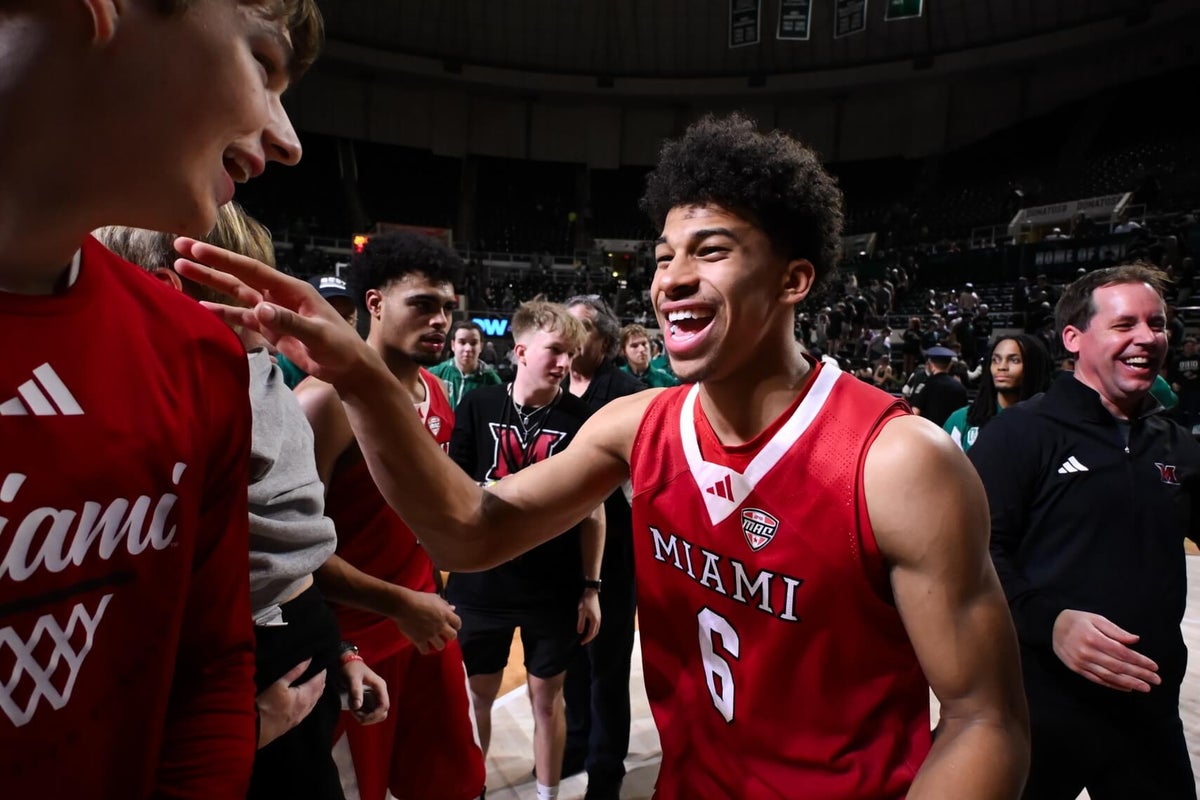
Last night, Ohio’s Miami University beat the Ohio Bobcats, 110-108, in overtime to move to 31-0, in one of the most thrilling games of the men’s college basketball season. You’ll rarely see a regular-season college hoops game that feels like a bigger deal as it’s unfolding. Personally, it might be the most fun regular-season college hoops game I have ever watched, wrapping up on a missed OU three that would’ve won it at the overtime buzzer. Ideally, this result will preempt the whole discussion we’re about to have. I expect that it will, and Miami should, finally, be a confirmed March Madness team.
After all, the No. 16 RedHawks are the first men’s basketball team to finish a Division I regular season undefeated since Gonzaga in 2021. They were already the first in 35 years to start a season 30-0.
The RedHawks should now be looking forward to their inevitable Cinderella opportunity in March Madness. Except that isn’t universally agreed, because a wretched discourse from college football has crossed into basketball: Should a non-power team with an exceptional resume get a shot at the sport’s premier postseason event? If Miami loses in its conference tournament next week, should the RedHawks be forced to the NIT while an SEC or Big Ten team with double-digit losses takes their slot? It’s highly doubtful, but some folks will keep arguing it.
Of course, Miami could win the MAC tournament and make this all moot. But the anti-RedHawk movement is real, and it’s important to preemptively push back on those who would dump them if they lost a single game. The brewing case against Miami is a case against everything people claim to enjoy about college basketball.
The face of the anti-Miami movement has a conflict of interest:
Bruce Pearl built Auburn into an SEC powerhouse, then retired just before the season, effectively forcing the school to elevate his son, Steven, to head coach.
It’s gone poorly, with Auburn staring down a 7-11 record in SEC play if it loses at No. 16 Alabama today. The Tigers have faced a brutal schedule, sure, but they’ve performed badly against it. “No team is feeling the pressure of the bubble more than Auburn,” our staff says. It turns out that collecting a huge sack of TV cash in an expanded conference also means playing games you might lose.
So it was galling when the elder Pearl went on TV last weekend to argue against Miami, which could jump Auburn in the bubble queue: “If we’re selecting the 68 best teams, then Miami is going to have to win their tournament to qualify as a champion. Because as an at-large, they are not one of the best teams in the country,” Pearl told his TNT colleagues, contrasting “best” with “most deserving.” He later defended himself, claiming “there is no nepotism involved here.” (Pearl does say that nepotism played a role in his son getting the Auburn job — obviously — but that’s a separate Pearl-nepotism storyline.)
We have seen this a billion times in football, a sport where the power conferences have tried to manipulate the playoff format to hoover up as many spots as possible — after years of denying the smaller conferences any chances at all. (If something good accidentally happens for non-power teams, the rules quickly change.)
Sure, Miami’s schedule is light, with a best win over No. 62 Akron. But loads of power-conference teams declined to schedule the RedHawks when they asked. You can’t beat who you can’t play, and the genius of the NCAA Tournament is that your opponents don’t have a choice. College basketball is supposed to love potential Cinderellas.
If people like Pearl got their way, the selection committee would more or less just grab .500-ish teams based on their KenPom ratings — Auburn is 40th, Miami 90th — and turn the tournament into an “on-paper” referendum that the power conferences would always win. Having fewer mid-majors in the tourney would only expand the power conferences’ financial advantages.
In any format, a selection committee will balance “best” (stats, roster quality, the “eye test”) with “most deserving” (resumes, achievements). College football disputes invented that terminology. But if wins and losses don’t matter, what’s the point? Spurning Miami would tell most of Division I that there is no point. It would also deny us the chance to see how far Miami could go, all to watch a totally forgettable team from a bigger league wash out after the same one to three games as Miami. I know why Bruce Pearl might want that, but why should we?