
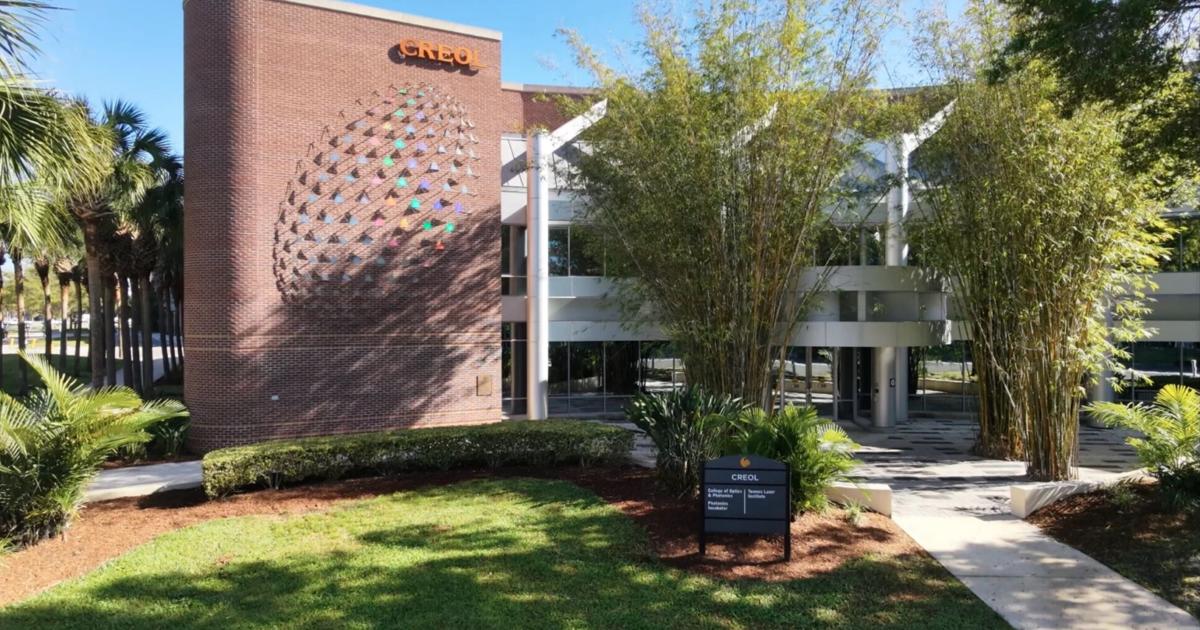

UCF’s CREOL, The College of Optics and Photonics, was recently accused by The Nation for alleged conflict of interest regarding Jeff Crystal and his role as a part of the school’s dean external advisory council.
Joseph Wiedeman
UCF is under increased scrutiny after a recent article by The Nation detailed its relationship with Israeli drone manufacturer and the university’s longstanding feeder programs to weapons companies like Lockheed Martin and L3Harris.
The article asserted that two of the university’s leading researchers at its Center for Research in Computer Vision received direct grants from Elbit Systems, an Israeli military technology company, in 2020. This totalled $260,000 for its “human activity recognition” technology and its “algorithms for object detection and human activity recognition.”
Dr. Mubarak Shah is the founder of UCF’s Center of Computer Vision and one of the two researchers who allegedly accepted the grant money from Elbit, according to The Nation. The Charge reached out to Shah for comment, but he said he was unaware of the article at the time of correspondence.
A petition from the UCF Divest Coalition to Chair Brian Butler asking for the school to ”Disclose and Divest” from technologies contributing to the “more than 35,000 Palestinians that have been killed and the over 75,000 injured.” The petition also asked to allow student oversight in the decision making process when the university forms partnerships.
Joseph Wiededman
Elbit is the largest manufacturer of weapons for Israeli drone systems, according to the American Friends Service Committee. Elbit came under fire for its “suicide drone” that has been used in the targeting of “civilian homes and infrastructure in Gaza,” since tensions escalated between Israel and Gaza in October 2023, according to The Nation.
The university also touts Jeff Crystal, technical director of Elbit Systems for America, as an external advisor to its College of Optics and Photonics.
In fiscal year 2023, UCF received more than $31 million from the Department of War, formerly the Department of Defense, for research and development purposes.
Lockheed Martin, an aerospace and defense company, has had a deep relationship with the university, starting in 1981 through its College Work Experience Program. The company is the “leading provider for offensive and defensive weapons systems,” according to its website.
The Nation stated that $550,000 in funds were set aside for the partnership between the university and the weapons company. The “Pegasus Partnership” has led the company to employ more than 3,000 alumni, according to the company’s LinkedIn.
An article from UCF Today outlines a previous agreement in July 2025 to establish the university “as Lockheed Martin’s first university strategic partner in Florida.”
“Lockheed Martin’s unwavering partnership empowers our students with real-world opportunities, drives innovation, and strengthens our shared commitment to building a brighter future,” UCF President Alexander Cartwright said in the article. “Together, we will work even more closely to shape the next generation of leaders and advance industries and technologies that benefit Florida and the world.”
Another prominent relationship the university maintains is its partnership with L3Harris, an American technology and defense company, recognizable from the L3Harris Engineering Center on campus.
The American Friends Service Committee defines L3Harris as “a U.S. weapons manufacturer that provides phone tracking devices and other equipment to the Israeli military and U.S. immigration authorities.”
L3Harris, based in Melbourne, was under fire in 2019 by the Department of State for violating the Arms Export Control Act and the International Traffic in Arms Regulations, forcing a settlement of $13 million to be paid out by the company.
In 2025, L3Harris paid $62 million due to false claims the company made about the cost of communication equipment sold to the Department of War, formerly known as the Department of Defense. This year, the company received a new billion-dollar deal from the Department of War for the supply of rocket motors.
Furthermore, on Feb. 26, Peter Williams, former managing director for a digital division of L3Harris, was sentenced to 87 months for selling stolen U.S trade secrets to a Russian broker, according to the Office of Public Affairs.
“Williams exploited his senior role at a U.S. defense contractor to enrich himself at the expense of the United States and his employer,” said Assistant Attorney General for National Security John A. Eisenberg in a press release. “The tools he compromised were intended to protect this Nation; instead, he auctioned them off to a Russian bidder.”
Will Greenberg, a 2013 UCF alum in computer science, works as a senior staff technologist at the Electronic Frontier Foundation, an organization that has been defending people’s digital rights online since 1990. He said that partnerships with large-scale security corporations are concerning.
“Given that one of the preeminent surveillance companies powering the Trump Administration’s deportation machine is named Palantir (after the obviously evil spy orb in Lord of the Rings),” Greenberg said in an email. “I don’t think it’s a stretch to say that some tech CEOs and politicians are reading dystopian books as instruction manuals.”
Orlando further cemented its connection to the wider security apparatus, as the city council voted in favor of amending its contract with Axon Security on Feb. 23.
The city added 11 Skydio drones to the police’s repertoire that can be built into the existing emergency response network provided by Axon. This would make Orlando a part of the growing national “Drone as First Responder” program, which faces scrutiny due to Skydio’s ties to Israel’s attacks on Gaza, as reported by the American Friends Service Committee.
In an email from the Orlando Police Department, officials stated the program is designed to improve emergency response times and overall public safety outcomes for residents within the first minutes of 911 calls.
“DFR drones would not be used for random patrols or mass surveillance,” the police department said. “State law will govern the types of calls that the drones can respond to.”
However, OPD’s longtime partner, Axon Security, worked in partnership with Canadian police departments to integrate facial recognition software for its body cameras, the Electronic Frontier Foundation reported in December. This is an area of law enforcement that the company has largely cornered in North America, according to the University of Denver.
Tony Ortiz, commissioner for Orlando’s District 2, is a UCF alumnus and a 14-year veteran of OPD. He said during a call that he would be hesitant to implement facial recognition technologies, but that in certain situations it has “helped a number of cases.”
Wired, a technology and science magazine, reported that within 10 days of the Robb Elementary School shooting in Uvalde, Texas, in May 2022, the CEO of Axon announced that the company had started developing taser-equipped drones to be put into schools.
A letter from Axon’s board of ethics indicates that nine of 12 members resigned following the announcement, and the company temporarily halted the program, according to Wired. The company then acquired the drone manufacturer Sky-Hero, a surveillance and security company based in Belgium.
“Drones are a form of remote and relatively covert surveillance, and as such they should receive the same level of scrutiny as any other type of police surveillance,” Greenberg said. “This means demanding transparency into how and when they’re used, that the data is properly secured and disposed of in reasonable time frames, and ensuring that the data they collect isn’t shared to agencies who shouldn’t have access to it.”
A Flock Safety automated license plate reader-system at Alafaya Trail and E. Palm Valley Drive. One of 16 total ALPRs is mapped within a 2-mile radius of UCF’s main campus, according to DeFlock.
Joseph Wiedeman
The expansion of the city’s drone capabilities follows last year’s additions to its red-light camera system and years of records from the EFF’s Atlas of Surveillance connecting OPD to advanced surveillance technology. The Atlas documents that OPD established its “real-time crime center” in 2019, as it created a network of surveillance cameras, a variety of police databases and an array of Automated License Plate Readers.
Will Freeman, founder and creator of DeFlock, has centered his mission on informing others about growing privacy concerns. DeFlock’s mission statement is to shine a light on the widespread use of ALPRs and raise awareness about the threats it poses to privacy and civil liberty.
“Axon is the biggest trending replacement to Flock Safety,” Freeman said on a call. “If the tech is on the police themselves, I feel it is less risky, since there are natural factors that limit the amount of surveillance they can do. When you stop putting these devices on them and start putting them all over the state and county, that’s when it gets out of control.”