
When military families experience acts of domestic violence, officials on base can issue a military protective order — essentially a restraining order — to require perpetrators to stay away from victims.
But those protections disappear the second a person steps off base. Police officers can’t enforce them. To get protection off base, survivors must apply for an injunction in district court.
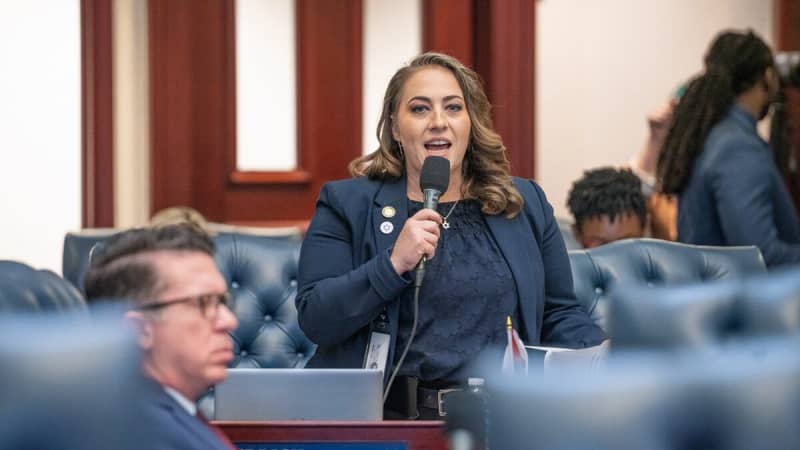
Florida House Bill 277 would make doing so easier. The bill, introduced by Rep. Debra Tendrich, D–Lake Worth, would add language to Florida law instructing courts to consider whether a military protective order is already in place when issuing an injunction for protection. Once a survivor has an injunction, it becomes illegal for a perpetrator of domestic violence to have contact with that person, regardless of location.
At a committee meeting in Tallahassee in February, Samantha Sliney, a representative for military families who serves as a policy liaison for the U.S. Department of War spoke to endorse the bill. She said the language change gives victims peace of mind that their evidence will explicitly be admissible.
“Victims may not have to relive their trauma twice, once when obtaining a military protective order and again when seeking to obtain a civilian protection order or restraining order,” Sliney said. “This statutory update will update the court with a fuller picture of current and or potential threat.”
House Bill 277 also seeks to address communication gaps between local law enforcement officers and military bases when responding to acts of domestic violence.
Though civilian law enforcement officers can’t enforce a military protective order, they can see if one has been issued when responding to calls for help off base. But because the systems are siloed, said Sliney, police don’t always notify the military that an incident off base has occurred which creates blind spots for military families.
There is no requirement that police notify the military when responding to an act of domestic violence off base involving a military service member. HB 277 would change that by requiring local law enforcement to notify the military in instances when an abuser comes into contact with a victim off base when there is a military protective order in place.
“Interpersonal violence extends well beyond an individual victim, as the effects of violence directly impact our service members, their families, units to which they are assigned, and our greater national security,” said Sliney. “This is a safety and accountability issue.”
In 2024, there were more than 5,600 military protective orders issued across the world, Sliney said. In Florida, nearly 750 domestic abuse reports were tracked by the department’s family advocacy program. That included 504 reports of spouse abuse and more than 240 intimate partner abuse reports.
“This ensures all stakeholders, both local, state and federal, have the most up to date information available to prevent further harm to the victim,” Sliney said.
Protections for military families are just a tiny component of the domestic violence reforms HB 277 is seeking to make in Florida. Among the other changes are more money for victim relocation services, harsher punishments for repeat offenders and a pilot program to track abusers using GPS monitoring.
House Bill 277, co-sponsored by Rep. Danny Nix, R-Port Charlotte, passed the House unanimously this week. A companion bill in the Senate is slated for a possiblevote today.
Tendrich, who left an abusive relationship in 2012, said continuing to strengthen domestic violence response will remain her priority.
“Every year that I serve in this Legislature, domestic violence reform will remain my priority,” Tendrich said. “Florida will become the national gold standard for how domestic violence is addressed and I will not stop until it is.”