
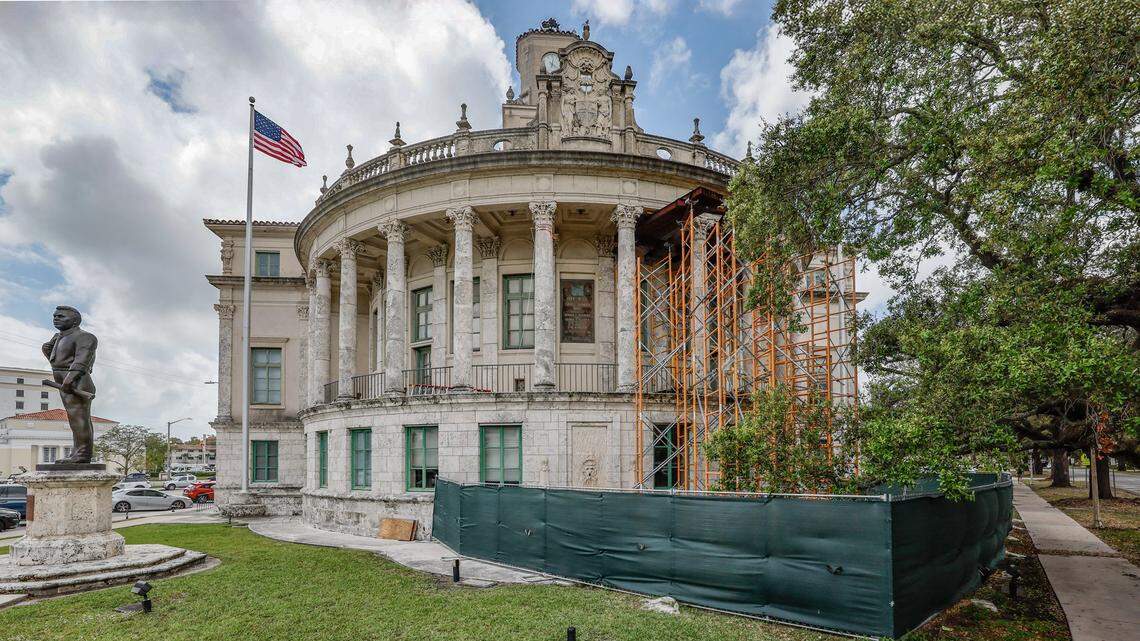
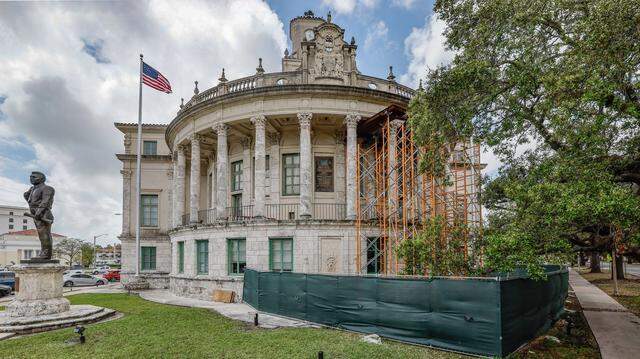
Support scaffolding holds up four cracking Corinthian columns at Coral Gables City Hall, which is being vacated for a full restoration that’s expected to take up to three years. It’s the first extensive renovation for the historic building since it opened in 1928.
PHOTO BY AL DIAZ
adiaz@miamiherald.com
After 98 years, the roof, walls and windows are leaking at Coral Gables’ historic City Hall, one of South Florida’s most prominent civic and architectural landmarks. The building’s limestone and stucco exterior and concrete decorative bits are badly cracked in places, and four of the Corinthian pillars in the rounded colonnade that lends it the look of a fine Mediterranean cake are close to fracturing.
And so this month city administrators and commissioners are vacating their venerable home for temporary quarters to make way for a comprehensive restoration — the first since the three-story building opened in 1928. It’s expected to take up to three years and cost Gables taxpayers as much as $30 million.
In the end, city officials promise, it will be worth the trouble and the money.
Under a plan by Coral Gables-based architect and historic preservation specialist Richard Heisenbottle, the City Hall building will be fully restored to its original splendor inside and out. The renovation will not only fully repair and replenish the building and replace its mechanical, electrical and fire-safety systems, Heisenbottle said, but also reverse some questionable alterations from more recent decades, like dropped ceilings and carpeting in offices that obscured original architectural proportions, materials and details.
In one of the most significant measures, the semicircular, double-height City Commission chamber, modernized decades ago in maladroit fashion, will be returned to its historic style and configuration. In another, an entrance garden and courtyard that was partially paved and built over will be restored and re-greened.
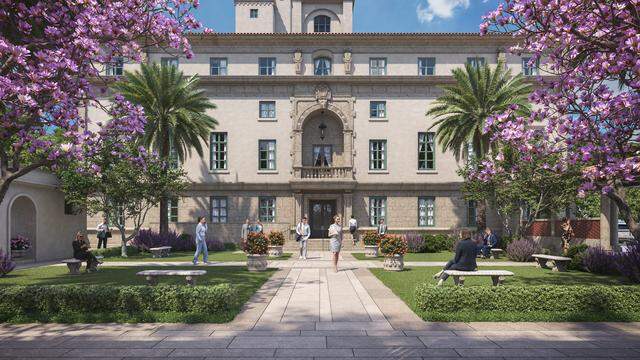 An architectural rendering depicts a renovated Coral Gables City Hall with a restored entry courtyard and garden. RJ Heisenbottle Architects
What it all adds up to, Heisenbottle said, is the promise of renewed life for a treasured landmark that embodies the high architectural aspirations and enduring legacy of the City Beautiful and its founder, George Merrick.
“This is the iconic symbol of the city of Coral Gables, a symbol of who we are,” Heisenbottle said in an interview. “That colonnade that marches on the east side of the building, that is visible as you walk Miracle Mile, is a spectacular example of traditional architecture.
“When we’re done restoring it, it will continue to last for the next 100 years.”
Mayor Vince Lago, who pushed up the timing of the long-contemplated renovation after some signs of structural deterioration were discovered last year, said it’s important for the city to do it right — “slowly, carefully and methodically.” And that will take patience and money, he said.
“It’s a very complex project,” Lago said. “It’s a huge source of pride for us.”
What happens next?
The city can’t yet say exactly how much work is required, how much it will cost or how long it will take.
Heisenbottle and the team of engineering and restoration experts he has assembled have already spent months performing a preliminary evaluation of the building and preparing a work proposal that the city formally accepted last week, about five months after city commissioners gave the green light to the project.
But as City Hall is cleared out, the experts will conduct a deeper analysis and prepare a more detailed work plan and construction documents, a process that Heisenbottle expects will take three to four more months before restoration can start.
One outstanding question is whether the building has any asbestos, a cancer-causing material that was commonly used in buildings for insulation and fire-proofing from the 1940s to the 1970s before it was banned. Asbestos must be removed in a strictly regulated process.
“We have a heck of an experienced team,” HeIsenbottle said. “Generally speaking, the building is in good condition, but it is 100 years old and needs the kind of work you would expect.”
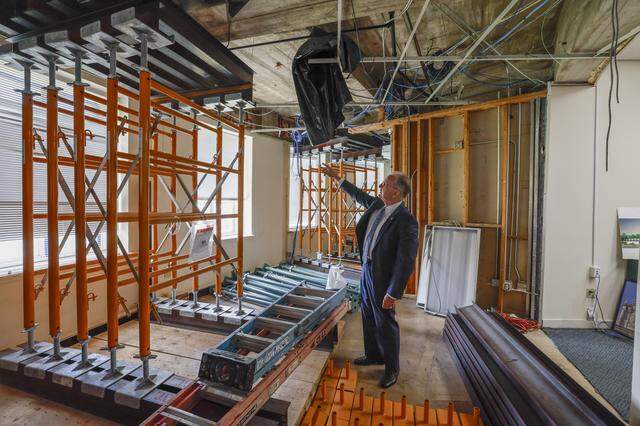 Coral Gables City Manager Peter J. Iglesias points out temporary structural reinforcements installed in Coral Gables City Hall in preparation for a comprehensive renovation, the first since the historic building opened in 1928. PHOTO BY AL DIAZ adiaz@miamiherald.com
Heisenbottle, a leading restoration architect, has designed and overseen projects at Miami City Hall, the Freedom Tower, and Vizcaya Museum and Gardens, among other historic landmarks, and developed plans for the possible renovation of the long-closed Miami Marine Stadium. The city selected his firm, along with general contractor Thornton Construction, in a competitive process based mainly on qualifications, not price, Lago said.
“We went with the best,” Lago said.
The team has done considerable research and analysis, diving into archives and, where possible, literally peeling back layers of history to see what’s inside walls and above dropped ceilings, Lago said. Interior demolition has already begun on the third floor, he noted.
“This has been an exploration,” he said. “Heisenbottle has unlocked a lot of information about the building we didn’t even know about.”
The original vision
One advantage the restoration team has in conducting the Gables City Hall restoration, Heisenbottle said, is that they have a full set of original plans by Phineas Paist, the noted supervising architect for Merrick’s Coral Gables Corporation who designed the building with Harold Steward.
Paist, who came to Miami from his native Pennsylvania to work on industrialist James Deering’s Vizcaya estate, is one of the most consequential local architects of the period. He designed or oversaw plans for numerous cherished Coral Gables buildings and places aside from City Hall, including the Venetian Pool, Douglas Entrance, and the former police and fire building, now the Coral Gables Museum.
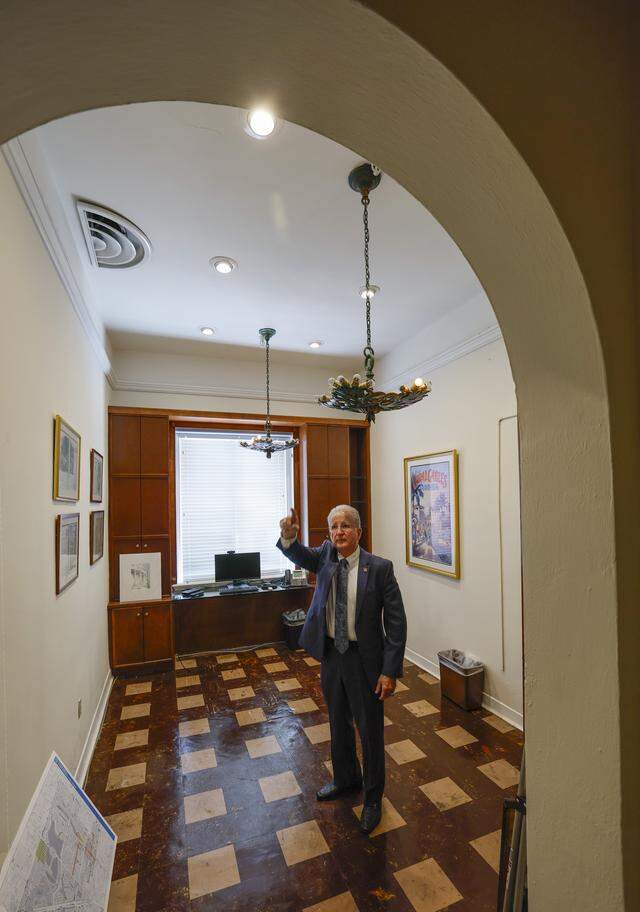 Coral Gables City Manager Peter J. Iglesias shows off a previously restored office in City Hall, which will undergo a full interior and exterior renovation that’s expected to take up to three years. Like the renovation of this office, part of the original mayor’s suite, the project will restore the historic City Hall’s interiors to their original look. PHOTO BY AL DIAZ adiaz@miamiherald.com
For City Hall, Paist took direct inspiration from the Philadelphia Exchange building of 1834, a national historic landmark that once housed the country’s first stock exchange and is today part of Independence National Historic Park. Also known as the Merchants’ Exchange Building, it features Greek Revival architecture and a rounded exterior colonnade at one end.
Paist adapted the model to South Florida’s subtropical environment by giving it a more eclectic Mediterranean look and style and using materials typically employed in local construction, like stucco, concrete made to look like stone, and oolitic limestone, often erroneously called coral rock.
City Hall was one of the last signature buildings completed in Coral Gables under Merrick’s leadership. He lost control in the aftermath of a devastating 1926 hurricane and the subsequent collapse of the Florida real estate boom that had propelled development of the Gables.
Despite his mounting woes, Merrick lavished money and creative focus on the building. He put his advisor and artist uncle Denman Fink to work with Paist and spent $200,000 on construction, the equivalent of about $3.7 million today — though the high level of refined, skilled handiwork that went into it would likely be far more costly today, if it’s even possible to attain.
“He wanted an iconic city with tree-lined streets, formal entrances, a university and a City Hall,” Lago said.
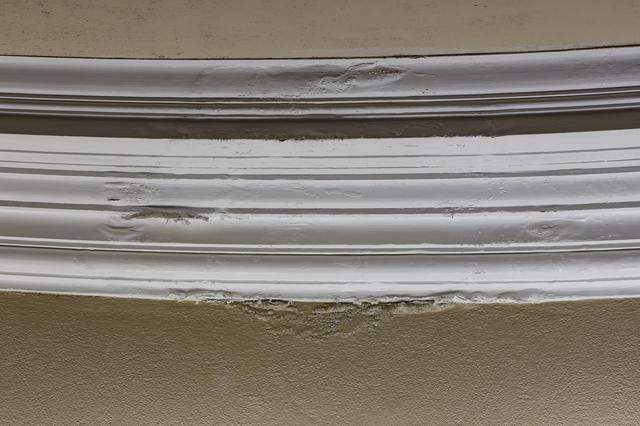 Wood ceiling moldings in the commission chamber at Coral Gables City Hall show signs of water damage from leaks that plague the historic building, which will undergo a comprehensive restoration expected take up to three years. PHOTO BY AL DIAZ adiaz@miamiherald.com What’s planned in the renovation?
The building interiors, formal and elaborate, are as splendid as the exterior. There’s a vaulted ceiling over the ground floor and an elegant central stairwell that rises to the open interior of the clock tower over the building’s roof. A mural by Fink graces the top of the stairwell and will be restored.
On the second floor are offices for the mayor and four elected city commissioners and a grand, semicircular commission chamber that sits behind the exterior colonnade. At some point, the chamber was significantly altered, with the commission dais moved from its original position facing the colonnade and a set of eight tall windows to the opposite side, facing the flat back wall.
The renovation plan returns the dais to its original position and drapes the windows — in recent years usually covered by plain blinds — with curtains to restore their prominence and allow natural light into the room. The plan also expands seating, improves comfort and acoustics, and fully accommodates access for the disabled, Heisenbottle said.
To eliminate ductwork, equipment and dropped ceilings that were added when air-conditioning was installed in the building, the plan calls for hiding most of the new system components inside a third-story attic and in a space above the vaulted first-story ceiling, an approach Heisenbottle said is one of the project’s biggest engineering and design challenges.
Wherever possible, the plan is to expose and restore original flooring throughout the building. Those materials include terrazzo and terracotta tile. The commission chamber should have a floor of stone or simulated stone, Heisenbottle said, but it’s covered in cork and restorers haven’t had a chance yet to peek underneath.
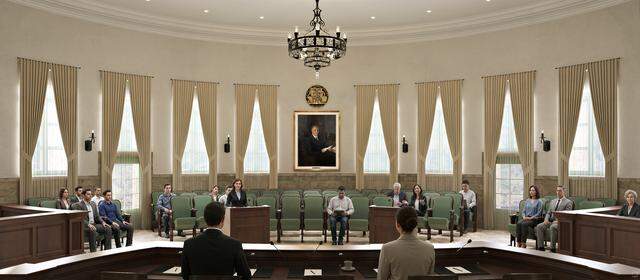 The commission chamber in Coral Gables City Hall will be restored to its historic style and configuration as part of a comprehensive renovation plan for the building, the first since it opened in 1928. RJ Heisenbottle Architects
Another challenge was a surprise: figuring out how to repair the four failing exterior columns. In building plans, the limestone columns were supposed to have a reinforced-concrete core. In reality, they don’t, because the concrete cores and steel reinforcement were left out for unknown reasons, Heisenbottle said.
Because those four columns bear the biggest loads in the colonnade, the plan envisions removing them, erecting steel supports in their place, then reinstalling the original columns over those supports, he said.
In the meantime, the columns have been temporarily braced. The other columns will be patched and repaired, Heisenbottle said.
Engineers found the same issue when they drilled into a cracking interior support column on the first floor last year — the rebar detailed in the plans was missing.
The cracked column exacerbated political tensions on the commission dais when some members called for City Hall to be evacuated on an emergency basis over the objections of Lago and Vice Mayor Rhonda Anderson, though engineers said temporary shoring would ensure it did not collapse. Commission meetings were briefly moved to the city public safety building before returning to City Hall, but the finding underscored the need to accelerate the long-planned restoration project, Lago said.
“I pushed the project forward,” he said.
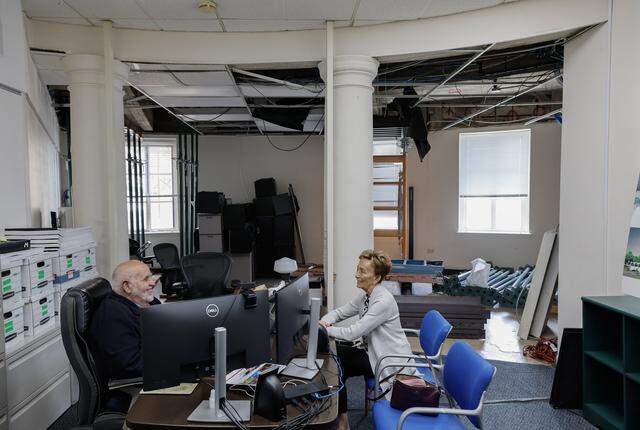 Dropped ceilings in offices that obscured original architectural details and proportions at Coral Gables’ historic City Hall are being removed as the building is vacated for a comprehensive restoration expected to take up to three years. PHOTO BY AL DIAZ adiaz@miamiherald.com
The city long relied on patchwork and partial repairs to keep City Hall functioning, but it became clear that would no longer do, Heisenbottle said. For instance, a new barrel-tile roof was installed a couple of years ago, but leaks that had plagued the building for years persisted.
The roof will require further repairs, though not replacement, Heisenbottle said. So will roof flashing, aging building joints and cracked walls that have allowed water to seep inside the building, damaging walls and ceilings.
“The building was leaking in all sorts of locations,” he said. “One of our challenges is to make sure we stop all of those leaks.”
The neglect extended to architectural details. The copper weather vane atop the clock tower, for instance, fell off some time ago and was left to corrode on the roof. It will be restored and reinstalled, Heisenbottle said. Pressure washing also caused damage to a section of the building exterior, which will be laboriously and appropriately cleaned and repaired.
Sometimes, expediency tarnished Paist’s designs. An entry garden and courtyard on the building’s grand west entrance was partly paved over, and a building housing bathrooms was erected along one side. Those additions will be removed, and the courtyard restored to Paist’s symmetrical garden layout.
Lago said those details about the courtyard are something Heisenbottle’s research uncovered that no one now at the city knew about.
The restored building will also be significantly more efficient in its use of water and energy, Heisenbottle said. Insulation, now totally lacking, will be installed.
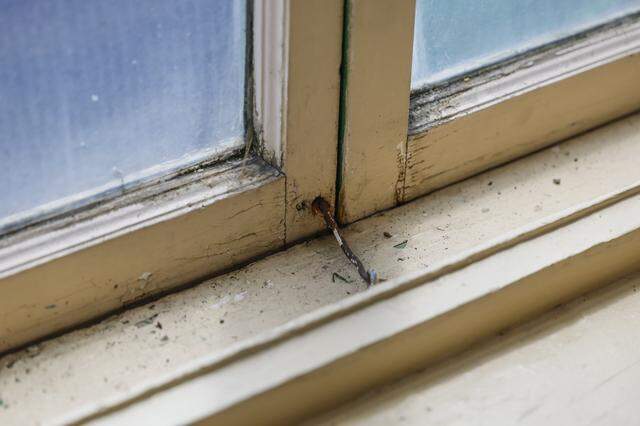 Original but leaky wood casement windows at Coral Gables’ historic City Hall will be replaced with steel-framed replicas as part of a full restoration of the 1928 building that’s expected to take up to three years. Preservationists had asked for restoration of the windows. PHOTO BY AL DIAZ adiaz@miamiherald.com
And new windows will be both storm-resistant and energy efficient. Over ardent objections from preservationists and some residents, city administrators and a commission majority opted to replace the building’s wooden casement windows from 1928, still in place, with compatibly designed modern windows made with galvanized steel, arguing that restoring the originals to meet current hurricane standards would be costly and unfeasible.
Heisenbottle said his team has designed custom replacement windows that replicate the look and dimensions of the originals in steel.
“The new windows are beautiful,” Lago said, before alluding to the restoration project as a whole. “It’s a beautiful story.”

Miami Herald
Andres Viglucci covers urban affairs for the Miami Herald. He joined the Herald in 1983.