
By Cliff McBride and Matthew Cimitile, University Communications and Marketing
Along the seawall of Bayboro Harbor, a group of USF students and professors recently
installed 3D-printed habitats that they hope will soon house thousands of oysters.
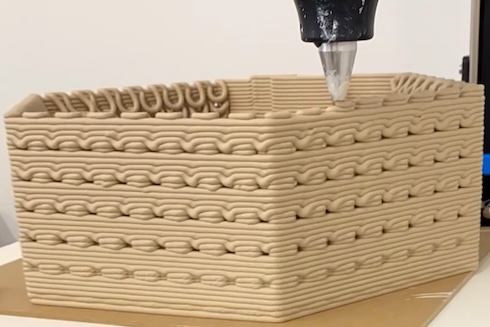
Made of clay, the structures will act as a living seawall, propagating oysters that
can filter thousands of gallons of water per day and improve both water quality and
ecosystem health.
The project is part of two classes within the Judy Genshaft Honors College and College of Arts and Sciences, where students conduct site assessments, utilize 3D printing, install structures
and conduct environmental research. The classes are taught by USF Honors College professors
Tina Piracci and Taylor Crosland, and Integrative Biology professor William Ellis.
“Our oyster restoration brick structures, or ORBS, are designed in a honeycomb pattern
that serve as ideal habitats for oysters while fusing art with innovative design,”
Piracci said. “The overall goal is to reverse the decline of oyster populations in
Tampa Bay that have plummeted due to development and as more seawalls with synthetic
materials are constructed.”
Oysters are a critical species for marine environments as they filter water to remove
excess nutrients, which can reduce harmful algal blooms. The reef structures they
create are critical for protecting shorelines and provide habitat for more than 300
marine species.
The artificial habitat installed at Bayboro Harbor will act as a pilot project. Students
in the USF biology course will track changes in fish numbers and behavior after installation,
as well as develop monitoring protocols for measuring oyster growth.
From there, the project team plans to install about 30 3D-printed structures in southeast
St. Petersburg over the next several years. The team will share open-source information
so other educational groups can modify, print and install their own oyster reef structures.
The project, part of The Habitat Laboratory, is a partnership between the University of South Florida (including the College
of Design, Art and Performance), Clearwater Marine Aquarium, the Clay Co-Op, the Tampa
Bay Estuary Program, the USF St. Petersburg Student Green Energy Fund, Laguna Clay
Company, Saint Raphael Middle School, Shorecrest Preparatory School and Clam Bayou
Educational Center.