
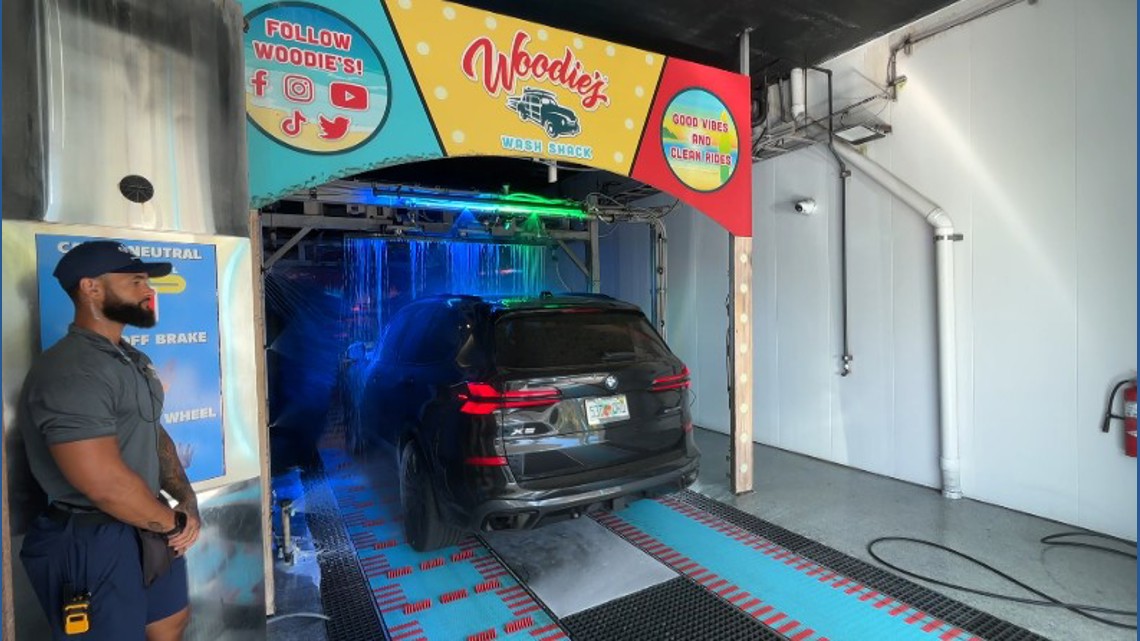
With residential water restrictions in place, more drivers are turning to commercial car washes.
TAMPA, Fla. — A mix of scattered rain showers and heavy spring pollen has left cars across Tampa Bay coated in yellow dust and water spots — and with residential water restrictions still in place, more drivers are skipping the driveway wash and heading to commercial car washes instead.
Operators say the seasonal combination of pollen and passing showers has made this an especially busy time.
“We are rocking,” said Ryan Branney, general manager at Woodie’s Wash Shack. “The pollen this time of year is just going crazy, leading to very dirty vehicles.”
Branney said the problem gets worse when light rain mixes with pollen already sitting on cars.
“Once you start adding sprinkles of water on top of the pollen, it leaves a lot of spots and we just get even busier,” he said.
Customers say the buildup can happen almost overnight.
“I washed it on Friday. I woke up on Saturday morning and it was green again — with just the dust, the pollen,” said customer Manny Adams.
For many drivers, convenience is another reason to visit a professional wash.
“This is much faster,” said Doug Nipper, who brought his vehicle in for a cleaning. Nipper said the trees around his home in South Tampa make it difficult to keep his car clean.
“I live in South Tampa, so they have a bunch of oak trees. So, I am inundated with leaves. I’ve got the straight vacuum here that gets all of that out. Plus, I’ve got the pollen off,” Nipper added.
Some customers also believe commercial facilities use less water than washing at home.
“And it’s definitely worth it because I feel like they have an effective system going on,” said customer Olivia Costaldi. “If you’re at home, it might be like you might be wasting more water.”
That perception reflects how most modern car wash facilities operate.
Commercial car washes are generally exempt from one-day-a-week residential water restrictions because they are designed to be more efficient.
Many use water reclamation systems that recycle and reuse between 75% and 90% of the water used during the wash process.
“At our location, as the cars go through, we spray the water on the cars, it goes through our process, and then it gets reclaimed,” Branney explained. “Basically, we will filter it — different layers of filtration — and then it will go right back through the pumps and onto the cars.”
Branney said the system creates what he described as a highly effective recycled wash cycle.
“We put together a really clean reclaimed water that does a great job washing the cars, even though it is reclaimed water,” he said.
The technology also helps protect the environment by capturing runoff that might otherwise flow into storm drains.
“If you’re in your driveway, the water just runs right off into the storm,” Branney said. “Whereas we catch that water that goes right back through the system and we can easily reuse it.”
Customers say the quick turnaround is another advantage — especially during periods when water use at home is limited.
“Yeah, restrictions,” Adams said. “I’m up here in 10 or 15 minutes. I have it all clean and ready to go.”
Branney says the recycling systems also allow car washes to keep operating even during dry conditions.
“When you’re in a community that has water restrictions, we can just keep on trucking,” he said. “The water keeps on getting filtrated and we can just keep washing cars.”
For some customers, that combination of speed, convenience and water conservation makes the choice simple.
“You know, to conserve water,” Nipper added.
Officials still remind residents that anyone washing vehicles at home during enhanced water restrictions must do so only on their assigned watering day using a hose with an automatic shutoff nozzle.