
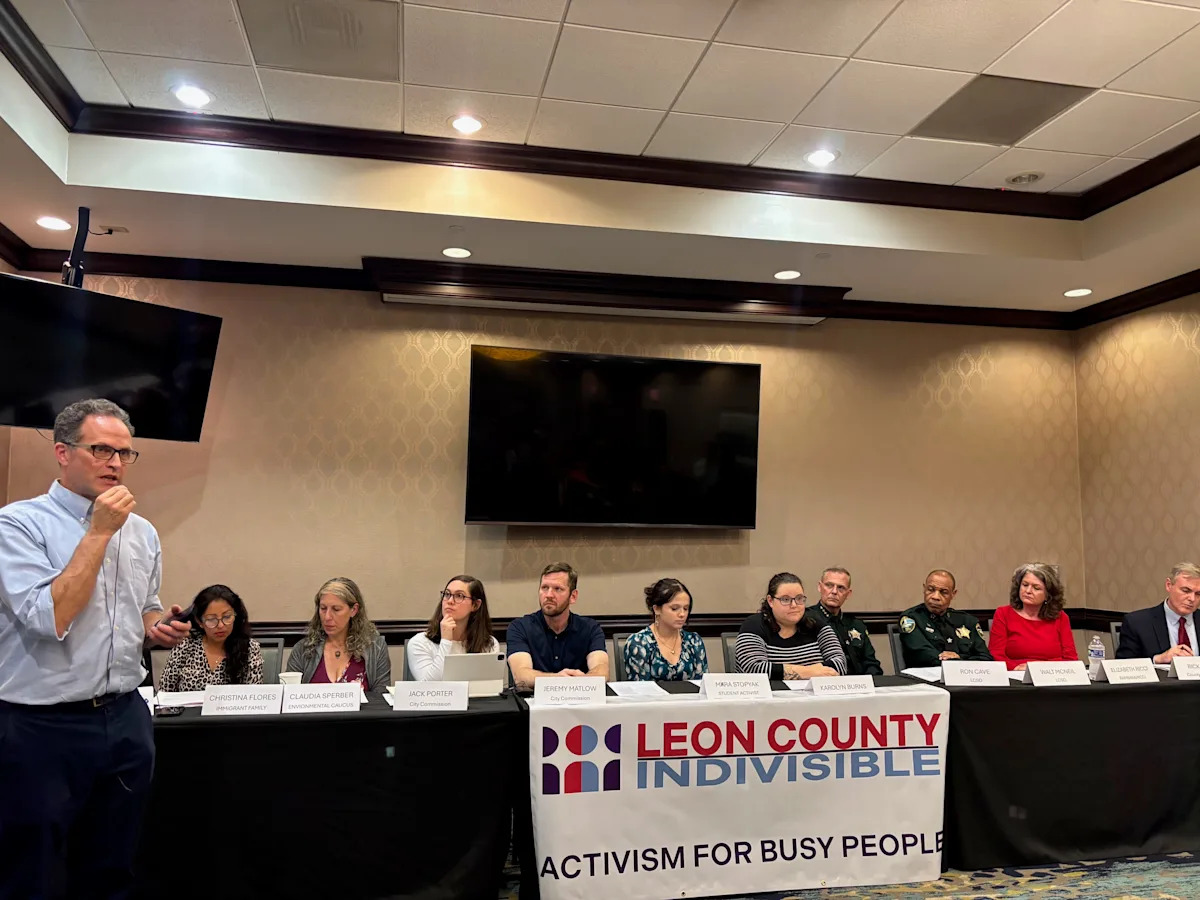
Law enforcement, elected officials, and community members came together on March 4 to discuss local immigration policies at Leon County Indivisible’s Just The Facts Immigration Forum, held at the Holiday Inn & Suites on Graves Road.
Leon County Indivisible founder Cheryl Gratt and Tallahassee State College political science professor Edward Duggan organized the event to educate the Tallahassee community on their rights regarding ICE.
“We are one of the three working Indivisible groups in Tallahassee,” Gratt said to the audience. “We are the education component.”
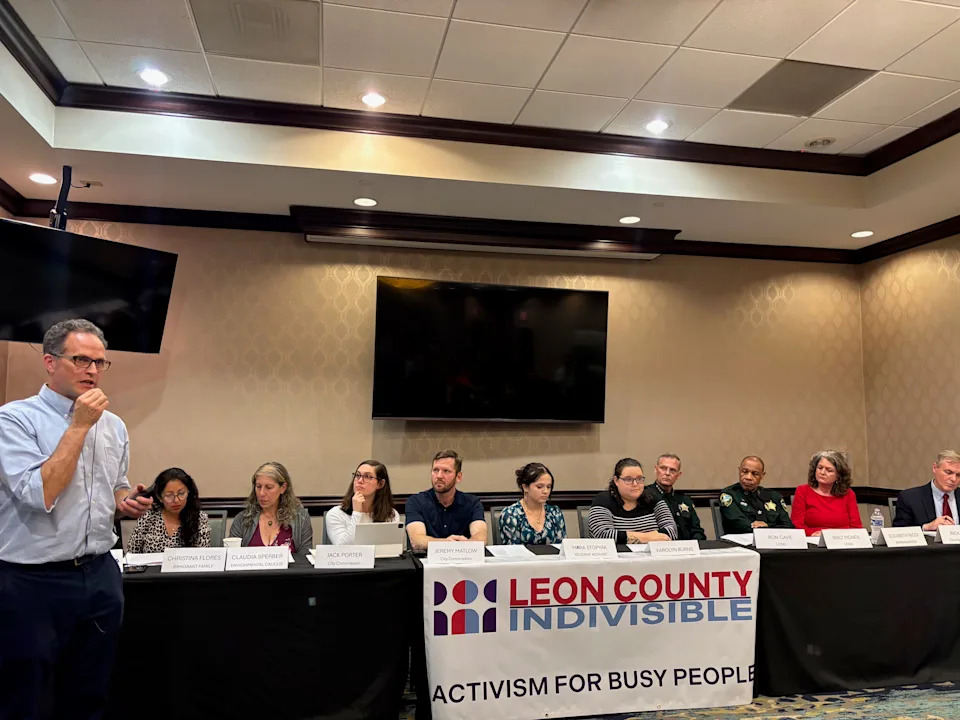
Panelists gather at the Leon County Indivisible “Just the Facts” Immigration Forum.
The forum featured a panel of candidates for local offices and advocates from groups including the Tallahassee Immigrant Rights Alliance (TIRA), the Democratic Environmental Caucus of Leon County (DECLC), Humanitarian Aid of Tallahassee, and others.
Rambana & Ricci, a law firm focusing on complex immigration policy, was represented by managing partner Elizabeth Ricci. Leon County Sheriff Walt McNeil and Undersheriff Ron Cave were featured on the panel.
They were joined by City Commissioners Jeremy Matlow and Jack Porter, County Commissioner Rick Minor, the spouse of a U.S. Immigration and Customs Enforcement (ICE) detainee, Christina Flores, and Lincoln High School student Mara Stopyak, who organized the school’s ICE walkout.
Tallahassee residents get clarification on Leon County’s 287(g) agreement
The conversation revolved around immigration control in Tallahassee. Topics included the May 2025 College Town ICE raid and justifications behind a state grant received by the Leon County Sheriff’s Office. Most notably, participants sought clarification on whether the Leon County Sheriff’s Office signed the Task Force or Jail Enforcement model of 287(g).
More: FSU students and community speak out against campus police ICE partnership
According to the ICE website, there are four models of 287(g) partnerships that local law enforcement can elect into. The Task Force Model, which the Leon County Sheriff’s Office has signed, allows local officers to enforce immigration law during “routine police duties” under federal oversight.
At the panel, the TIRA asked why the Leon County Sheriff’s Department signed the Task Force Model. McNeil said the agency is instead implementing the Jail Enforcement Model, which is “designed to identify and process ‘removable aliens’ — with criminal or pending criminal charges — who are arrested by state or local law enforcement agencies,” according to ICE’s website.
McNeil said that the discrepancy between which model was in effect is the result of a mistake on the ICE website.
The TIRA and other advocacy groups have criticized Leon County’s 287(g) agreement. Multiple college campus police forces, including the Florida State University Police Department and Florida A&M University Police Department, have signed 287(g) agreements.
Students for Progressive Victory at Florida State University President Riley Pusins told the FSView that she is concerned about the conflicting information regarding the sheriff’s office.
“I think that we need to demand transparency there,” Pusins said. “The fact that someone is coming to [McNeil] with a signed [Task Force] document saying one thing and then he’s saying another, that’s concerning to me.”
Elizabeth Ricci details warrants and legal rights
Ricci, an FSU adjunct professor of immigration law, provided the forum’s primary educational component. She explained the difference between the two types of warrants used by U.S. Immigration and Customs Enforcement.
A judicial warrant, signed by a federal judge, is required for officers to enter a home or private space. In contrast, an administrative warrant is signed by an agency official and only allows for arrests in public spaces.
“You don’t have to open the door for an administrative warrant,” Ricci said. “If they enter without consent, you should say aloud that they do not have consent to preserve that for the record.”
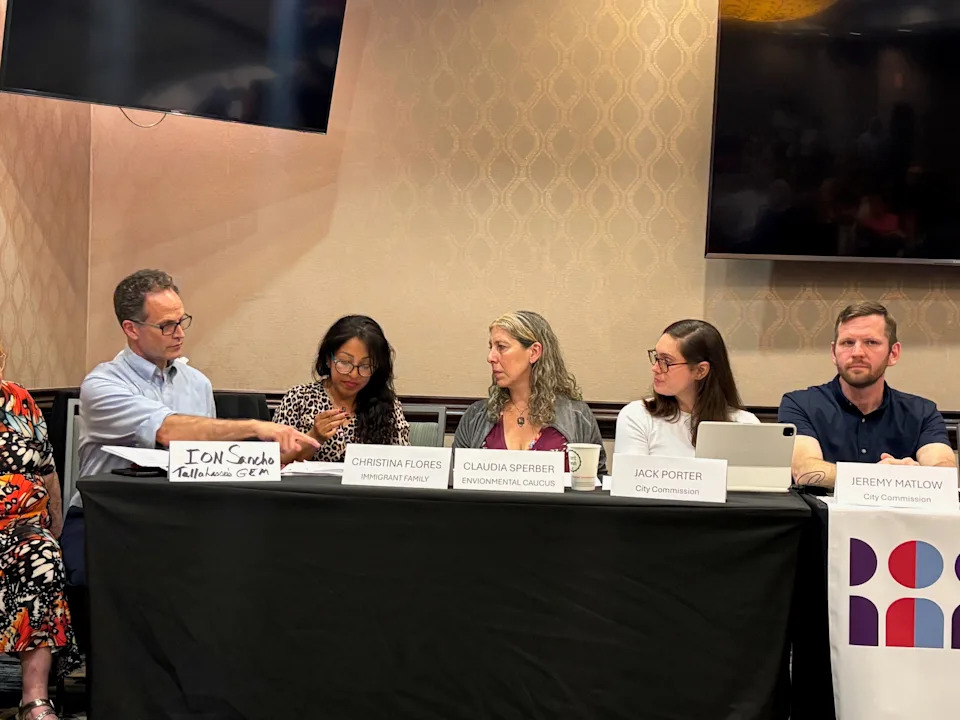
Christina Flores speaks about her husband’s detainment at Indivisible panel.
More: FSU students call for sanctuary campus status
Ricci also highlighted the nuances of defining undocumented individuals.
“Someone can be undocumented and have entered the country with permission,” Ricci said at the event. “For example, an FSU student maybe came in as an F-1 visa holder, they stopped going to classes, they’re undocumented. That’s an undocumented immigrant.”
Ricci encouraged students and residents to support the local immigrant community by partnering with and empowering immigrants, educating others, accompanying affected families to appointments, contacting elected officials to demand policy changes, funding legal support, uniting across differences, and logging witnessed enforcement actions.
“Immigration has become a hot topic in Tallahassee with the raid this last May … I would like to encourage you to know your rights,” Ricci said. “Knowing your rights means knowing the types of warrants that exist.”
Advocates call for community action on ICE
Tallahassee resident Flores, whose husband, Abraham Flores, is being held at the Federal Detention Center on Capital Circle, also spoke at the event. Flores expressed frustration with the difficulty of contacting her husband following his arrest by ICE several months ago.
“I have reviewed the instructions for visitation carefully, we have filled out the forms correctly, and followed corrections, but nothing’s working. After all of these months, I am still waiting for when I can come see him,” Flores told the audience. “The punishment that I am receiving was also handed down to me and my 9-year-old granddaughter that we are raising together because of … the ICE detention we have lost our stability … overnight.”
More: YDSA, other organizations march on FSU campus against ICE agreement
DECLC advocate Claudia Sperber followed Christina Flores with a call to action.
“How can we help? … We can all become stronger advocates, and it will only take a few minutes,” Sperber said during the event. “Just remember this prison is right across from the Lucky Goat Coffee, it’s right in the heart of Tallahassee, and it’s not only her husband. There are many more immigrants … detained there … [and] there are steps that we can take.”
Sperber urged audience members to contact Federal Bureau of Prisons executive assistant Pedro Rivera at 850-878-2173, requesting they call on behalf of the Flores family to advocate for visitation rights. The proposed call to action asks Rivera’s office to allow Flores to visit her husband at the Federal Detention Center in Tallahassee.
Gregory Rusin is a Senior Staff Writer for the FSView & Florida Flambeau, the student-run, independent online news service for the FSU community. Email our staff at contact@fsview.com.
This article originally appeared on FSU News: Local organizations discuss 287(g) and issues surrounding ICE