
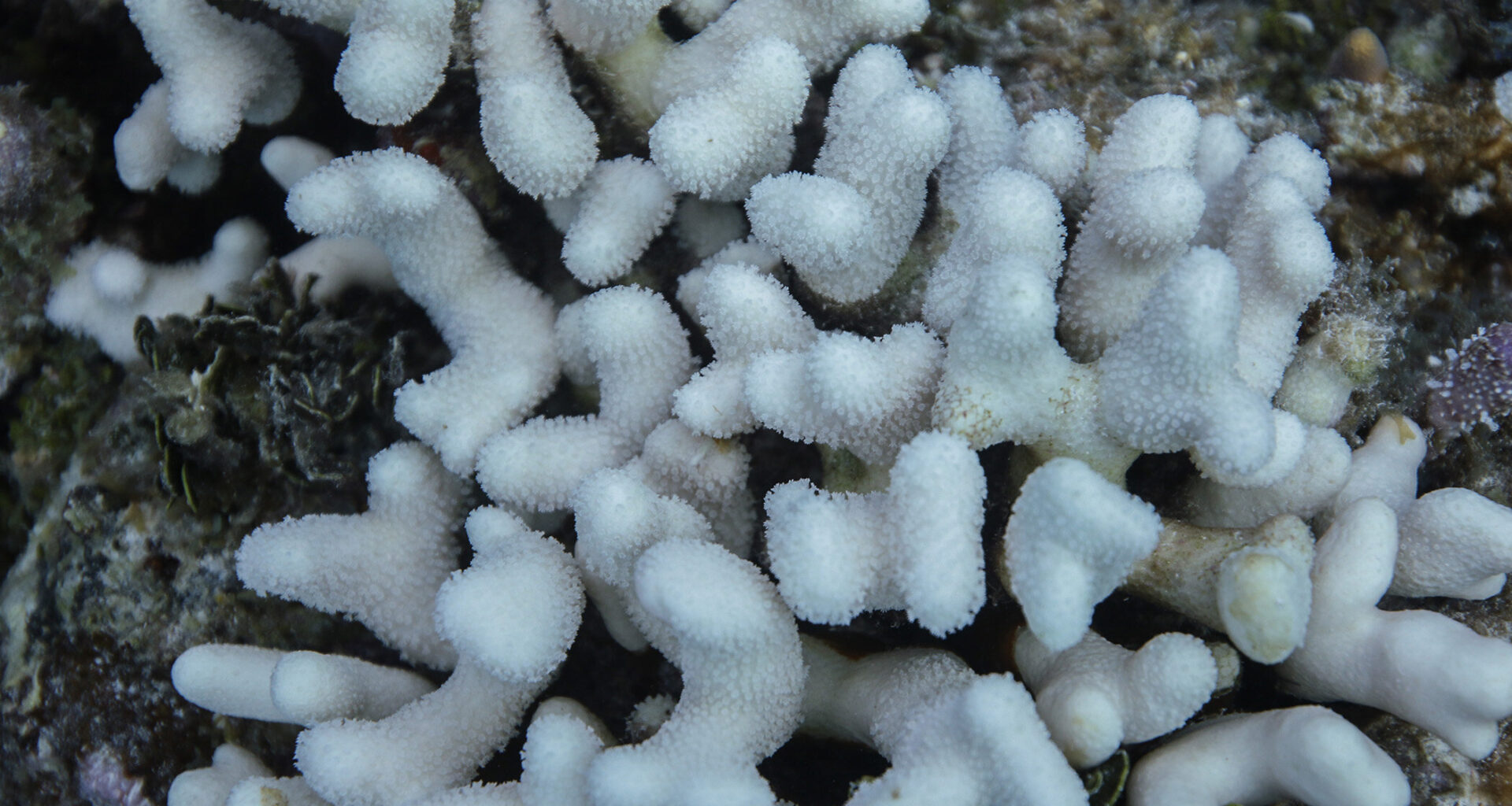
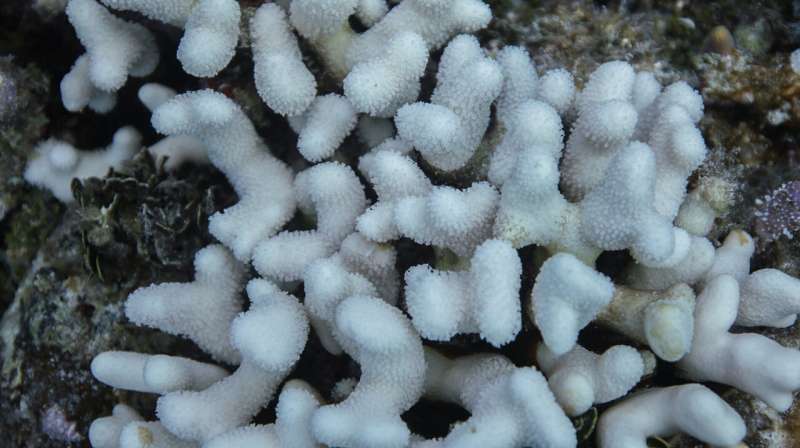
Coral bleaching on Acropora corals from Florida’s Coral Reef. Credit: Shedd Aquarium/Gavin Wright
New research reports the functional extinction of Acropora corals from Florida’s Coral Reef. Scientists have documented catastrophic mortality of these critically endangered corals following a record-setting marine heat wave in 2023 that marked the ninth mass bleaching event for the region.
Both Acropora coral species—staghorn (Acropora cervicornis) and elkhorn (Acropora palmata)—are important reef-builders in Florida and the Caribbean and have been a major focus of recent coral restoration efforts.
The study is published in the journal Science. Led by the National Oceanic and Atmospheric Administration’s Coral Reef Watch and Chicago’s Shedd Aquarium, the study involved 47 authors representing 22 institutions that contributed data detailing the coral die-off.
While some individual elkhorn and staghorn corals remain, their numbers are now so low that they can no longer fulfill their vital roles in the ecosystem—providing habitat for marine life and helping protect coastlines. This collapse of ecological function marks what scientists call a functional extinction, a stage that often precedes global extinction or the complete disappearance of species.
While most other coral species in Florida did not suffer losses as extreme as the more heat-sensitive Acropora, the loss of these species deals a devastating blow to the ecosystem and stands as a stark warning for the future of coral reefs worldwide.
“We’re running out of time,” said Dr. Ross Cunning, research biologist at Shedd Aquarium and co–first author of the study. “Extreme heat waves are increasing in frequency and severity due to climate change, and without immediate, ambitious actions to slow ocean warming and boost coral resilience, we risk the extinction of even more corals from reefs in Florida and around the world.”
The study documents that the temperatures reached during the 2023 heat wave were the highest ever recorded on Florida’s Coral Reef in over 150 years, and that the heat stress persisted for 2–3 months. Heat exposure levels were 2.2 to 4 times greater than in any previous year on record.
As the heat wave and mass bleaching event unfolded, the team of researchers conducted diver surveys to track more than 52,000 colonies of staghorn and elkhorn coral across 391 sites. In the Florida Keys and Dry Tortugas (almost 70 miles west of Key West), mortality rates reached a staggering 98–100%. Mortality rates were lower offshore in southeast Florida, at around 38%, reflecting cooler temperatures in the region.
These two species of coral were already in decline due to decades of disease, poor water quality, previous bleaching events and other human-driven stressors, but the 2023 marine heat wave accelerated the near-total collapse of staghorn and elkhorn corals on the reefs in this region. The population is unlikely to rebound without conservation interventions because of low numbers, continued warming, and additional stressors.
What happens next
Scientists have already established living repositories to safeguard remaining Acropora in aquarium facilities on land and in offshore coral nurseries and have rescued more of the survivors of the 2023 heat wave to bolster these collections. Under expert care, corals in these “gene banks” can continue to grow, supporting further research and restoration efforts for the species. Yet, the authors caution that the success of restoration will ultimately depend on the return time and severity of future bleaching events.
To secure a future for these species, restoration efforts must also incorporate new, adaptive interventions. Introducing resilient genetic diversity from outside Florida or manipulating the types of symbiotic algae that help corals tolerate heat may be the only means to maintain any Acropora populations in Florida.
Ultimately, the study underscores that ocean warming from climate change is now surpassing the thermal limits of entire populations of corals. Alongside bold, science-based actions to enhance coral resilience, urgent global action to slow climate change is essential to prevent the collapse of these critical reef ecosystems.
More information:
Derek P. Manzello et al, Heat-driven functional extinction of Caribbean Acropora corals from Florida’s Coral Reef, Science (2025). DOI: 10.1126/science.adx7825
Provided by
Shedd Aquarium
Citation:
Catastrophic loss of Florida’s staghorn and elkhorn corals highlights accelerating climate pressures for reefs worldwide (2025, October 23)
retrieved 24 October 2025
from https://phys.org/news/2025-10-catastrophic-loss-florida-staghorn-elkhorn.html
This document is subject to copyright. Apart from any fair dealing for the purpose of private study or research, no
part may be reproduced without the written permission. The content is provided for information purposes only.