
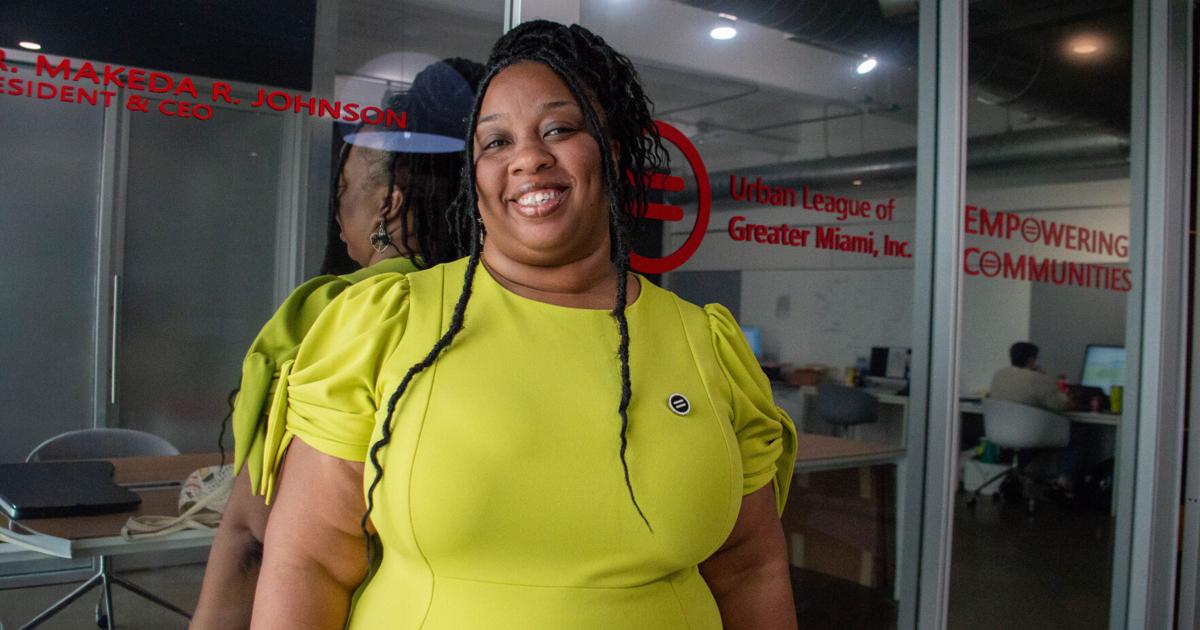
Nearly seven months into her tenure as president and CEO of the Urban League of Greater Miami, Dr. Makeda Johnson’s mission is clear: restore the organization’s visibility while expanding its impact on education, housing, and economic empowerment.
Johnson, who took the helm on Aug. 25, 2025, is the first woman to lead the affiliate in its 80-year history. Her appointment marked a new chapter for one of Miami’s longest-standing civil rights and community development organizations following the six-decade tenure of T. Willard Fair.
While Fair guided the organization through segregation, integration, and decades of advocacy, the Urban League has recently maintained a quieter approach to public engagement. Last year, Fair told The Miami Times that the group preferred to focus on its work rather than promote it, rarely issuing press releases or digital updates.

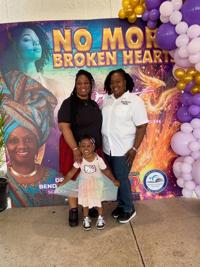
Dr. Makeda Johnson, Urban League of Greater Miami president, along with Daniella Pierre, president of NAACP Miami-Dade, at a domestic violence awareness event.
(Urban League of Greater Miami)
Johnson, however, is ushering in a season of vocal advocacy.
“I believe my predecessor did an amazing job,” Johnson told The Miami Times. “He definitely laid the foundation, even in our new strategic plan, ‘Legacy, Leadership, Lift.’ We have to build on the legacy he built, but we are now moving toward the leadership of not just myself and our executive team, but also the individuals that work with us.”
One of her immediate priorities is re-establishing the organization’s presence in the public eye.

Dr. Makeda Johnson is the first woman to lead the Urban League of Greater Miami.
(Amelia Orjuela Da Silva for The Miami Times)
“I want people to understand that the Urban League is still here, that we’re still doing the work within the community,” she said. “We have a ton of programming coming up just to reintroduce ourselves. We respect the past, but we’re also trying to grow into the future.”
A leader rooted in the movement
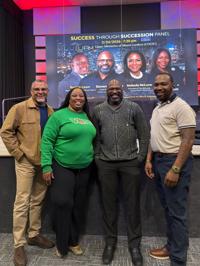
Dr. Makeda Johnson on a panel in Miami Gardens.
(Urban League of Greater Miami)
Johnson is no stranger to the Urban League’s national mission.
Her career path has been a steady climb through the movement, having served as director of education for the Buffalo, New York, affiliate, followed by roles as director of education and emerging programs at the Urban League of Central Carolinas, and eventually chief operating officer of the Urban League of Winston-Salem.
In Miami, she notes that the reception has been overwhelmingly positive.
“I tell everybody that the Urban League’s tagline is ‘empowering communities, changing lives.’ This affiliate is no different,” Johnson said. “Since I’ve been here, Miami has been good to me. I’ve met some amazing people, some other people, and nonprofits, as well as businesses, who have been very welcoming to me, to my family, to the changes in the organization.
For Johnson, the role is also deeply personal.
“My grandmother was a maid, so when you look at that, and you put that in perspective — she was a woman who did not have a formal education, and her granddaughter is sitting in a position to make change — it gives me almost a sense of pride to say that I stand on the shoulders of my ancestors.”
Increasing visibility and advocacy
One of Johnson’s primary goals is dismantling what she calls the “best-kept secret” status of the local affiliate.
“We may be one of the best-kept secrets,” Johnson said. “And over the next three to five years, I would like to get the secret out.”
She noted that many residents, particularly those new to the region, are unaware the organization is active in South Florida.
“I cannot say how many people I’ve met who say, ‘There’s an Urban League in Miami?’ Especially people who moved here from areas where they have an Urban League in their community. So really having that conversation with everybody that we are here.”
To achieve this, Johnson plans to collaborate extensively with other nonprofits and civic institutions under her guiding mantra: “Ubuntu,” an African philosophy meaning “I am because we are.”
“Together we’re stronger; nobody can do this work by themselves,” she said. “I want to collaborate.”
This strategy includes a more robust role in civic engagement and public policy.
“It looks like us being more vocal, more visible, and involved with advocacy,” she explained. “It means showcasing the reasons why people should vote and what that looks like, while maintaining a non-partisan role in the process.”
Expanding the housing footprint

View 29, a proposed 12-story, 116-unit mixed-income project in Wynwood, targets residents earning 30% to 120% of the Area Median Income (AMI).
(Wynwood Design Review Committee)
Housing remains one of the Urban League’s most robust pillars. Through its “New Urban Development” and property management affiliates, the organization currently manages over 1,000 units across Miami-Dade County.
Projects currently underway include The Villages II, an eight-story, 120-unit affordable housing development in Little Haiti nearing completion, and View 29, a proposed 12-story, 116-unit mixed-income project in Wynwood. The County Commission recently approved up to $44 million in bonds through the Housing Finance Authority to kick start this development, targeting residents earning 30% to 120% of the Area Median Income (AMI).

The Villages II, an eight-story, 120-unit affordable housing development in Little Haiti, is nearing completion./
(Rinaldi Group)
Beyond brick-and-mortar, Johnson is strengthening housing advocacy. The league recently appointed a vice president of housing empowerment and hired a consultant for housing development.
Johnson also said the Urban League plans to expand programs that help residents navigate the financial realities of housing, particularly first-time homeownership, with workshops.
“Just telling people this is what you can do,” Johnson said. “Even if you’re not ready to buy yet, just having those conversations about what my credit should look like or what this looks like to own.”
Education and small businesses
With a background in education, Johnson is expanding the league’s youth initiatives. While the “We Rise Reads” program continues to anchor literacy efforts in Liberty City schools, helping students improve literacy outcomes, new “creative workforce” workshops are introducing students to modern economic skills.
“We have the storyteller workshop coming up, we have a sewing workshop coming up where the students will walk away with their own Singer sewing machine,” she said. “Or we’re working with Mojo Arts, and we’re doing like a DJ intensive, where students will learn how to brand their name, learn marketing, and then learn how to DJ.”
The goal is to provide youth with skills that reflect today’s evolving creative economy. Simultaneously, the League is doubling down on support for local entrepreneurs by helping them develop business plans and navigate the hurdles of launching a company.
“Small businesses — we’re here to help,” she said. “If you need help writing your business plan, if you need help talking about capital, making sure we’re able to connect those people to the right individuals here in the city.”
The road back to Liberty City
The organization is currently operating from a temporary office on 2121 N.W. Second Ave. in Suite 203, but the heart of the organization remains in Liberty City. Plans are currently being finalized for a new permanent headquarters along Northwest Seventh Avenue.
“We’re in the midst of still building our headquarters on Seventh,” she said. “Getting that up, getting the plans done for that so that we can see what that looks like for us, but making sure we’re a staple in the community.”
For Johnson, success will be measured by accessibility and visibility.
“Success for the community looks like people having access to services, access to education, access to workforce development,” she said. “For the Urban League movement, success looks like the secret being out. I hope to be here long enough to enable sustainable growth and visibility within Miami-Dade County.”