
When people hear the term, virtual reality (VR), many quickly conjure up an image
— a person whose eyes are covered by a small, rectangular plastic box that is held
on by straps crisscrossing the top of their head. Although popular culture has made
it easy for people to picture VR headsets, innovative researchers and experts are
needed to envision educational uses of VR technology. From View-Masters to flight
simulators, artificial environments aren’t new, however, today’s increased affordability
and advancements in computing have evolved VR beyond entertainment or high-level training
to an accessible pedagogical tool.
Thanks to grants from the Florida High Tech Corridor Early-Stage Innovation Fund and the University
of South Florida (USF) Sarasota-Manatee Office of Research, an interdisciplinary USF
team is contributing their knowledge and skills to develop the virtual reality adventure
game, World of Wonder: A Curious Journey. This collaborative partnership includes USF faculty, staff, graduate student research
assistants in education, undergraduate computer science and digital art students and
local middle-grades youth.
Virtual reality offers opportunities to explore in a ‘no stakes’ environment where
mistakes are free — very much unlike their experiences in this world.
Lindsay Persohn
Similar to smart phones, VR headsets utilize apps that are available in app stores
to create a virtual experience. World of Wonder: A Curious Journey is a VR app prototype
where “each encounter invites you to question, reflect, and think differently about
the world around you.” To advance through the story, World of Wonder users are immersed
in an illustrated world where they must solve problems such as deciphering a riddle
to identify the proper door key or build a vessel to cross a river.
Project lead Lindsay Persohn, assistant professor in Literacy Studies, states, “In
talking with youth about VR, they express excitement for the opportunity to take part
virtually in experiences that would be inaccessible to them due to timeline, geographic,
economic, or other constraints, or impossible on planet Earth.”
The app’s framework was inspired by Persohn’s dissertation in which she studied the
illustrations from Lewis Carroll’s “Alice’s Adventures in Wonderland” overlaid with
elements of Joseph Campbell’s “Hero’s Journey”. This prototype aims to overtly use
the virtual reality environment as a space for youth to explore and develop solutions
to challenges they see in the world, such as economic insecurity, climate change,
and social-emotional health.
“Each encounter invites you to question, reflect, and think differently about the
world around you. World of Wonder challenges your thinking through interactive moments
that spark inquiry and imagination.” World of Wonder App Description
Howard Kaplan, associate director of USF’s Advanced Visualization Center, led a team
of staff and student developers and artists to create the app prototype. During this
process, the team utilized civically-engaged thinking to not only enhance the prototype,
but to also ensure that the app provides meaningful experiences for the user — middle
school aged students. “It’s about human-centered design and human flourishing through
the use of technology and innovation,” said Cheryl Ellerbrock Sarasota-Manatee campus
dean of Education.
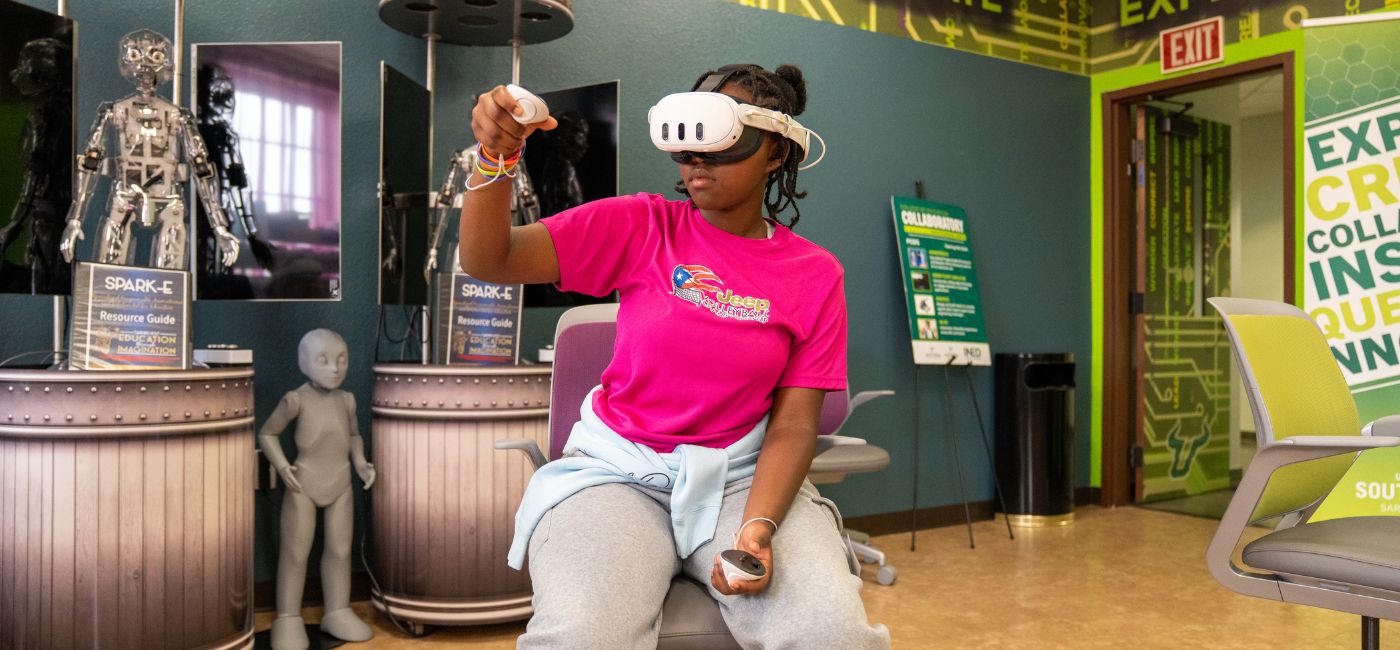
Workshops and camps were hosted at the USF Collaboratory — a hub where immersive, emerging and intelligent technologies advance education
— for youth to test World of Wonder. Creative Director of the Collaboratory Csaba
Osvath patiently guided youth participants through the VR experience and thoughtfully
listened to their feedback. The development team received insightful input from the
youth participants, while the youth gained insights into digital design processes
and together, they watched their ideas come to life.
“Working on the World of Wonder game was my first large collaborative project,” said
USF Fine Art student, Jasmine Jakubowicz, “it gave me great experience both technically
and artistically. However, I think the main thing that I took away from the project
was being able to grow in my communication and teamwork while learning the details
of the development pipeline.”
Spaces like USF’s Collaboratory serve as valuable resources for area students and
community members to experience cutting-edge technology such as VR with expert guidance
and support. “In today’s rapidly changing world, we don’t even know the careers that
we are preparing youth for,” said Ellerbrock. “We want to help them think differently.
We want them to understand human-centered design, starting with the person and moving
forward from that.”
This prototype will eventually become a completed app and continue to educate students
through the VR experience, however, the impact for the middle school and college students
involved in this collaborative process goes far beyond the finished product. These
students have seen the value of creativity, innovation and digital mindfulness to
support human flourishing in a rapidly changing world.
World of Wonder Team
Lindsay Persohn, assistant professor of Literacy Studies
Cheryl Ellerbrock, campus dean of the College of Education and associate professor
of Middle Level Education
Howard Kaplan, associate director of the Advanced Visualization Center
Triparna De Vreede, assistant professor of College of Business
Csaba Osvath, assistant professor of instruction of Literacy Studies
Timi Hager, associate director of Digital Learning
Vladislav Krukhmalev, student programmer/developer
Danyl Balbas, student programmer/developer
Jonathan Wong, student programmer/developer
Jasmine Jakubowicz, student artist