
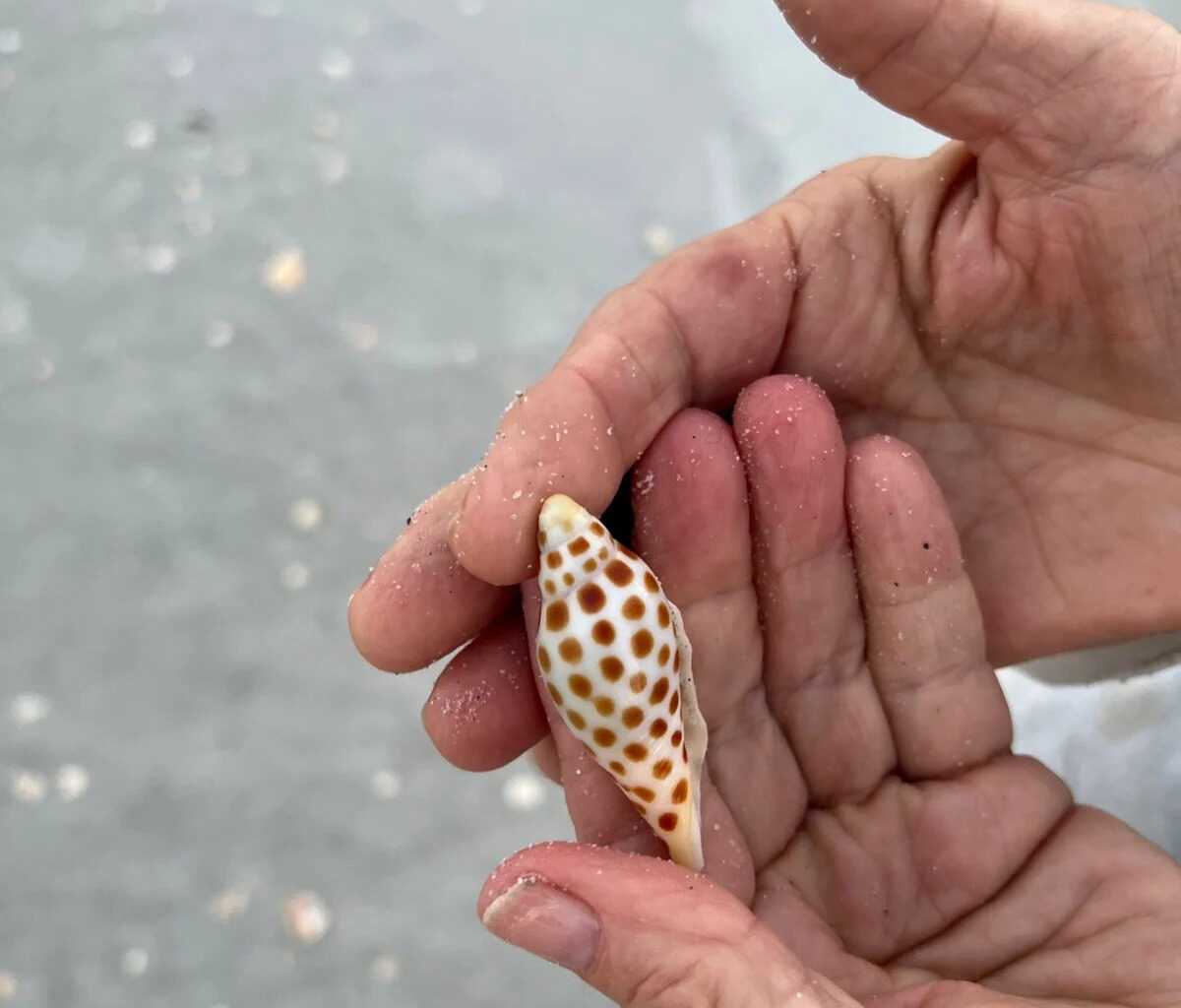
For shell seekers, the junonia is the proverbial needle in a haystack. In other words, good luck finding one.
And if you are lucky enough put your sand-covered hands on a junonia − the creamy-white or ivory, spindle-shaped body covered in distinct rows of brownish-orange to dark brown, squarish spots − it might feel similar to what gold diggers felt back in the day.
So if you are one of the lucky ones, go ahead and say it − or scream it: Eureka!
No one is more of an expert on shells in Southwest Florida than Jose H. Leal, the science director and curator at the Bailey-Matthews National Shell Museum & Aquarium on Sanibel. Leal has decades of experience studying seashells, conchology, and malacology, including the paleontological and archeological/anthropological aspects of the study of shells.
This includes the junonia.
He recalled the first time he found one.
“I believe the first time I found a junonia was dredging in deeper water aboard a research vessel,” Leal said. “A pretty stunning animal.”
Where are the best places on Sanibel Island to find junonia shells?
Shell seekers will comb Florida beaches for hours at a time looking for the junonia. What starts as a fun hobby can quickly turn into an obsession. Before you know it, you’ve spend a good portion of your life looking for one, single junonia shell only to come up empty handed and frustrated.
We asked Leal for some help. In 2025 a website called Trip Memos published a story titled “8 Beaches in Southwest Florida Where Seashell Hunters Strike Gold.” One of the sections in the article was labeled “Best Spot for Finding Junonia Shells.”
According to the author, the junonia “appears more frequently at Blind Pass than almost anywhere else in the region.” Furthermore, according to the story, many experienced shellers focus their searches in the area where the current flows strongest through the pass. After winter cold fronts or tropical weather systems disturb the deeper waters, your chances of finding unusual specimens like the junonia increase dramatically.
We asked Leal for his take on finding a junonia on Sanibel.
“I believe the west end of Sanibel (and Captiva Island) are more conducive to the beaching of Junonia shells because they are more exposed to the open Gulf of Mexico than the more protected beaches to the east-northeast of Tarpon Bay Road,” Leal said.
Geography plays a role in finding a junonia shell
Leal said there are 69 records of junonias at the Bailey-Matthews Shell Museum. Of those, 17 were beach-collected on Sanibel-Captiva. Of the ones with more granular geographic location data, Leal said, one is from Chateau-sur-Mer (Sanibel), another from Bowman’s Beach (Sanibel), yet another from West Gulf Beach (Sanibel), and one from Turner Beach (Captiva).
Leal said he’s noticed an uptick of people finding junonias this season compared to past years.
“This last season has been great for beached junonia finds,” Leal said. “Lots of them in the local and social media.”
Please support local community journalism and stay informed about Southwest Florida news by subscribing to The News-Press and Naples Daily News; download the free News-Press or Naples Daily News app, and sign up for daily briefing email newsletter, food & dining and growth & development newsletters here.
This article originally appeared on Fort Myers News-Press: Where is the best place for find a junonia shell on Sanibel, Florida?