
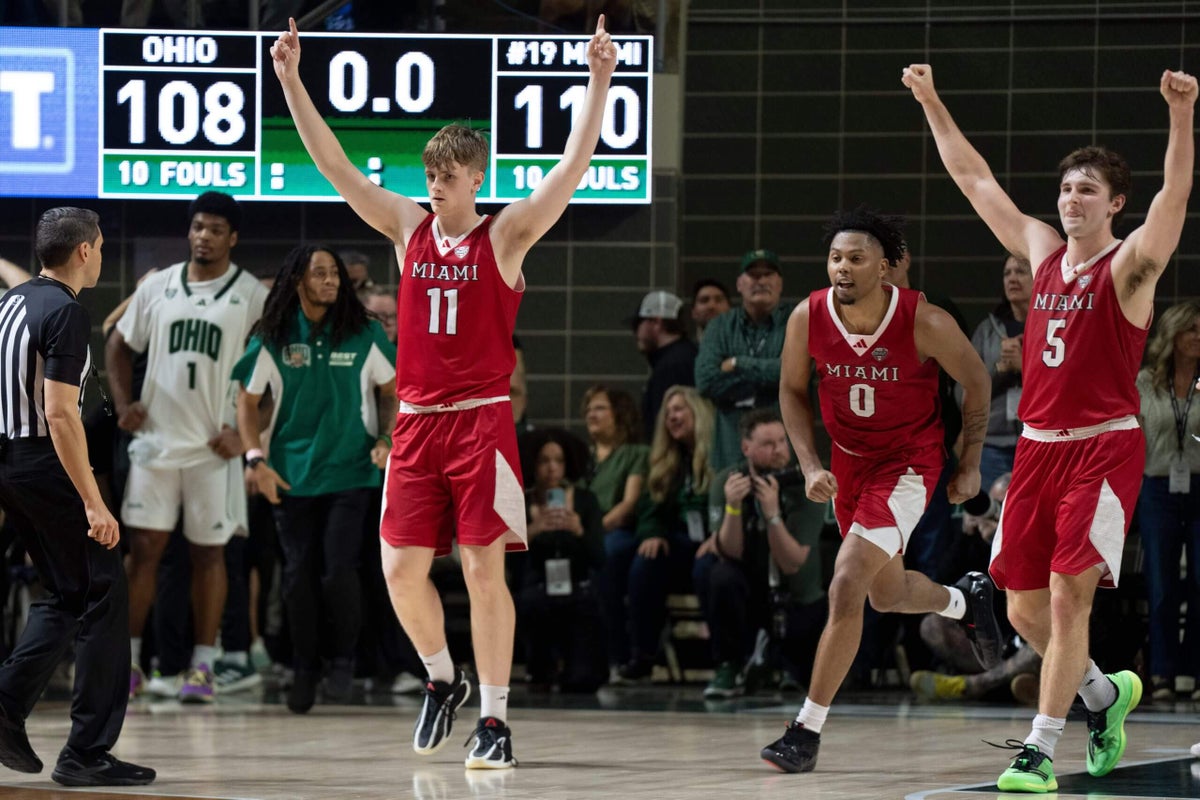
Miami (Ohio) is the latest NCAA Division I men’s basketball program to finish its regular season undefeated. The 31-0 RedHawks did so with a 110-108 overtime win over in-state rival Ohio on Friday — the type of win that put even basketball junkies on the edge of their seats.
That win summed up Miami’s season in a nutshell. The RedHawks have won four games in overtime this season — tied with Virginia (also 4-0) for the most — and finished the regular season with three wins by fewer than five points. That’s pretty gutsy for a team that was just 15-17 and in the middle of the Mid-American Conference pack two seasons ago.
In addition to having a flair for the dramatic, Miami (Ohio) wins with offense, ranking second in the nation in scoring at 90.9 points per game. Peter Suder paces a balanced attack at 14.8 points per game. The RedHawks’ defense, meanwhile, could use some fine-tuning ahead of Thursday’s MAC tournament opener. They allow 74.9 points per game and rank 91st nationally in defensive rating, per KenPom.
Despite their mixed resume, the RedHawks enter the MAC tournament having won 31 straight, the latest team attempting to dominate during a championship run. Many have tried, and many have failed since Bob Knight’s Indiana Hoosiers went unbeaten on the way to a title in 1976.
Larry Bird’s Indiana State Sycamores couldn’t do it, falling to Magic Johnson’s Michigan State Spartans in the 1979 championship game. Jerry Tarkanian’s 1991 UNLV juggernaut fell short as well, losing by two to a loaded Duke squad in the 1991 Final Four. There are several other more recent examples.
What makes it more challenging for Miami (Ohio) is that there is a chance the RedHawks won’t even get out of the MAC tournament unscathed. As The Athletic’s Joe Rexrode wrote Tuesday, the committee accounts for every conference tournament championship. Teams could drop a seed line during the conference tournament, even if they went perfect in the regular season.
Miami (Ohio) has been a trending topic throughout the season. Can coach Travis Steele continue the streak? Let’s look at recent teams that have come close.
2004 Saint Joseph’s: Run cut short in conference tournament
Saint Joseph’s advanced to the postseason unbeaten 22 years ago, but its status and success as a mid-major serves as a nice comparison to Miami (Ohio). The A-10 school tucked in suburban Philadelphia completed a 27-0 regular season in 2003-04.
The Hawks went on to lose in a 20-point beatdown to Xavier in the A-10 quarterfinals, as soon-to-be NBA draftees Delonte West and Jameer Nelson struggled to score, while Xavier put on a scoring clinic.
Xavier may have won the A-10, but the Hawks still rode the momentum of their Cinderella season to the Elite Eight, where they lost to Oklahoma State in a heartbreaker that came down to the final seconds. The loss stung, but a two-loss season had to have been some consolation for the mid-major.
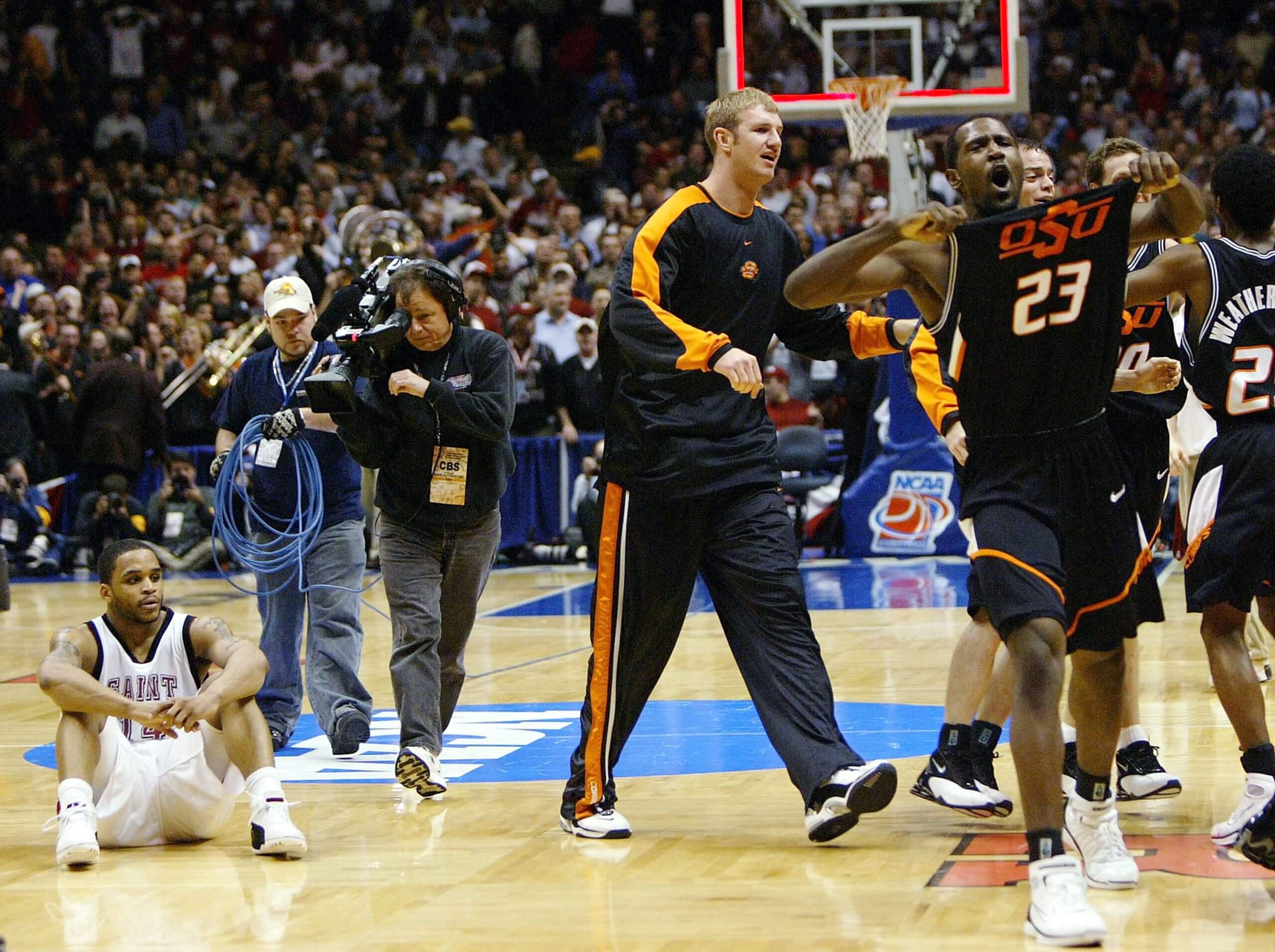
Jameer Nelson, seated, and the Saint Joseph’s Hawks were eliminated from the NCAA Tournament by Oklahoma State. But their first loss of the season came earlier, in the Atlantic 10 tournament. (Doug Pensinger / Getty Images)
Saint Joseph’s success, albeit 22 years ago, could be a telling tale of Miami’s journey. A question remains: If Miami (Ohio) loses in the MAC tournament, will it be left out of the Big Dance? The RedHawks’ strength of schedule, 272nd as of Tuesday night, will not help, but the RedHawks give Cinderella vibes with the way they’ve played in crunch time throughout the season, regardless of their opponent.
One or two conference tournament wins would give them a chance at an at-large bid. Even so, the grim reality is that Saint Joseph’s played (and still plays) in a bigger conference and also notched a non-conference win over then-No. 10 Gonzaga. When you lack Quad 1 wins, as Miami (Ohio) does, those conference trophies matter.
2015 Kentucky and 2021 Gonzaga: Powerhouses loaded with future NBA stars
Miami (Ohio) has a storied program history. Five-time NBA champion Ron Harper played there from 1982-86 and is the program’s all-time leading scorer, and Wally Szczerbiak led the RedHawks to the Sweet 16 in 1999. Yet they’ve never had the depth of talent that the 2021 Bulldogs or 2015 Wildcats had in their near-unbeaten seasons.
The Wildcats had nine McDonald’s All-Americans on their roster. Karl-Anthony Towns, Devin Booker, Willie Cauley-Stein and twins Andrew and Aaron Harrison started for a team that rotated in a strong unit off the bench. Kentucky, which went 24-0 in the regular season, was the best defensive squad in the country, with pesky on-ball defenders and plenty of length inside that limited opponents to 54.3 points per contest. Kentucky didn’t lose until meeting Wisconsin in the Final Four.
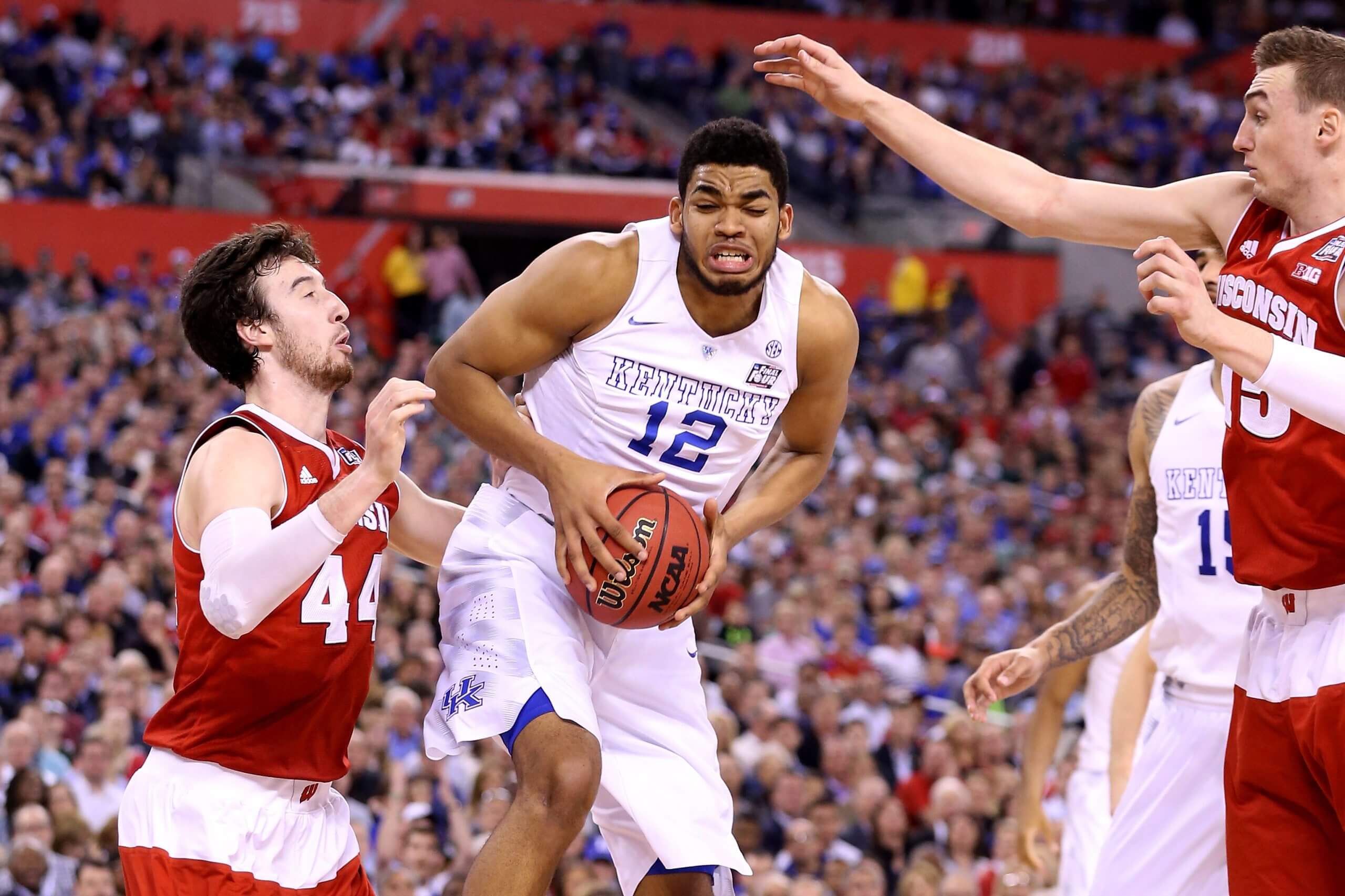
Karl-Anthony Towns and a loaded Kentucky team didn’t lose a game in the 2014-15 season until running up against Frank Kaminsky and Wisconsin Badgers in the Final Four. (Andy Lyons / Getty Images)
Gonzaga finished the 2020-21 regular season undefeated at 24-0 before winning the West Coast Conference tournament, but ultimately lost to Baylor in the national championship game. Yet, Jalen Suggs revealed his clutch gene in a pivotal Final Four game with a nearly half-court buzzer-beating bank shot to beat UCLA and keep their streak alive, halting Johnny Juzang’s magical run inside an empty Lucas Oil Stadium.
The Bulldogs’ rapid scoring rate in 40 minutes (91 ppg) and their efficiency (54.9 percent) made them nearly unstoppable. Bulldogs coach Mark Few relied on old-school, dump-it-in-the-post action to allow Corey Kispert and Drew Timme to be elite inside, but Suggs and Andrew Nembhard often ran out in transition. The Bulldogs shot 35 percent of their attempts in the first 10 seconds of the shot clock.
2014 Wichita State: A run cut short in the second round
Wichita State finished the 2013-14 regular season 31-0 and earned a No. 1 seed in the NCAA Tournament, but the Shockers’ run ended abruptly in a 78-76 second-round loss to Kentucky. The matchup drew scrutiny across college basketball, with some criticizing the selection committee for pairing the tournament’s lone undefeated team with a Kentucky squad that had multiple future NBA draft picks and appeared far stronger than its No. 8 seed suggested.
Despite an inconsistent regular season, John Calipari’s Wildcats were loaded with NBA-caliber talent. Their roster featured future pros including Julius Randle, Aaron Harrison and Andrew Harrison, James Young and Dakari Johnson — a lineup that eventually powered Kentucky to the national championship game.
Wichita State still nearly survived the back-and-forth matchup. The Shockers, who entered the NCAA Tournament 34-0, traded blows with Kentucky throughout the game. Guard Fred VanVleet had a chance to win it in the final seconds, but his potential game-winning 3-pointer fell short.
If history can predict Miami (Ohio)’s upcoming journey, an NCAA championship may not be in the cards — only seven teams have finished an undefeated season and won an NCAA Division I championship.
It’s March, though, and anything can happen. The RedHawks could lose in the first round of the MAC tournament and lose the automatic NCAA bid, or they could win the MAC tournament and take it out of the committee’s hands.
That’s the beauty — and chaos — of March.