
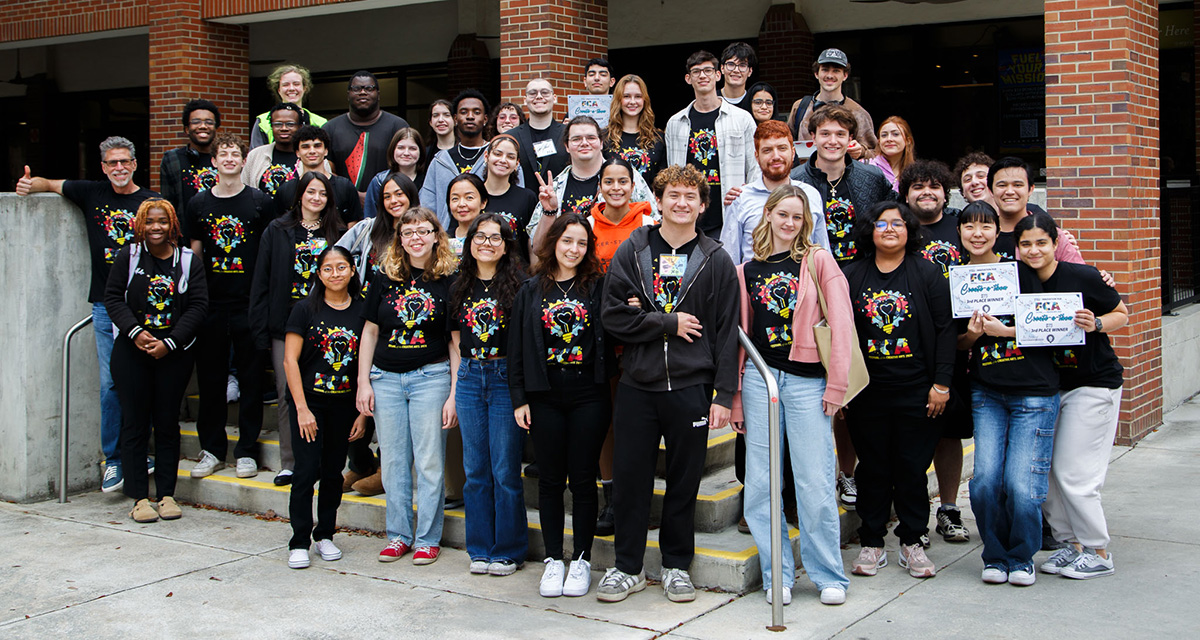
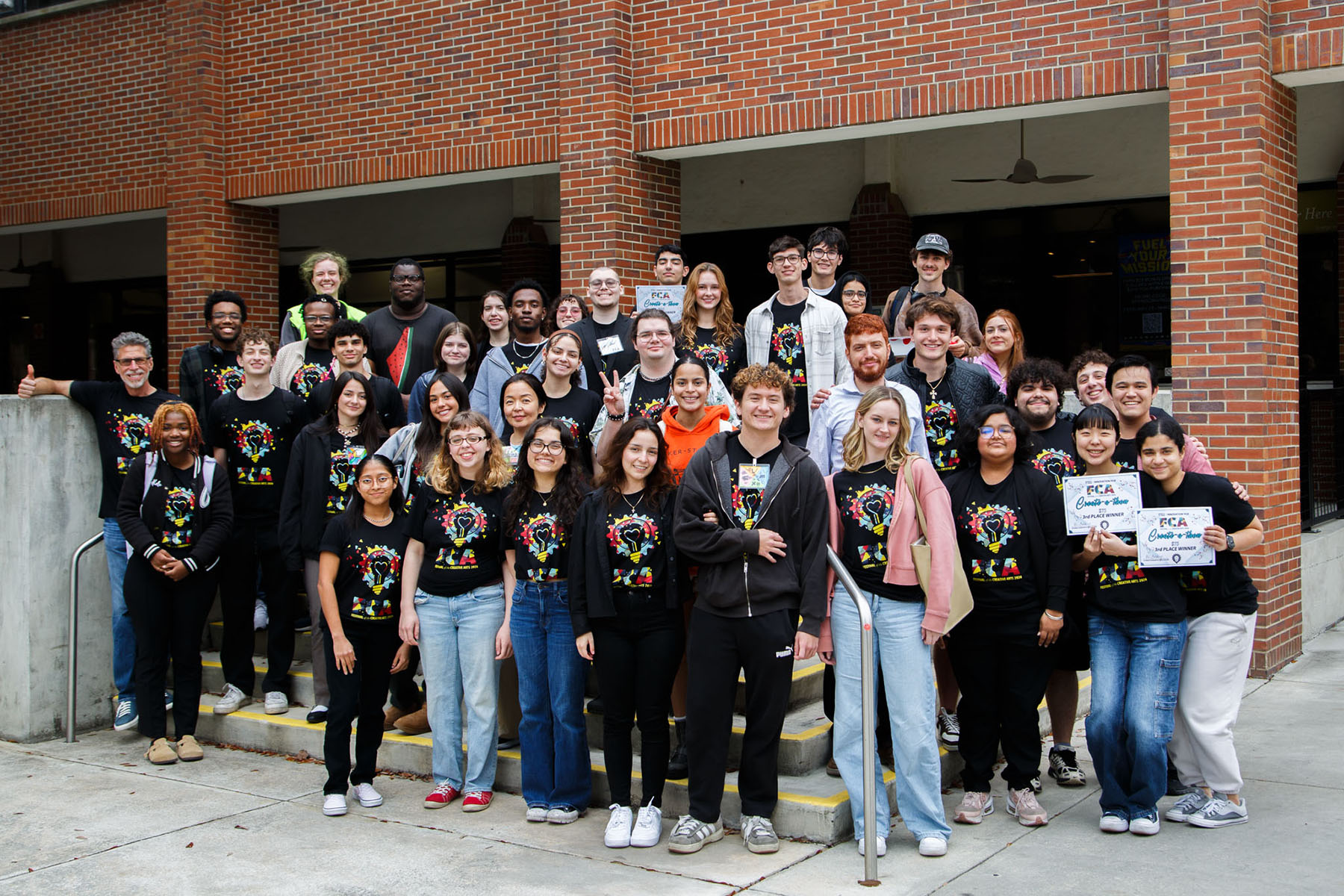
 Florida State University’s Innovation Hub recently hosted a 24-hour Create-a-thon as part of the 2026 Festival of the Creative Arts, partnering with the FSU Office of Research to help students use innovation and creativity to make projects that bring the Tallahassee community together. (Casey McCarthy/Florida State University)
Students at Florida State University fused human creativity with modern technology during a recent 24-hour Create-a-thon. The design sprint, hosted by FSU’s Innovation Hub, challenged participants to celebrate Tallahassee’s community spirit by building interactive experiences that cultivate a lasting sense of belonging and connection.
The event served as a feature of the 2026 Festival of the Creative Arts (FCA), an initiative led by the FSU Office of Research that highlights the voices and talents of students and faculty across the university.
“Events like this Create-a-thon provide our students with a space where creativity is the primary driver of discovery,” said Ken Baldauf, founding director of the Innovation Hub. “When we bring together dancers, engineers, musicians, writers and scientists, we aren’t just making art, we are developing a universal language for problem solving that leverages the latest technologies.”
Students from various fields, including music, art education, computer science and engineering, worked for 24 hours to research the needs of the Tallahassee community and develop solutions. (Logan Lowery/Florida State University)Students consulted with university and community experts throughout the event, asking questions and receiving direct guidance to help develop their projects. (Logan Lowery/Florida State University)Teams comprising students with various backgrounds worked together to identify local needs and develop creative projects that support the Tallahassee community. (Casey McCarthy/Florida State University)Ken Baldauf, founding director of the Innovation Hub, shares the Create-a-thon objective that students will spend the next 24 hours innovating ideas that will help people in Tallahassee feel more connected. (Logan Lowery/Florida State University)
During the event, eight interdisciplinary teams of five students from varied fields, such as music, art education, computer science and engineering, worked for 24 hours to understand the needs of the Tallahassee community and develop solutions that build connections and strengthen our sense of community.
The event kicked off with an interactive discussion featuring Tallahassee Mayor John Dailey, moderated by Brittney Pieper of the FSU Career Center. During the discussion, Dailey answered student questions ranging from the role of creativity in civic problem solving to successful city projects like Cascades Park, the Longest Table and Word of South, as well as modern challenges that open possibilities for connection.
He encouraged students to look past the campus “bubble” and find ways to apply their education to the city’s real-world civic challenges.
“Tallahassee is a university town. Anytime we can engage students to think big and help us solve the challenges that face society, it is a win-win situation,” said Mayor Dailey.
The program opened with a Q&A session where Tallahassee Mayor John Dailey and Brittney Pieper from the FSU Career Center shared how creative thinking can build a brighter future for the local community. (Logan Lowery/Florida State University)Following the group discussion, Mayor Dailey met with students for one-on-one conversations, sharing how their creative ideas could help shape the city and bring local projects to life. (Logan Lowery/Florida State University)
Students also participated in a panel discussion with creative experts including Rob Duarte of the Department of Art, Wen Guo of the Department of Art Education, Noel Wan of the College of Music and Eric Adams of the Innovation Hub.
The panel provided insights into how public art, interactive exhibits, events, performances and augmented reality technologies can positively impact a community, using examples from cities around the world.
“It’s great to show the students examples of creative projects that engage the community in authentic ways and then see how they brought their own experience and empathy to the design process,” said Rob Duarte, associate professor and MFA program director.
For the next 24 hours, students applied a formal design thinking framework to tackle these urban challenges. The teams were mentored by a group of experts comprising the previous panel, which included dance professor and creativity specialist Tiffany Rhynard, who guided them through their unique creative processes.
Student teams presented their final designs and interactive prototypes, explaining how their creative visions could help bring the Tallahassee community together. (Casey McCarthy/Florida State University)The design sprint concluded with a pitch-and-performance competition, where a panel of faculty and community leaders celebrated the students’ most creative, practical, and impactful prototypes. (Casey McCarthy/Florida State University)
The design sprint culminated in a high-stakes pitch and performance competition Saturday afternoon where a panel of faculty and community experts evaluated the projects based on innovative creativity, impact, feasibility and the quality of the prototype and pitch.
Taking first place was Tallahassee Twilight Trails, featuring Isiaq Allison, Kamden Hatten, Ahmed Owens and Pixit Taylor. The group developed an interactive trail system that uses sidewalk murals and photoluminescent paint to connect historic neighborhoods, encouraging residents and students to explore the city safely after dark to foster a greater sense of shared local identity.
Second place was awarded to Pop-Up Books TLH, a team comprised of Sebastian Abril, Conor Finnegan, Mrinal Raina, Riyad Rzayev and Dakota Turner. Their project featured a creative literacy and art initiative that brings oversized, interactive “story stations” to vacant public spaces to celebrate local history and encourage intergenerational storytelling throughout the community.
Participants showcased their work to the judges, demonstrating how they used new technology to address local challenges. (Casey McCarthy/Florida State University)James Hudson, one of the guest judges, provides feedback to students on how their creative designs can address real-world challenges in Tallahassee. (Casey McCarthy/Florida State University)
“The Create-a-thon was an intersectional way to combine minds from different fields and majors to solve a uniting issue that is pertinent within our community,” said Sebastian Abril, a student in the College of Arts and Sciences. “It felt great to make new friends and figure out creative solutions to real-world situations that can positively impact the community that we all share.”
Third place went to Tallahassee STOMP, developed by Sloan Campbell, March Jeongmin Seok, Darcie Ogando-Almanzar and Lillian Thoburn. The group designed an interactive musical exhibit based on Native American/Seminole Stomp Dancing using pressure plates that serve to trigger music when stepped on. The exhibit bridges the gap between different demographic groups by transforming public squares into interactive event spaces.
Beyond the competition, the 24-hour Create-a-thon united students from every corner of campus under a shared goal of community connection and the profound impact they can have as creative leaders in society.
“An event like this that focuses on human creativity has significant value not only for students in the arts and humanities, but for all students as we recognize the value of our humanity in the age of AI and automation,” Baldauf said. “It also provides a unique and valuable way to connect students with the broader Tallahassee community.”
For more information about the Innovation Hub and upcoming events, visit innovation.fsu.edu.