
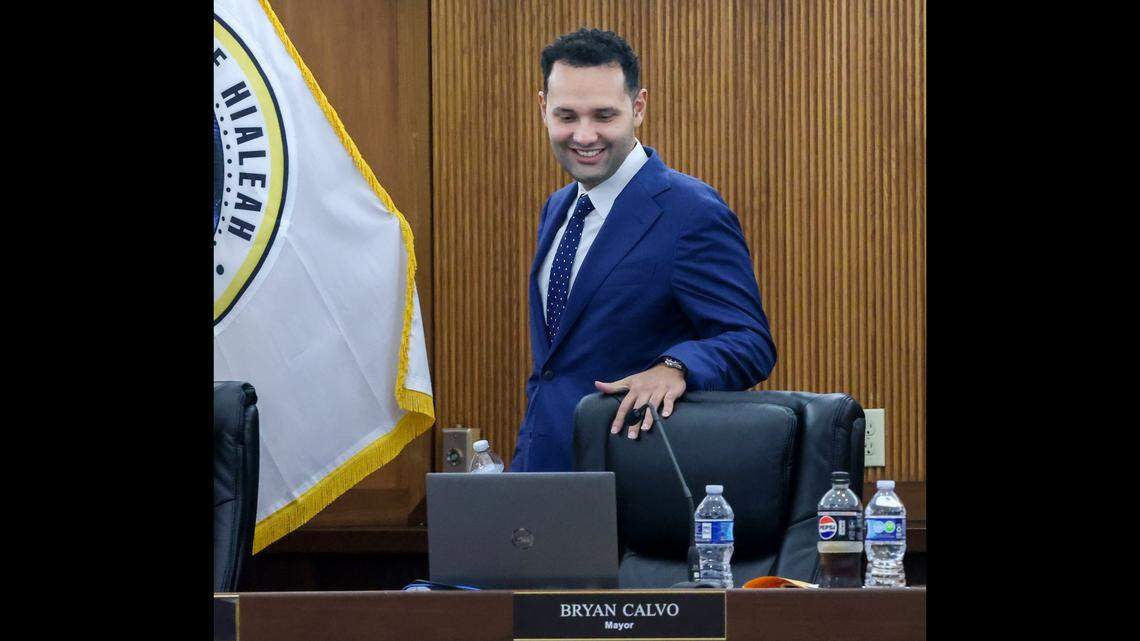
Hialeah Mayor Bryan Calvo takes his seat as he attended his first city council meeting on Tuesday, Jan. 13, 2026, at City Hall in Hialeah, Florida.
Carl Juste
cjuste@miamiherald.com
During his campaign for mayor last year, Bryan Calvo promised to eliminate property taxes for senior citizens. Now, as Hialeah’s youngest-ever chief executive, he introduced a measure to provide relief to certain homeowners over 65, a rebate that has been approved unanimously by the city council.
But is it really an elimination of property taxes?
Not exactly. The city has created a one-time property-tax relief program that will send stimulus-style rebate checks to qualifying senior homeowners, based on the city’s portion of their property tax bill.
The rebate would amount to roughly 33 cents for every dollar paid to the Miami-Dade Property Appraiser, meaning qualifying seniors would receive a check reimbursing the city portion of the property taxes they paid or owed for 2025.
The measure does not eliminate property taxes and does not change how taxes will be assessed or collected in future years. Instead, eligible homeowners will receive a one-time reimbursement.
The ordinance was introduced Feb. 24, approved unanimously on first reading, and passed in final reading Tuesday night. The mayor is expecting to send the checks as soon as the end of March.
Who qualifies?
To receive the stimulus check, homeowners must:
Be 65 years or older,Have a homestead-exempt property in Hialeah, andHave an annual household income of $37,694 or less.
Not every senior over 65 qualifies — only those meeting the income threshold.
Eligible residents will receive a rebate calculated from the city’s portion of their 2025 property tax payment. Seniors who qualify do not need to register or fill out any forms. The city already has the necessary information based on property tax records provided by the Miami-Dade County Tax Collector’s Office, and will automatically issue the rebate checks to those who meet the eligibility requirements.
How much will it cost the city?
The city estimates the program will cost about $1.2 million. The funding will come from the city’s general-fund surplus, generated in part by savings from early pension payments that reduced long-term liabilities. The use of the money has raised legal questions regarding whether the use of property tax revenue to provide a benefit to a narrow class of residents is allowed.
Is it legal?
The question over the program’s legality centers on the source of the funds. The rebate checks are being paid from Hialeah’s general fund, which is used for the city’s operating expenses and receives revenue from multiple sources, including property taxes.
Municipal law experts note that cities generally cannot use property tax revenue to benefit a specific group of residents. While cities can direct other funds, such as federal grants or Community Redevelopment Agency dollars, toward programs that assist low-income or needy residents, the use of general city funds for a narrowly targeted benefit could raise legal questions.
In other words, experts say, any city rebate program must serve a legitimate public purpose and cannot be structured solely to provide financial benefits to a particular group, such as seniors, without a broader justification.
How many residents will receive the rebate?
The ordinance estimates that 2,226 senior households will qualify for the program. According to records, there are 5,146 homeowners in Hialeah with a senior exemption. Of those, 2,918 — or 56.7% — paid $0 in property taxes because of the state’s senior exemptions, meaning they already benefit fully from the exemption.
City projections say rebates will average about $539 per household, though actual payments will vary depending on the city portion of each homeowner’s 2025 tax bill.
Will everyone receive $539?
No. The rebate depends on how much each homeowner paid in city property taxes.
Records provided to the city clerk show a wide range: some seniors could receive as little as $1.70, while others could receive up to $3,583.54.
According to city records:
188 seniors would receive less than $100265 would receive $100–$199909 would receive $250–$499549 would receive $500–$999270 would receive $1,000–$1,99943 would receive $2,000–$2,9992 would receive more than $3,000
About 28% of recipients would receive between $200 and $999.
Does the program benefit 21% of homeowners?
Calvo has said the proposal would benefit 21% of homeowners. But the rebate program itself reaches far fewer people.
Hialeah has roughly 32,100 homeowners. Of those, about 2,226 households would receive the rebate, representing about 6.9% of homeowners, not 21%.
The higher number appears to include seniors who already receive property tax exemptions under existing programs, such as homestead benefits for older residents.
Those exemptions reduce taxable property value but are separate from the city’s new rebate program.
What would happen to property taxes next year?
The ordinance provides only a one-time rebate. Seniors will still be required to pay property taxes in future years, including the 2026 tax bill, unless the city implements a new stimulus program for them.
The current relief follows a bill recently passed by the state House of Representatives that seeks to repeal property taxes on all property except the portion that funds schools — a proposal that mirrors initiatives Gov. Ron DeSantis has campaigned on for more than a year.
Calvo has said his administration could consider approving another rebate or stimulus-style payment in the future, but doing so would require a separate vote and funding approval. For now, the council’s measure provides temporary relief, not a permanent elimination of property taxes for seniors.
This story was originally published March 11, 2026 at 4:36 PM.
Follow More of Our Reporting on Reality Check
Related Stories from Miami Herald
el Nuevo Herald
Verónica Egui Brito ha profundizado en temas sociales apremiantes y de derechos humanos. Cubre noticias dentro de la vibrante ciudad de Hialeah y sus alrededores para el Nuevo Herald y el Miami Herald. Se unió al Herald en 2022. Verónica Egui Brito has delved into pressing social, and human rights issues. She covers news within the vibrant city of Hialeah, and its surrounding areas for el Nuevo Herald, and the Miami Herald. Joined the Herald in 2022.