
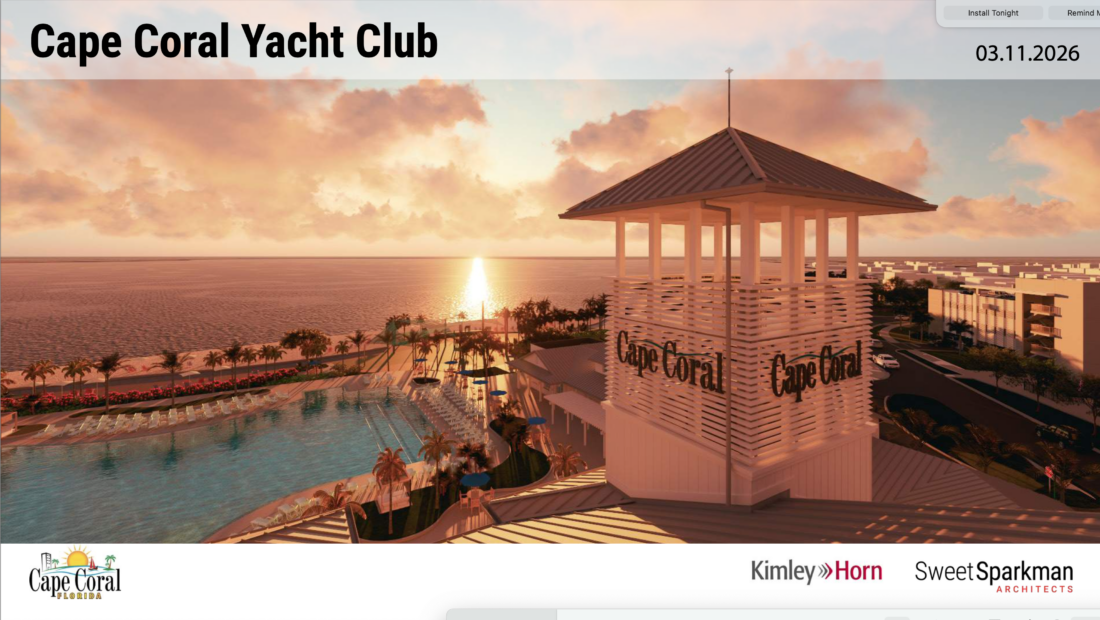
A workshop to discuss design renditions for the multi-million dollar rebuild of the Cape Coral Yacht Club pivoted to a discussion on numbers on how the project could be funded.
A Cape Coral City Council majority said they could not spend an estimated $196 million on the Yacht Club rebuild without a funding mechanism with the discussion including whether to phase in the plan to build a new community center, pool, marina, parking structure and more so as to not incur all of the debt at once.
Councilmember Rachel Kaduk expressed the viewpoint that government needs to get back to the basics – provide and manage infrastructure, ensure public safety, and provide recreational green open space. She said the city should finish the marine work and put up a “for sale sign” to gain the commercial tax.
“I am not understanding how we are here. To me, the local government is not to develop properties. We had a Yacht Club back in the day to attract people to come and move and build here,” she said. “It needs to be put up to the people to vote on the ballot. I don’t know how we are going to max out our credit card to build this.”
Many other council members wanted to explore a phased-in approach for the project, with many saying rebuilding the docks at the city park razed in the wake of Hurricane Ian needed to be done first.
Councilmember Jennifer Nelson-Lastra, who supported the phased-in cost approach, said the no bites on the city’s Request for Information from potential private partners should be a huge clue.
“For now, I agree with the marina things. Those will be ready around the same time the Boathouse is completed, so people can get in and out to visit the Boathouse,” she said. “The marina piece is key.”
Mayor John Gunter said the docks are estimated at about $12 million. He said with the concessionaire agreement with the Boathouse Tiki Bar & Grill , the city has to put in fuel tanks – a $3 million investment. The harbor master building has been estimated at $7 million, the beach restrooms at about $4 million and the maintenance building at about $2 million.
Gunter said that is $28 million. There is then the cost of $35 million for civil site improvements and utilities.
“We already have $29 million left over from last year’s budget. What I am looking for – funding strategies. A more defined approach where we have a variety of options,” Gunter said. “If we can’t pay for it, why waste our time looking at it?”
He said quite honestly, he is almost tired talking about the Yacht Club.
“The rubber has to meet the road,” Gunter said.
He asked City Manager Michael Ilczyszyn to get the numbers together so Council can decide how to move forward.
“We don’t know what the property taxes are going to do this year. We don’t know what legislation is going to do. I have to feel a little more comfortable with what is going to happen there especially if we are talking about incurring debt, but losing millions of dollars with property taxes on an annual basis,” Gunter said of proposed state legislation to eliminate property taxes upon which the city relies.
Ilczyszyn said with everyone agreeing to a phased in approach, he would need some time to gather the information to bring back to council.
“We had a funding strategy for $150 (million) – we have to come up with a little bit more,” he said. “We need some time to really digest.”
The research includes getting back with Kimley-Horne, as well as going over the contract with the Boathouse and what is required for the docks, , Ilczyszyn said.
In addition, they will have to look into site and civil improvements.
“Based on my understanding, as soon as you pull the first permit on anything on the upland, it is going to trigger a whole downstream effect,” Ilczyszyn said. “It’s not a simple exercise, but absolutely doable.”
A presentation will come back before the council to prioritize the costs and phased in approach by what will generate revenue – such as the Boathouse, and docks, to generate payments for any debt services.
The workshop presentationCape Coral Yacht Club Presentation 26-03-11 23743
Council first listened to a commissioned 3D rendering presentation on the project to provide a visual of the components Council previously outlined as desired components.
Amenities include boat slips, master harbor building, boat and trailer locations, a four-level parking garage, community center, and resort-style pool.
John Bryant, of Sweet Sparkman Architecture & Interiors said when designing the space there were a few goals and objectives carried through the design – the iconic waterfront, expanding access, safe marina operations, flexible civic event space and a vibrant year-round community hub.
James Pankonin, with Kimley-Horn and Associates, said the boat and trailer locations, largely the same, were realigned to be more responsive to the current boat and traffic needs.
The boat ramp has been relocated from the direct launch into the river, to the marina basin to separate motorboats from those swimming at the beach.
“The new location is in the northeast corner of the basin,” Pankonin said.
Bryant said the parking garage has a timeliness classic design with durable and easy-to-maintain materials.
As designed, the parking deck itself has two entries in and out with a central emergency plant that serves the larger buildings to have a continuance of operations and backup power on the top floor.
“Just north of the parking garage is Driftwood Parkway, stormwater treatment and a meandering drive into the park site,” Pankonin said.
There is also a playground for beach patrons that reinforces a beachfront and tropical theme, as well as additional gathering space on the waterfront.
There are beach and pool restrooms – which have a split access, a children’s pool with a large play structure, resort-style pool with no beach entry and a lap pool that is combined in the same body of water.
Bryant said the harbormaster building, the key building to support functions of the marina, includes public safety, ship store, and public restrooms.
The core of the site, Pankonin said, is improvements over the demolished original community center building and the old Tony Rotino Center.
Ilczyczyn said the Community Center now combines what was the senior center and the historic ballroom built by the city’s founders.
“We combined it in one structure with two stories,” he said.
Bryant said what drove the design of the Community Center is the ability to have two large events at any given time. As designed, the ground level could seat 500 in the multipurpose room, while the second-floor banquet hall could seat 350 people.
The Community Center has good natural lights with many views of the marina, pool area and beach.
The design also allows for the larger meeting rooms to be subdivided into smaller spaces.
Pankonin said the design also shows a placeholder for a potential future restaurant or operation, an element discussed ruing the planning process.
The plans are proposals in keeping with previous council direction. Plans have not been approved.