
The prolonged contract impasse between Florida Blue and tax-supported hospital districts Broward Health and Memorial Healthcare System is a real children’s health crisis. This is not manufactured, like the DeSantis administration’s obsession with bogus fluoride studies or vaccine conspiracies.
The governor could try to fix this. Lawmakers can demand it. To date, they choose not to. Kids suffer the consequences. The state needs to do its job.
It’s been months since contract negotiations broke down, leaving thousands of Florida Blue policyholders squeezed out of medical care provided by the two sprawling Broward hospital districts’ 11 hospitals and caregiver networks.
Children with serious health needs are at particular risk. Almost 99% of inpatient Broward pediatric hospital beds are no longer covered by Florida Blue plans. About 50 different types of pediatric specialists work at the Memorial-operated Joe DiMaggio Children’s Hospital alone, but Florida Blue no longer pays them, either.
A bigger burden for families
Emergency treatment is still covered by Florida Blue plans. But in general, other care in the two hospital systems, particularly for children, is not covered and is prohibitively expensive.
It’s how Fort Lauderdale mother Kim Vasser, whose 8-year-old daughter has autism and a rare genetic syndrome, lost access to a team of pediatric specialists. It’s why Mike O’Hanlon’s son, whose emergency surgery for appendicitis was covered, had to have follow-up surgery in Miami.
Parents and doctors have asked the state to enforce a state law on “network adequacy,” which could allow policyholders to receive care at the insured rate. They have had no response.
State lawmakers and Gov. Ron DeSantis have repeatedly clawed back local government power to give Tallahassee the final say over everything from crosswalk colors to who sits on Broward’s school board.
This is not the time for Tallahassee to be wary of intervention, because this is not just another dispute between an insurer and a hospital district.
Opaque hospital districts
The system is too opaque to give anyone outside the negotiations a clear view of whether the Broward hospital systems are demanding too much or Florida Blue is offering too little.
But the stalled negotiations and disruption of care have dragged on longer than usual. Brown University School of Health policy researcher Jason Buxbaum said most similar disputes end within weeks; others within three months. Cleveland Clinic, for instance, negotiated for months, but it also settled with Florida Blue before the contract could lapse and interrupt patient care.
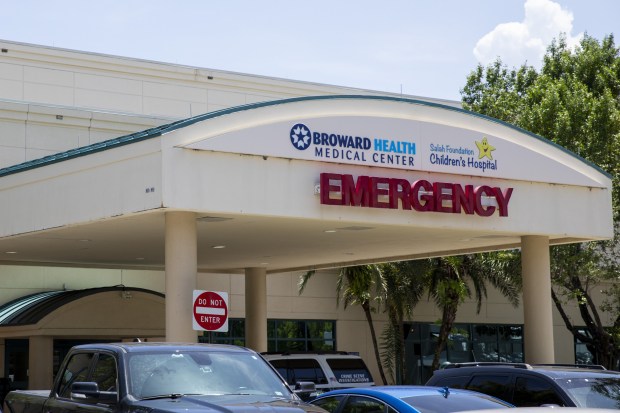
Chris Day / South Florida Sun Sentinel
Broward Health Medical Center in Fort Lauderdale, still referred to as “Broward General” by long-time residents.
By contrast, Florida Blue coverage stopped nine months ago at Broward Health and seven months ago at Memorial. Active bargaining appears to have come to a standstill.
Further, a potential conflict of interest needs to be addressed.
There’s no legal merger between Broward Health and Memorial, but they currently share the same CEO, Shane Strum, and as of last November, they share a new insurance company. As negotiations with Blue remained stalled that month, a subsidiary of the two hospital districts launched 22 Health.
22 Health offers coverage under the Affordable Care Act marketplace. Florida Blue offers marketplace coverage, too. That means Florida Blue is negotiating rates with the same hospital districts whose insurance company can compete with it for policyholders.
Talk straight to taxpayers
Equally troubling, Florida Blue has stated that agreeing to payment hikes requested by the two districts would lead to higher premiums for its policyholders. Such premium hikes could also lead those Florida Blue clients to look for other insurance — including insurance from 22 Health.
If competing for business with commercial insurance companies is an acceptable practice for state-created nonprofit hospital districts, then the state should make that clear to the Broward taxpayers who by law support them. If it is not acceptable, the state should make that clear, too.
State intervention in this dispute would be a Band-Aid, not a cure-all. But it could temporarily do what the two public, safety-net health systems and the insurer are not doing, which is ensuring that Broward children get the doctors and hospital care they need, when they need it. The people of Broward County deserve help.
The Sun Sentinel Editorial Board consists of Opinion Editor Steve Bousquet, Deputy Opinion Editor Dan Sweeney, editorial writers Pat Beall and Martin Dyckman, and Executive Editor Gretchen Day-Bryant. To contact us, email at letters@sun-sentinel.com.