
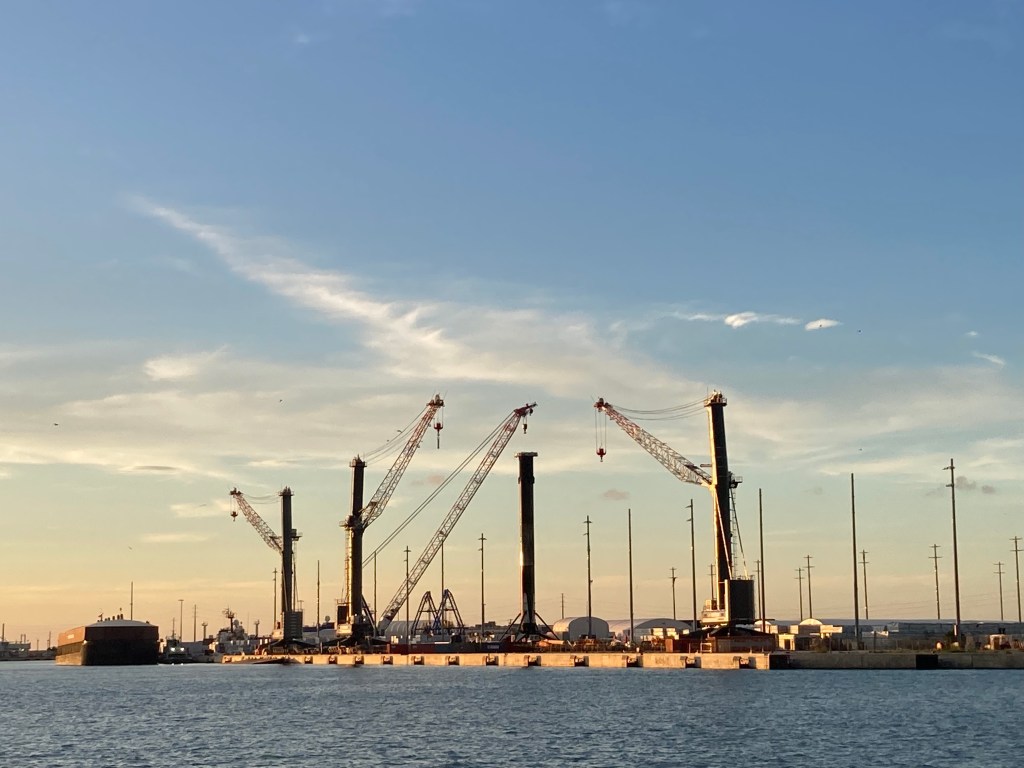
Port Canaveral officials celebrated record revenue this week after running through its fiscal year numbers, but President Donald Trump’s tariffs cost the port more than $800,000 that wasn’t in the planned budget.
The port’s new mobile harbor crane, as well as a passenger boarding bridge, were among 2025’s capital projects that cost the port more nearly $10 million combined, which then were subject to a 10% tariff.
Port officials rounded up the cost — $819,401 — when discussing the extra costs at Wednesday’s port authority commission meeting.
“We actually had two different payments for two different pieces of equipment that we received from Europe,” said port Chief Financial Officer Jeff Long. “Those two tariff amounts approximated a million dollars that we had to pay, that we had not planned on doing.”
That cost was shelled out from the capital budget, and did not affect the operating revenue or expenses. It will be absorbed across several years of budgets as a depreciation expense on the hardware, he said.
The crane was manufactured by Liebherr in Germany and was brought on to assist with the port’s burgeoning space industry support. The port paid $8,059,875 for the hardware, which brought on a $731,306 tariff.
“We have a third mobile harbor crane, fully deployed, performed its first vessel lift operation just last week, which was great to have that crane up and running,” said port CEO Capt. John Murray.
In fiscal 2025, the port unloaded 90 SpaceX boosters and 194 fairing (or nosecone) halves, with more recovery operations expected in the coming years.
The mobile passenger boarding bridge, which can be deployed to any of the port’s six cruise terminals and is needed when existing boarding bridges need repair, came from Spanish manufacturer Thyssen Krupp at a cost of $1,693,135, which added a $88,095 tariff.
The check could have been less had the goods been delivered before Aug. 1 when the 10% European tariffs kicked in.
“So it does impact expense, but it is spread out,” Long said. “But obviously it does impact, day one, our cash, because we had to pay that million dollars.”
“It’s a big check,” commented commissioner Kevin Markey.
Port officials, though, did confirm they have filed a protest form to seek reimbursement of the tariffs from U.S. Customs and Border Protection, but that’s an ongoing effort.
As for good money news, the port saw a record $218.4 million in operating revenue for fiscal 2025, which ran from Oct. 1, 2024 through Sept. 30, 2025, according to unaudited results presented Wednesday.
That was driven by a record 1,038 cruise ship calls to the port that brought the port 8.6 million passenger movements, which includes both getting on and off the ships. That’s up from 910 ship calls in fiscal 2024 which brought nearly 7.6 million passengers. The numbers make Port Canaveral the second busiest port in the world behind PortMiami.
Total cruise revenue, including a lucrative bump from increased parking, topped $181.9 million, exceeding the budget by $6.5 million.
Cargo revenue for the year topped $24.5 million, up $584,000 from 2024, coming from 558 cargo calls and more than 6.1 million tons moved.
Lease revenues topped $4.9 million while recreation revenue, mostly from Jetty Park fees, topped $4 million.
Operating expenses hit $135.8 million, which subtracted from revenue led to $82.6 million in operating income. Nonoperating revenue and expenses left the port with a net position of $80.7 million, which was $10.6 million over the 2025 budget.
That’s a 37% operating income margin compared to the operating revenue, Long said.
“Put another way, for every dollar of operating revenue that we bring in, 37 cents is basically profit or income,” he said. “So that allows us to invest further into the port, in people, facilities, operational capabilities, to make sure that we have a future sustained growth of revenue here at the port.”
Originally Published: October 23, 2025 at 6:00 AM EDT