
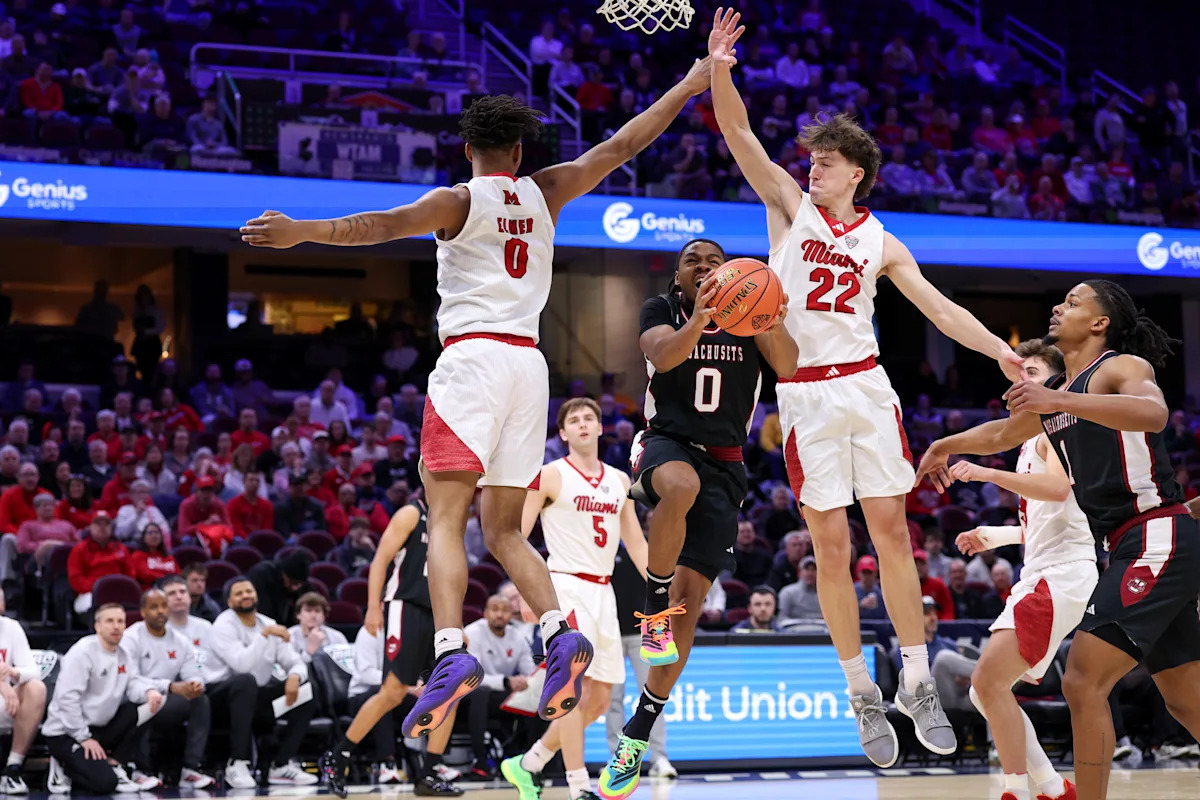
Three letters are going to save Miami (Ohio) when the selection committee sits down to discuss the RedHawks’ NCAA tournament worthiness.
WAB is the reason that Miami likely will still get its Cinderella opportunity even after squandering its perfect season against unheralded UMass in the quarterfinals of the Mid-American Conference tournament on Thursday afternoon.
Advertisement
What is WAB? It stands for Wins Above Bubble, a résumé-based metric that measures a team’s total number of victories compared to how many wins the average bubble team would be expected to rack up against the same schedule. It has quickly become the selection committee’s favorite tool to objectively compare the achievements of teams that played vastly different strengths of schedules.
That metric is critical to evaluating a Miami team that will enter Selection Sunday with a gaudy 31-1 record but a résumé unlike any previous NCAA tournament at-large team. The RedHawks piled up those wins against a tissue-soft schedule that included three NAIA foes and a handful of other non-league games against the dregs of Division I. Their lone top-100 victory came at home against Akron in January. Their next-most impressive result is an early-season road win at a Wright State team ranked 134th in the NET rankings.
Most predictive metrics scream what Bruce Pearl famously screamed earlier this month — that Miami is not the quality of other contenders for at-large bids. The RedHawks fell to 87th in Bart Torvik’s rankings and 93rd in KenPom on Thursday after their 87-83 loss to UMass. No team with KenPom ratings as low as those has ever earned an at-large bid.
WAB evaluates Miami differently, as do other résumé-based metrics. The RedHawks fell only to 33rd in WAB after their loss, tucked right among NCAA tournament-bound UCLA (32), Utah State (34) and Ohio State (35).
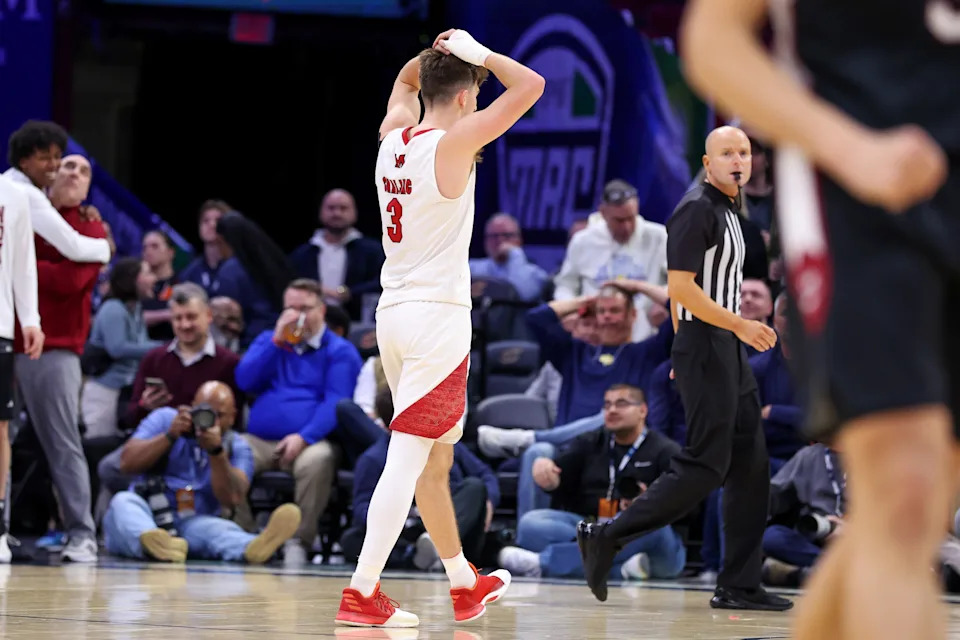
Miami (Ohio) went undefeated throughout the regular season before falling to UMass in the MAC tournament quarterfinal. (Frank Jansky/Icon Sportswire via Getty Images)
(Icon Sportswire via Getty Images)
Other bubble teams with many more marquee wins but many, many more losses trail behind Miami in the WAB rankings. Auburn checks in 44th, followed by SMU and Texas. Indiana (51), Oklahoma (53) and Stanford (56) are even further behind.
Advertisement
When asked by reporters last month which of the seven metrics on the team sheets used by the selection committee are most important, NCAA vice president of men’s basketball Dan Gavitt went out of his way to highlight WAB, “especially when it comes to selecting teams.” Gavitt said that the selection of last year’s final at-large teams was more highly correlated to WAB than it was to any other metric.
“WAB certainly has grown in importance in the last several years,” NCAA media coordinator for March Madness David Worlock told Yahoo Sports. “While the NET and some of the other predictive metrics are certainly helpful for the seeding process and for giving an idea of the general strength of teams, WAB actually answers the question: ‘What have you accomplished?’ That’s essential to the selection process.”
Had Miami managed to hold onto a late 10-point lead against UMass in the MAC quarterfinals, the RedHawks would still be in control of their own NCAA tournament destiny. They needed to win only three games in three days at the MAC tournament to claim the league’s automatic NCAA tournament bid.
Miami instead gave up 23 second-chance points and committed some costly late turnovers en route to a damaging loss to the MAC tournament’s No. 8 seed. UMass entered play Thursday with a 16-15 record and only two victories all season against top-200 KenPom opponents.
Advertisement
“Offensive rebounding absolutely killed us,” Miami coach Travis Steele said.
When asked if he thought Miami had done enough be included in March Madness, Steele said, “Man, I’d be very, very surprised if we’re not.”
“Our guys have earned the right, in my opinion, to play in the NCAA tournament,” he added.
One factor that will complicate the NCAA tournament selection committee’s evaluation of Miami is that the RedHawks did not play the nation’s 364th-ranked non-league schedule by choice. Few highly ranked opponents wanted to play a sneaky-good mid-major that won 25 games the previous season and retained six of its top nine players.
Advertisement
Associate head coach Jonathan Holmes spread word last spring that Miami was willing to travel to two or more power-conference opponents with no expectation of a future return game in Oxford. Coaches who responded to Holmes’ messages told him they wanted only marquee matchups against top-tier opponents or low-risk games against small-conference pushovers ranked 275th or worse.
The feedback was similar when Holmes lowered his sights and began targeting elite teams from the Atlantic 10, Mountain West and other top mid-major leagues. Some coaches saw no benefit in scheduling Miami. Others didn’t have open dates available. The few who initially expressed interest got cold feet when Holmes sent contracts for them to sign.
Advertisement
By the end of the summer, Holmes became desperate enough to call some of his best friends in the business and beg them, “C’mon, man! Do me a solid! Help us out!” They each apologetically told Holmes that they couldn’t help him because Miami was exactly the type of opponent they sought to avoid, projected to finish outside the top 100 nationally yet plenty dangerous enough to dish out a damaging loss.
“I was told no by probably 75 to 90 teams, from obviously all your power conferences, to your A-10s, to your Mountain Wests,” Holmes told Yahoo Sports earlier this month. “I guess you could say we were in scheduling no man’s land. We didn’t fit the profile of what anyone was looking for.”
Will that matter to committee members? It should at least matter enough for them not to penalize Miami for playing nobodies in non-league play.
The bigger factor will be Miami’s strong WAB.
That’s the metric that might turn out to be the RedHawks’ savior.