
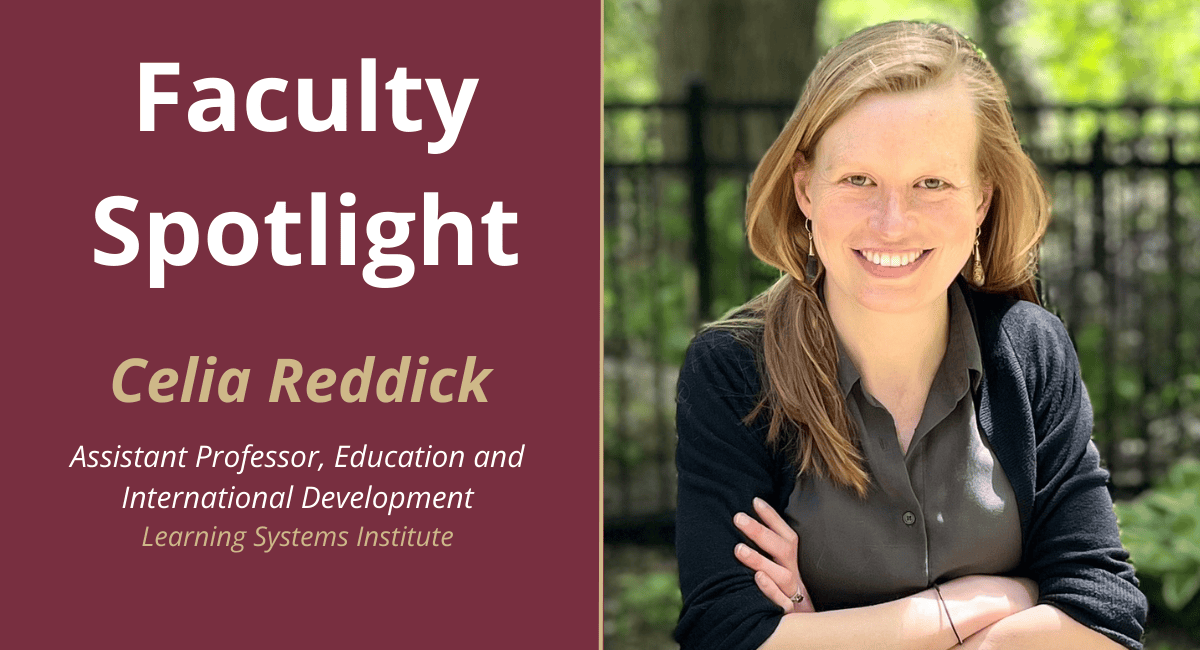
“Florida State has been so great and such a wonderful place to do this,” Reddick added. “I have the good fortune of being based at the Learning Systems Institute, as well as in the Educational Leadership and Policy Studies Department. This means I have two worlds of colleagues. I’m fortunate in that way.”
Reddick and her colleagues recently worked together on a seed grant funded by LSI to perform transformational work with resettled refugees in the U.S. She recently received a grant through the Jacobs CIFAR Research Fellowship to conduct comparative work in Colombia, Uganda and Germany.
Wherever her work takes her, the value of education is widely recognized.
“What I heard over and over again in Kampala, Uganda, was families saying the education that kids were getting was their investment in the future,” Reddick said. “That after displacement, their educational opportunities were the path forward for these kids. And I’m hearing that from kids here in the U.S.”
Those comments reinforce the belief of many refugee families that economic stability and opportunity are claimed through classroom learning. As someone who examines the work of teachers, families and international organizations to help create these opportunities, Reddick assists with projects that make a positive impact for refugees.
“It’s gratifying to feel that you might be making small, incremental progress, but the truth is, I’m learning so much as we go that it feels like it’s a collaborative process,” Reddick said. “It’s not me thinking of something that’s used, it’s us creating and learning together, and that’s been the real work.
“It’s very humbling being in classrooms where there are 10 languages represented, the teachers speak multiple languages and everyone is making it work.”
Through her research at FSU, Reddick is ensuring that education remains not just a system, but a source of dignity, belonging and hope for displaced students worldwide.