
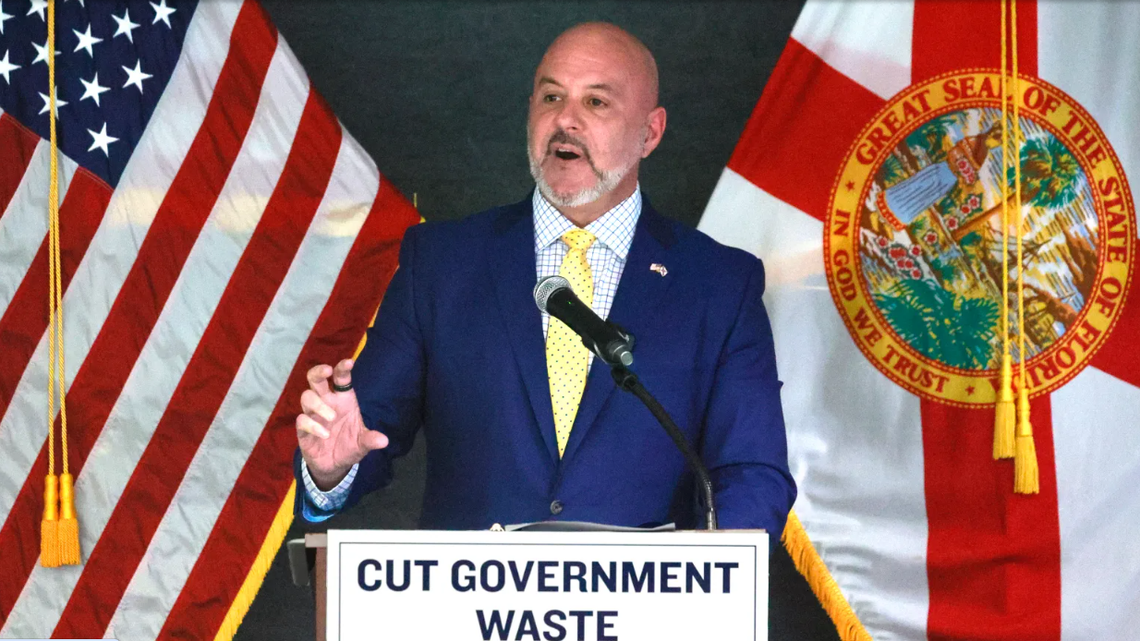
Florida Chief Financial Officer Blaise Ingoglia speaks during a news conference on Tuesday, Sept. 30, 2025, at Keiser University in Pembroke Pines. He was discussing property taxes, government accountability and wasteful spending.
Mike Stocker/South Florida Sun Sentinel
Reality Check is a Herald series holding those in power to account and shining a light on their decisions. Have a suggestion for a future story? Email our journalists at tips@miamiherald.com.
If Florida voters approve big cuts in property taxes, that would mean a sharp drop in revenue that Miami-Dade counts on to fund public safety, transportation and the county hospital system.
Of the $3.2 billion in property taxes allocated in Miami-Dade County’s 2026 budget, about 68 cents of every dollar goes to five expenses: Fire Rescue, the Sheriff’s Office, jails, Jackson Health and transportation, according to a Miami Herald analysis of budget data.
As the Florida Legislature considers a special session focused on the kind of sweeping statewide tax-cut proposal that Gov. Ron DeSantis wants, local governments are warning they wouldn’t have enough money to fully fund key services and programs. Legislation that passed the Florida House earlier this month would end non-school property taxes on primary residences — a change Miami-Dade estimates would cut property-tax revenue by about 28%, a reduction of about $900 million in local tax bills.
“It will be the ‘Hunger Games’ in the community,” said Miami-Dade County Commissioner Vicki Lopez, who led a committee on property taxes last year when she was a Republican member of the Florida House. “There will be a diminishing pot of revenue, and everyone will be coming for it. It really is a little frightening.”
Backers of historic cuts in property taxes for Florida homeowners call those kinds of predictions alarmist and say a drop in tax revenue will force local governments to cut back on high salaries, excessive hiring and frivolous spending.
“Big government apologists are coming out of the woodwork trying to make excuses for a lot of the spending that you will see,” Florida Chief Financial Officer Blaise Ingoglia said last year in Pembroke Pines while barnstorming for tax relief for homeowners. “They’re going to be saying things like, ‘Well, if we cut, we’re going to have to cut fire and police, right?’ That is just nonsense.”
Grim predictions on the consequences of a tax cut also operate under the premise that local governments would not take any steps to raise new revenue. That could include increasing tax rates on properties not covered by a new state ban — such as apartment buildings and commercial facilities — or raising the 7% sales tax paid by local residents and tourists.
Miami-Dade Commissioner Kionne McGhee, a Democrat and former member of the Florida House, supports ending property taxes on primary residences. He said a higher sales-tax rate would be more fair by shifting the budget’s current outsized reliance on homeowners.
“Everybody would be contributing to the jails and to our sheriff — not just property owners,” McGhee said.
Will Tallahassee send a tax-cut proposal to Florida voters in November?
For now, any scenarios involving tax relief remain hypothetical. While the House on March 5 passed legislation that would ask Florida voters to eliminate property taxes on primary residences, the Senate has so far been cool to that idea. The 2026 legislative session is set to end Friday, leaving any tax-cut referendum legislation to a special session that might be called in the coming weeks.
No matter what the Legislature passes, the measure would still need to get 60% of the vote at the ballot box in November — the threshold needed to amend Florida’s Constitution.
Various proposals working their way through the Legislature would give voters the chance to force cuts in the taxes that homeowners pay to local governments. None would impact school budgets, but instead would impose cuts on the portions of a homeowner’s property-tax bill that funds city and county governments.
Even if the steep tax reduction backed by the House doesn’t make it to voters this fall, some sort of option for lower tax bills could make it out of the Republican-controlled legislature and onto the 2026 ballot.
Take a look at how Miami-Dade spends property tax dollars
What could that mean in Miami-Dade? Even though property taxes are the top source of revenue for the county’s core services, the annual budget doesn’t give department-by-department breakdowns of how that revenue is spent.
The Herald’s analysis provides a rough version of that missing breakdown.
Of the $3.2 billion in property taxes that Miami-Dade uses to fund departments and miscellaneous expenses, about 75 cents of every dollar goes into a pair of “general” funds that are a primary source of revenue throughout the county’s budget.
One general fund covers $2.8 billion in countywide expenses, and roughly 80% of the money in that fund comes from a countywide property tax.
Another general fund covers a limited set of expenses related to services that Miami-Dade provides to neighborhoods in the county’s unincorporated areas, outside of city limits. The unincorporated fund relies more on sales-tax dollars and less on property taxes, which make up about 35% of its $730 million in annual revenue.
To estimate the property tax dollars that are allocated to each county department in the 2026 budget, the Herald looked at how much money the departments received from the two funds and calculated how much of that money came from property taxes.
Fire Rescue and the public library system, meanwhile, rely on their own voter-approved property taxes, which provided about $660 million for Fire Rescue and $122 million for the library system in 2026. Fire Rescue also gets about $41 million this year from the countywide property tax.
The Herald analysis found:
Fifty cents of every dollar in property tax that Miami-Dade collects goes to three public safety agencies: Fire Rescue, Sheriff and Corrections, which runs the county’s jail system. Jackson Health, the county’s public hospital system, is the fourth-largest spender of property tax dollars in the budget, receiving $282 million. Transportation, a spending category that includes the transit system, traffic lights, sidewalks and Miami-Dade’s support of the Tri-Rail commuter train network, is budgeted to spend $267 million in property taxes this year. Community redevelopment agencies — offices authorized to spend property taxes within a neighborhood to end slum and blight — receive more property taxes than what goes to the county parks system. The agencies, known as “CRAs,” are budgeted at $89 million in county property taxes this year, according to the Herald calculations. The parks system is budgeted at $72 million.Shielding public safety agencies from voter-imposed cuts may get complicated. The House legislation includes a provision barring local governments from cutting current budgets for public safety agencies, even if voters approve cuts in the property-tax dollars that fund them. In Miami-Dade, the Sheriff’s Office currently receives about $183 million in property taxes from the county’s unincorporated general fund. But a county analysis in November estimated that ending property taxes on homestead properties would reduce that fund by $95 million, leaving about $151 million in property taxes from unincorporated areas to divvy out to county departments. That means that even if all of the property-tax money in the unincorporated general fund went to the Sheriff’s Office, the county would still need to find a way to raise the $32 million necessary to keep the department’s funding steady at $183 million from that fund.
Follow More of Our Reporting on Reality Check