
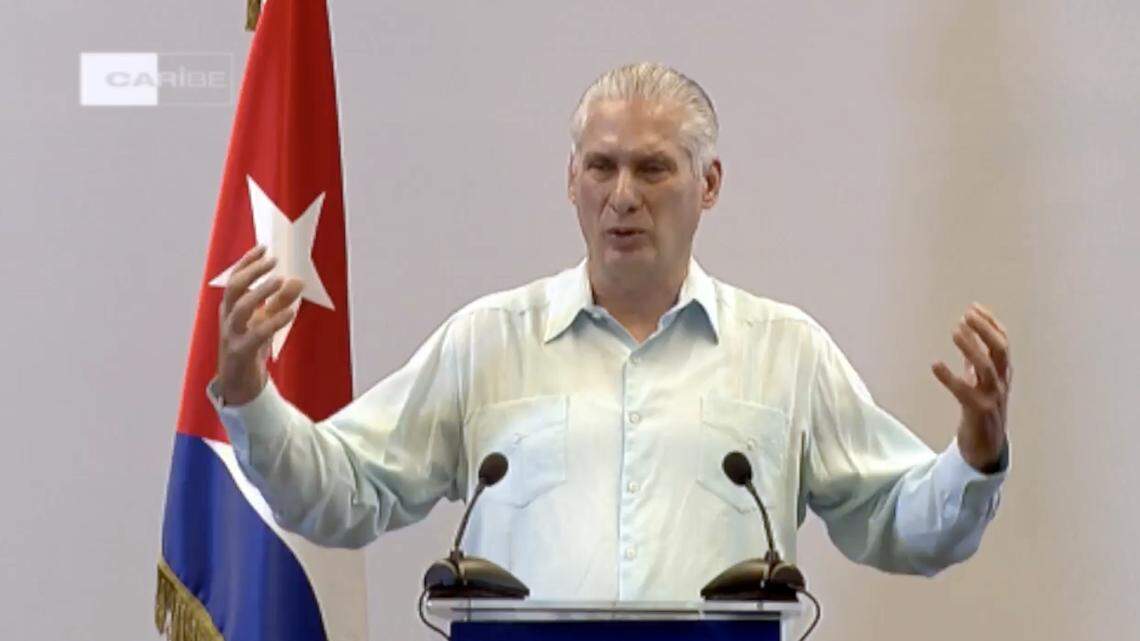

Cuban leader Miguel Díaz-Canel confirms talks with the Trump administration during a televised press conference in Havana on March 13, 2026.
Caribe TV, Cuba
Cuba’s leader Miguel Díaz-Canel said Friday his government is engaged in talks with the United States, confirming earlier reporting by the Miami Herald about the contacts.
In footage of a government meeting aired on state television early morning, he said Cuban officials have recently held talks with representatives of the United States government.
“These talks have been aimed at finding solutions through dialogue to the bilateral differences between our two nations. International factors have facilitated these exchanges,” he said. Crucially, he added, the exchanges have aimed to moved away from confrontation.
During a press conference carried on national TV Friday morning, Diaz-Canel described the conversations with the Trum,p administration as sensitive, discreet and in “the first phases.”
He said that the purpose of the conversations is to determine the problems the countries share, come up with potential solutions, and figure out whether there is the will to solve them to the benefit of both countries. He told reporters it wasn’t the first time that the two countries engaged in dialogue with international support, pointing to negotiations with the Obama administration from 2014-16.
“Cuban officials recently held talks with representatives of the United States government to seek, through dialogue, a possible solution to the bilateral differences between our two nations” he said. “This implies finding areas of cooperation with which we can face threats and guarantee peace and security in both our country and region.”
He spoke at length about the impact of what he called the oil “blockade” the U.S. has imposed on Cuba, especially on the “tens of thousands of surgeries” that have not been able to be performed.
In recent weeks, President Donald Trump has said repeatedly that his administration has been in contact with people in Cuba. He has urged the Cuban government to make “a deal” with the United States after he moved to cut off oil supplies from Venezuela and Mexico to Cuba as leverage to pressure Cuban leaders to negotiate. Trump said recently Cuba was about to “fall” and that Cuban leaders were eager to make an agreement.
The purpose of the talks, Diaz-Canel said, “is, first, to identify the bilateral problems that require solutions based on their severity and impact, and second, to find solutions to these identified problems. Furthermore, the talks aim to determine the willingness of both sides to take concrete actions for the benefit of the people of both countries. And, in addition, they seek to identify areas of cooperation to confront threats and guarantee the security and peace of both nations, as well as in the region where we live and work, which is the Latin American and Caribbean region.”
The Miami Herald reported that Secretary of State Marco Rubio’s advisers met with Raúl Castro’s grandson, Raúl Guillermo Rodriguez Castro, in Saint Kitts last month and that representatives from both governments were expected to meet later also in Saint Kitts.
U.S. Rep. Mario Díaz-Balart told the Miami Herald that the Trump administration has been having conversations with several people in Raúl Castro’s close circle, similar to discussions held with Venezuela’s strongman Nicolás Maduro before he was captured in a military raid earlier this year.
But this is the first time the Cuban government has acknowledged the high-level discussions.
“It is important to remember that it has not been, nor is it now, the practice of the leadership of the Cuban Revolution to respond to speculative campaigns on these types of issues,” Diaz-Canel said. “This is an issue that is unfolding as part of a very sensitive process, conducted with seriousness and responsibility because it affects bilateral relations between the two nations. It demands enormous and arduous efforts to find a solution and create spaces for understanding that will allow us to move forward and distance ourselves from confrontation in the exchanges that have taken place.”
“We have expressed—that is, the Cuban side has expressed—the willingness to carry out this process on the basis of equality and respect for the political systems of both states, for the sovereignty and self-determination of our government,” Díaz-Canel said.
This is a breaking story and will be updated.
This story was originally published March 13, 2026 at 7:34 AM.
el Nuevo Herald
Nora Gámez Torres is the Cuba/U.S.-Latin American policy reporter for el Nuevo Herald and the Miami Herald. She studied journalism and media and communications in Havana and London. She holds a Ph.D. in sociology from City, University of London. Her work has won awards by the Florida Society of News Editors and the Society for Professional Journalists.//Nora Gámez Torres estudió periodismo y comunicación en La Habana y Londres. Tiene un doctorado en sociología y desde el 2014 cubre temas cubanos para el Nuevo Herald y el Miami Herald. También reporta sobre la política de Estados Unidos hacia América Latina. Su trabajo ha sido reconocido con premios de Florida Society of News Editors y Society for Profesional Journalists.