
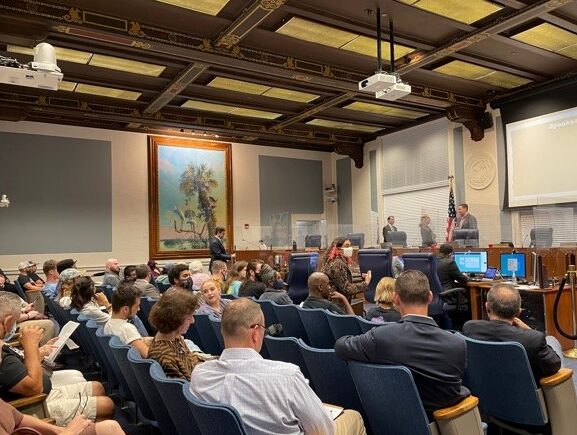
Dozens of speakers packed St. Pete City Hall in December 2021 to address concerns for renters. Credit: Arielle Stevenson/WMNF News
Listen:
On Tuesday, they hosted the first of three community feedback meetings via zoom. These meetings will inform the Housing and Urban Development consolidated plan.
The consolidated plan sets the housing, economic and social service priorities for the next five years. In it, officials also provide a detailed timeline and cost of projects serving said priorities.
Hillsborough County receives an estimated $54 million in federal grant money to pay for projects like affordable apartments, career-development programs, local business incentives, and more.
During the Tuesday meeting, community members said the three top issues for the county should be affordable housing, transportation and childcare.
“For those of us that are now considered elderly, a lot of us are spending almost half our income just on housing and utilities,” said Ybor resident Glenn Brown.
The Shimberg Center for Housing Studies in the University of Florida found Hillsborough County added nearly 27,000 rental units between 2012 and 2021. However, during that same time, the county lost about 36,000 units where rent was at $1000 or below.
The same report found about 222,303 households in the county were “cost-burdened,” meaning they were paying more than 30% of income for owner or renter costs.
Another big issues were food deserts around east Tampa, these refer to big areas with limited or no access to grocery stores or food pantries.
“There was not a single grocery store between downtown and Fletcher Avenue that could be seen from Florida Avenue,” said Lesa Weikel from the Tampa Hillsborough Homeless Initiative. Other residents claimed they were seeing neighbors rely on convenience stores for groceries.
The priorities are not separate issues from each other
Residents argued the rising costs of rent and utilities were leading to an increase in homeless people -especially for the most vulnerable.
According to Weikel, the Tampa Hillsborough Homeless Initiative has been seeing an increase in “of elderly persons ending up homeless and not getting beyond that at-risk status.”
Others claimed the lack of transportation hindered their ability to work and find accessible childcare locations.
“Many people either cannot afford a vehicle or cannot afford to mantain a vehicle,” resident Maggie Sanchez said. “And the bus system here could use a lot of improvement as far as timing and routes. If they want to find a good job it would take them a considerable length of time to get to and from work using the bus system here.”
Overall, the meeting also called on the unequal distribution of services between neighborhoods. Brown called on the disparity of infrastructures, saying “there are parts of East Tampa where the sidewalks and pathways are missing and there are parts of the county where there aren’t any at all.
To address these inequalities, the county is also developing a Neighborhood Revitalization Strategy Area Plan (NRSA). The plan would target small low-income areas for guided programs to strengthen housing and economic stability, improve community services and better coordinate public and private resources.
They are also asking for public input regarding the NRSA.
What are the next steps?
The consolidated plan is far from done. On April 1. and April 7. two other community feedback meetings will take place.
To attend the meetings, find more information at HUD Consolidated Plan 2026 | Hillsborough County, FL
You can also fill out their assessment surveys: