
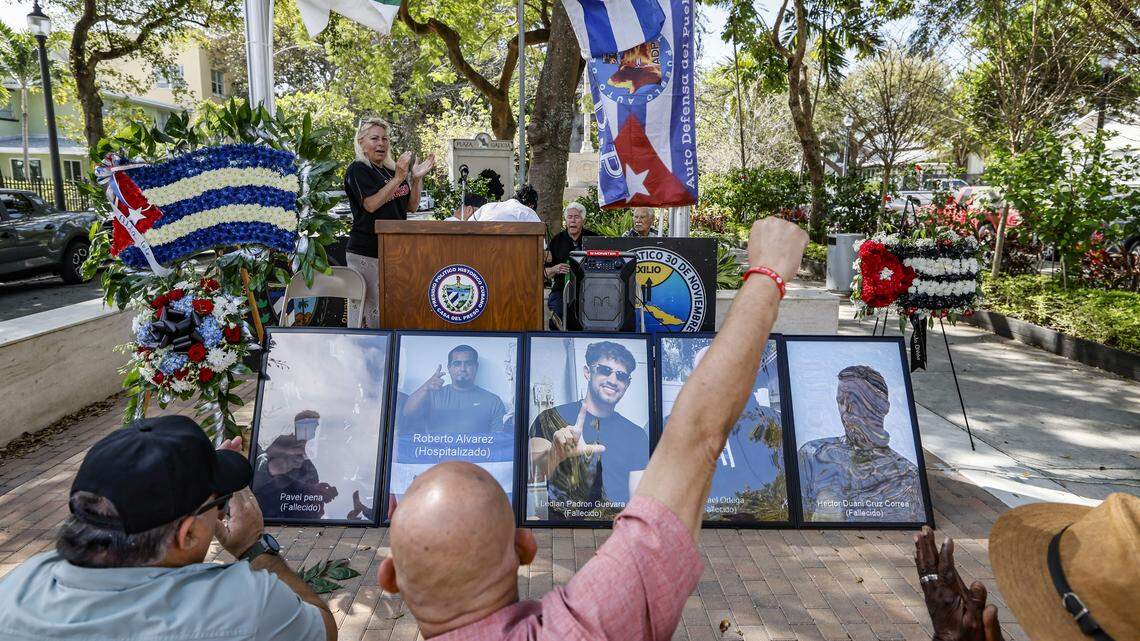
Maritza Lugo Fernandez speaks to supporters during a Proof of Life of Our Brothers ceremony at the Bay of Pigs Monument in Miami’s Little Havana neighborhood. Cuban dissident groups held a press conference to demand repatriation of the bodies of the men killed in the shootout with the Cuban Coast Guard on Sunday, March 8, 2026.
PHOTO BY AL DIAZ
adiaz@miamiherald.com
As the Cuban government engages in negotiations with the Trump administration, the city of Miami said it anticipates potential “mass migration” and is prepared for large-scale celebrations “in the event of a significant change in the government of Cuba.”
On Thursday, Miami City Manager James Reyes told city commissioners that Miami’s fire and police chiefs have recently updated plans relating “to the challenges presented with the politics surrounding Cuba and the impacts here in the city of Miami.”
At the commission meeting, Reyes said that earlier this year, he instructed those agencies to “refresh” their action plans in light of “the politics currently playing out in Cuba, particularly on two fronts.”
“One is obviously the mass migration front,” Reyes continued. “The other one is what we can expect, a lot of celebration and mass demonstrations here within the city.”
Reforms to Cuba’s government would be significant in Miami-Dade County, which is home to the largest Cuban diaspora in the world.
Depending on how things unfold, Reyes said the city of Miami is part of a task force that has partners in county, state and federal law enforcement to assist “particularly on the migration front.”
Speaking at that same meeting Thursday, Orlando Gutierrez-Boronat of the Assembly of the Cuban Resistance told the City Commission that “Cuba is on the cusp of change.”
“Preparedness is essential,” Gutierrez-Boronat said. “As we learned from history, what happens in Cuba deeply affects Miami. What happens in Miami also deeply affects Cuba.”
Miami District 3 Commissioner Rolando Escalona, who moved to the U.S. from Cuba about a decade ago, said in a statement Friday that, “for many in our community, Cuba is not a distant issue.”
“It is personal. It is our story,” Escalona said. “As developments continue to unfold, Miami understands that what happens in Cuba has a direct impact on our city.”
In an internal memo dated Feb. 4, Miami Police Chief Manuel Morales told Reyes the police department has developed a comprehensive action plan “to ensure public safety, maintain order, and protect constitutional rights in the event of a significant change in the government of Cuba.”
“Based on historical precedent and current intelligence indicators, such an announcement is expected to generate immediate, large-scale spontaneous celebrations throughout the City of Miami, particularly within the Cuban American community,” Morales continued.
Morales said Miami police anticipate “spontaneous gatherings, marches, rallies, and vehicle caravans concentrated in high-visibility and historically significant areas” like Little Havana, specifically Calle Ocho, downtown, Brickell and Bayfront Park.
“While the anticipated gatherings are celebratory in nature, the scale and spontaneity of the response present risks related to crowd density, traffic congestion, impaired driving, fireworks, and opportunistic criminal activity,” Morales wrote.
What about the Florida Keys?
Monroe County Sheriff Rick Ramsay said he doesn’t anticipate an ease in U.S.-Cuba relations to have much of a law-enforcement impact in the Keys, which is where the fallout for unrest in the island nation is often first felt in Florida in the form of migrant landings.
That’s because unlike other times when there were shake-ups in Cuba and citizens wanted to leave, the Trump administration has blockaded the country by water and tightened security at the U.S.-Mexico border, Ramsay said.
“If they could do some sort of mass migration, they’d be doing it now because the economy there is so bad,” Ramsay said. “But they can’t because of what I call the picket fence from the Coast Guard vessels and other agencies, and if they got caught after they arrived here, they know they’ll be deported right away.”
This story was originally published March 13, 2026 at 12:10 PM.
Miami Herald
David Goodhue covers the Florida Keys and South Florida for FLKeysNews.com and the Miami Herald. Before joining the Herald, he covered Congress, the Environmental Protection Agency and the Department of Energy in Washington, D.C. He is a graduate of the University of Delaware.
.jpg)
Tess Riski covers Miami City Hall. She joined the Miami Herald in 2022 and has covered local politics throughout Miami-Dade County. She is a graduate of Columbia Journalism School’s Toni Stabile Center for Investigative Journalism.