
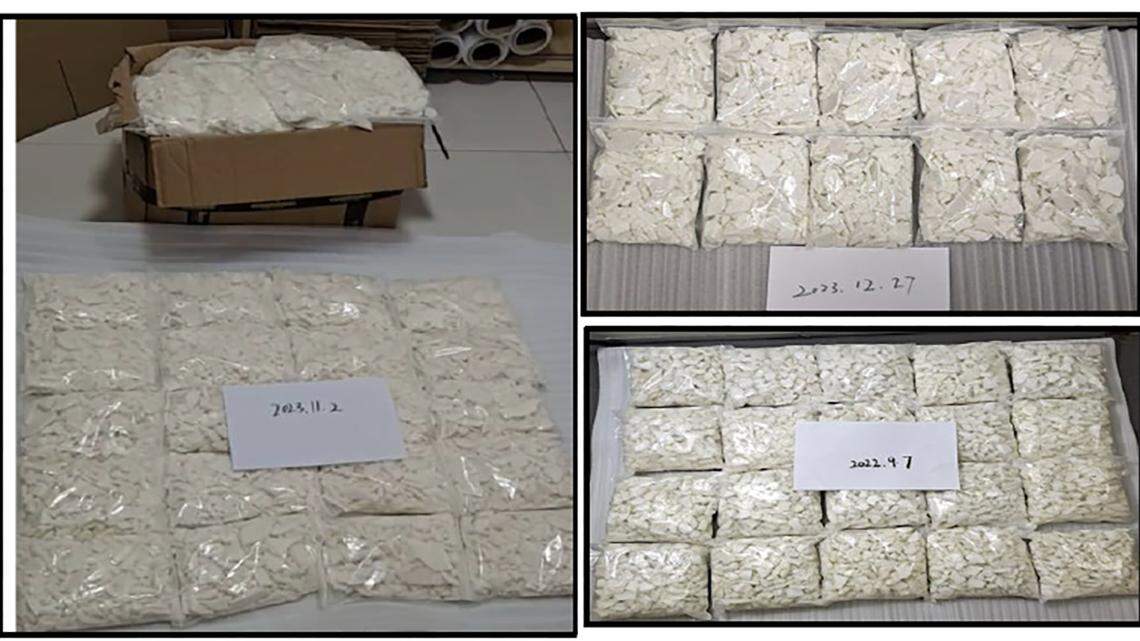
U.S. and Chinese authorities collaborated on an investigation that led to the seizure of 700 kilos (1,540 pounds) of the recreational stimulant drug known as ‘bath salts’ in China last year.
U.S. Attorney’s Office for the Southern District of Florida
A Miami-area man used the U.S. Postal Service for years to smuggle a designer drug known as “bath salts” into the United States, the latest federal case that authorities say highlights the illicit-narcotics pipeline between China and South Florida.
Terrell Jermaine Williams, 40, of Homestead, plead guilty on Wednesday in Miami federal court to conspiring with a Chinese supplier to import N-Isopropyl Butylone into the United States and conspiring to possess with intent to distribute N-Isopropyl Butylone — a recreational stimulant drug with unpredictable potency.
A factual statement filed with his plea agreement showed that Williams imported a steady supply of bath salts, which contain N-Isopropyl Butylone, and other designer drugs from his Chinese supplier since 2022, according to federal prosecutor Monique Botero.
Williams became the target of a federal probe a year ago when U.S. Customs officers intercepted a package of about 1,020 grams (2.2 pounds) of bath salts that were mailed from the Chinese supplier via the China Post to his Homestead residence. Federal agents put a tracker on the package and followed its delivery to his home, where he opened the shipment and was arrested.
“This defendant worked with a supplier overseas to bring a dangerous synthetic drug into South Florida and profit from its distribution,” Miami-based U.S. Attorney Jason A. Reding Quiñones said in a statement. “Synthetic cathinones — often referred to on the street as ‘bath salts’ or ‘flakka’ — are powerful and unpredictable stimulants that pose a serious threat to public safety.”
In his plea deal, Williams admitted that he communicated with the Chinese distributor through a messaging platform. In one message in November 2023, the distributor encouraged Williams to stock up on the substance before it was banned so he could charge higher prices when it became unavailable to others.
In another conversation in April 2024, the distributor warned Williams, “its election year there, they check more frequently than before, you know firearms and drugs from china.”
The Williams’ investigation stretched to China, where Homeland Security Investigations has an office in Guangzhou. There, HSI agents collaborated with Chinese authorities on a parallel probe.
In September 2025, China’s Anti-Smuggling Bureau and other regulatory agencies seized about 700 kilos (1,540 pounds) of N-Isopropyl Butylone that was believed to be destined for the United States, according to federal prosecutors.
At the time of the seizure, N-Isopropyl Butylone was not yet a regulated substance in China. Afterward, Chinese authorities determined the substance had no legitimate use and placed it under regulatory control, restricting its production.
Jay Weaver writes about federal crime at the crossroads of South Florida and Latin America. Since joining the Miami Herald in 1999, he’s covered the federal courts nonstop, from Elian Gonzalez’s custody battle to Alex Rodriguez’s steroid abuse. He was part of the Herald teams that won the 2001 and 2022 Pulitzer Prizes for breaking news on Elian’s seizure by federal agents and the collapse of a Surfside condo building killing 98 people. He and three Herald colleagues were 2019 Pulitzer Prize finalists for explanatory reporting on gold smuggling between South America and Miami.