
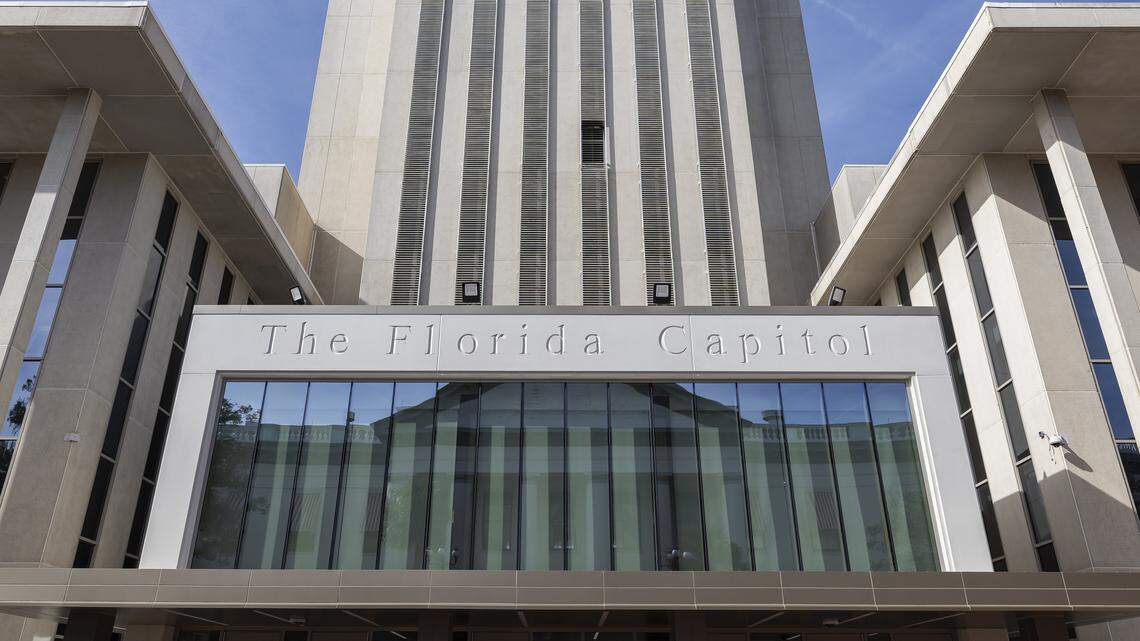
A view of the Florida Capitol before the start of the legislative session on Monday, Jan. 12, 2026, in Tallahassee, Fla.
Photo by Matias J. Ocner
mocner@miamiherald.com
Tallahassee
An emergency fund used by Gov. Ron DeSantis on immigration enforcement efforts that expired in February will be renewed after lawmakers agreed to extend it Friday, the last day of the legislative session.
After the House and Senate battled back and forth for most of the 60-day session, the two chambers struck a deal to extend the fund, but with new rules on how money can be spent.
While the bill (SB 7040) includes reporting requirements, mandating the governor’s office and the Division of Emergency Management to report spending to the Legislature quarterly, the bill’s restrictions on how DeSantis can use the funds were watered down. And the $250 million the Senate included in the bill was also taken out, leaving the funding to future budget talks between the chambers.
Since 2022, the legislature has deposited $4.77 billion into the fund, and currently the balance is around $200 million.
The fund, which expired Feb. 17, was originally created in 2022 to handle hurricane preparation and response and other natural disasters. But DeSantis has spent $573 million for expenses related to immigration enforcement within the last year alone.
That includes the creation and maintenance of two state-run immigration detention facilities, Alligator Alcatraz in south Florida and Deportation Depot in north Florida.
Democratic senators pushed back against the bill, questioning whether the federal government would ever reimburse the state, a promise that officials, including DeSantis, have doubled down on and blasted critics who said otherwise.
The federal government has approved $608 million in reimbursements to Florida for immigration enforcement efforts, including Alligator Alcatraz, but the state hasn’t received the funds.
The original House version of the bill severely limited the state’s ability to spend money and redefined how the money should be used, striking out the word “disaster” and replacing it with “natural emergency,” essentially banning purchases and contracts related to immigration enforcement.
But the sponsor, Rep. Griff Griffiths, R-Panama City Beach, amended the measure last month after criticism from DeSantis’ office and state leaders, including Attorney General James Uthmeier, one of the main architects of Florida’s mass deportation agenda.
The bill now allows for funds to be used for “manmade” and “technological” disasters, but the executive branch needs approval from the Legislative Budget Commission for spending on any spending on emergency declarations extended beyond 60 days. That approval can be waived if the chair and the vice chair agree.
Under state law, a governor can only issue a state of emergency for 60 days at a time. Since 2023, DeSantis has renewed the emergency order on illegal immigration approximately 20 times.
The bill also had a provision requiring any reimbursements by the federal government to go into the state’s main coffers, not back into the emergency fund, and money couldn’t be used on aircraft, boats or motor vehicles.
But the final iteration of the measure allows federal money to be put back into the fund but in a separate account, and allows the executive branch to control that money.
The bill still blocks the state from using money to purchase aircraft, boats or motor vehicles but allows for short-term leases.
According to a report by the DEM, between 2023 and 2025, the state spent over $29 million on property, including helicopter engines, 2,500 cargo vans and trailers for immigration enforcement-related purposes.
The bill extends the fund until July 1, 2028.
This story was originally published March 13, 2026 at 7:09 PM.