
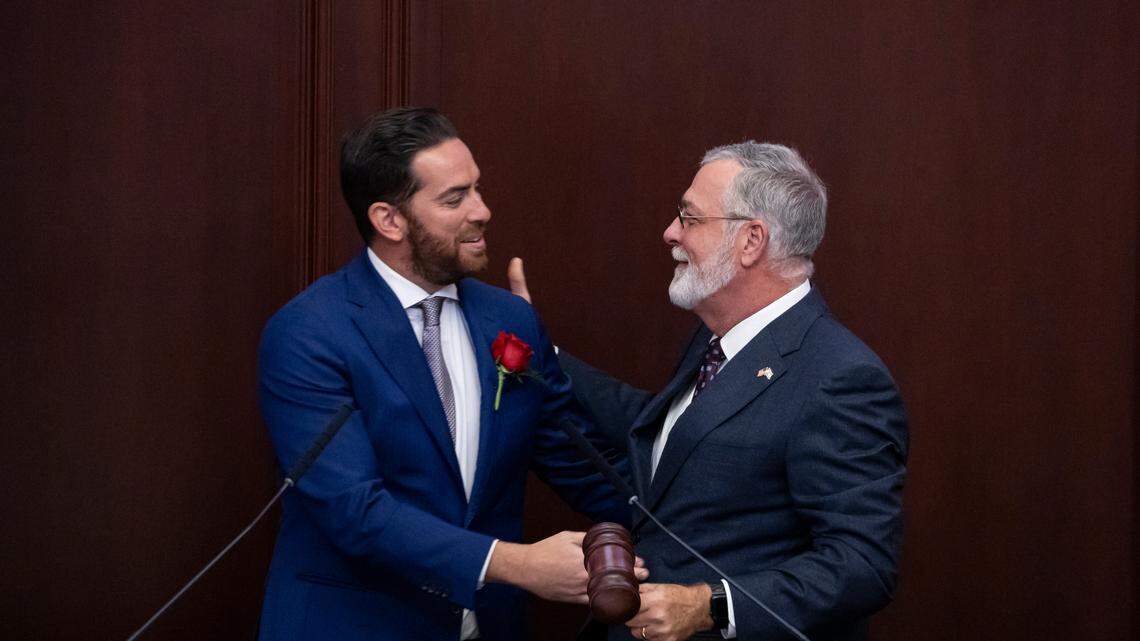
Florida House Speaker Daniel Perez, R-Miami, hands Florida Senate President Ben Albritton, R-Wauchula, the gavel during the first day of the legislative session at the Florida State Capitol on Tuesday, March 4, 2025, in Tallahassee, Fla.
Photo by Matias J. Ocner
mocner@miamiherald.com
TALLAHASSEE
When Florida lawmakers adjourned the regular legislative session Friday, they left Tallahassee with a thin list of accomplishments.
The Republican supermajority watered down consumer protection bills, approved no property tax cuts and did little to improve the cost of living.
And, as happened last year, lawmakers will soon have to drag themselves back to Tallahassee to finish the lone bill they must pass — the budget — before the July 1 deadline.
“There’s no way out,” said longtime Sen. Don Gaetz, a Pensacola Republican. “We’re just playing out the last act of a whimpering story.”
Gov. Ron DeSantis — a Republican seeking to cement his legacy before leaving the Governor’s Mansion — was largely silent about the Legislature’s work during his final session in office.
Rather than applying public pressure on lawmakers to pass his priorities, the governor spent time hopscotching across Florida and the country. He unveiled patriotic statues, made stops in Idaho and Kentucky, and dipped away for a two-day $70,000-per-person golf tournament in California.
Left largely to their own devices, the Legislature’s Republican leaders let high-profile conservative initiatives — including items on DeSantis’ wishlist — fall through. Among them: artificial intelligence regulations, an expansion of vaccine exemptions, Medicaid work requirements and stricter E-Verify rules for businesses.
Still, DeSantis praised lawmakers Friday for some “very productive” legislation, including bills reforming elections, school unions and how local governments can spend their money.
But he chided them for not finishing a budget in time.
“This isn’t rocket science at this point,” DeSantis said. “You just look at what we’ve done for seven years and cut and paste, and you’re probably in a pretty good spot.”
What marks a win?
As Gaetz sees it, the trouble began before the 2026 session started.
Many of the wounds opened by last year’s bitter inter-chamber clashes never fully healed, said Gaetz, a 78-year-old Panhandle Republican and former Senate president with two decades of experience in the Legislature. The lingering animosity, in his view, hamstrung budget talks and the passage of the Legislature’s most consequential proposals.
“The same people with the same grudges have come back to the same place to try to do the same thing — and not very well,” he said.
On the opening day in January, House Speaker Daniel Perez and Senate President Ben Albritton made it clear what roles their respective chambers would play.
Albritton focused mostly on the Senate acting as a stabilizing force, describing it as a patient — if slow-moving — legislative body. The chamber’s goal, he said, was “finding balance.”
The Senate should measure and ask questions,” Albritton said. “It might take more time. In fact, it might take a lot more time, but that’s the design of our form of government and the role of our Senate.
Perez, meanwhile, said he would embrace the turbulence of the prior session, even if it came at the cost of “a little more peace or a little more quiet.”
“We found the voice of this House,” the speaker said about last year’s session, “and we used it with resounding clarity.”
Lawmakers passed around 150 bills during their 60-day regular session, similar to the amount from last year.
Among them is a bill that would give DeSantis’ office the power to designate organizations as terrorist groups. Another would shield records related to those decisions from public view.
Other legislation would prohibit local governments from “diversity, equity, and inclusion” activities, with the threat of removal from office. Another bill would put regulations around data centers, although lawmakers in the final days stripped out some of the language that tech companies found disagreeable.
Lawmakers also approved an elections reform package that would require citizenship verification. They made changes to the state’s domestic violence protection laws and created a licensing path for naturopathic medicine.
They also passed stricter limitations on public sector unions, including teachers, while not addressing other major education issues, such as voucher funding and Schools of Hope taking up space in under-capacity district schools.
A bipartisan group of lawmakers pushed through a stopgap measure to ensure around 12,000 Floridians keep affordable access to their HIV/AIDS medication through the end of the fiscal year.
But some of the most closely-watched issues were left for later this year. Lawmakers will return for a special session April 20 on redistricting that DeSantis called.
As for affordability, which has become a vital issue for voters, lawmakers did little. Some of the bills that did make it to the governor’s desk could make life more expensive for some Floridians.
“We haven’t discussed insurance much the last two years,” said Rep. Jim Mooney, a Republican whose Keys district has the highest homeowners insurance rates in the state. “It’s been a little troubling.”
And while DeSantis hasn’t officially called a special session for property taxes, he continues to insist that voters will have something on their ballot in 2026.
Not all lawmakers think the session’s success should be measured by bill count.
Rep. Juan Carlos Porras, R-Miami, said the House establishing itself as a co-equal branch of government, not dictated by the Senate or the governor, is a win.
After years of unequal power, Porras said the change in the last two years was a “very necessary course correction.”
“I think it’s time that we emphasize that, and not just, you know, play a part just for a certain bill or a certain appropriation,” Porras said.
And for the Legislature’s long-hampered Democratic Party, the majority party’s fight kept some bills off DeSantis’ desk.
Sen. Tina Polsky, D-Boca Raton, said Wednesday it was a “shame” that lawmakers couldn’t get the budget done. But she said “some bad bills might die as a result of [GOP infighting.]”
“That could be a good thing for us and Floridians.”
The chip on everyone’s shoulder
Republicans have dominated Tallahassee for decades. Even so, a supermajority does not guarantee party unity.
As Donald Trump settled into the White House last January, Albritton and Perez joined forces to rebuff DeSantis’ call for a special session on immigration and put forward their own bill instead.
The fellow Republicans stood together a month later when DeSantis signed the compromise bill. But Perez and DeSantis continued to spar throughout that session as the House investigated the first lady’s premier initiative, Hope Florida, and advanced a raft of bills the governor disagreed with.
Perez’s frustrations weren’t solely with DeSantis. As the House pushed for a major sales tax cut and billion-dollar budget reductions, Perez and House Budget Chair Rep. Lawrence McClure fought with Albritton and Senate Appropriations Chair Sen. Ed Hooper.
When lawmakers finally put together a budget two weeks before the end of the fiscal year, DeSantis cut millions of dollars in projects from Republicans who had been critical of his administration.
Time did not heal those wounds.
Just before the 2026 session began, DeSantis wasn’t speaking to Perez, and the speaker appeared to still be at odds with his lawmaking partners.
A healthy relationship with the upper chamber, Perez said to the Herald/Times in early January, required “a willing and able partner, which, right now, doesn’t seem like something that’s feasible.”
Despite the divisions among leadership, lawmakers had hoped they could avoid last year’s fights.
Hooper, for instance, said in early February that he had “full faith” that this year’s budget negotiations would not be as “contentious as the last session.”
But the frosty dynamics between Perez, Albritton and DeSantis carried over into the 2026 session. And many of the House and Senate’s chief policy disagreements from last session resurfaced.
House lawmakers again sought to place guardrails on the governor’s authority over immigration enforcement; the Senate did not.
Like last year, Perez is jockeying for drastic budget cuts. Albritton, for the most part, is not.
By mid-February, Hooper was less rosy about the prospects of budget talks wrapping during the regular session. It was possible that negotiations would again go long, he said.
“Long as it’s not 105 days, I’m good,” said Hooper, a Palm Harbor Republican.
During a next-day speech to House lawmakers, Perez said the House didn’t feel time pressure when it came to the budget — and seemed to hint at his displeasure with the Senate’s lack of action.
“We will never let personalities or past resentments impede our work,” Perez said. “But also, please understand, we will not be pushed by artificial deadlines. We will not sacrifice a little integrity to gain a little time.”
Rep. Adam Anderson, R-Palm Harbor, said getting things right is what matters most.
On the penultimate day of session, as Perez was delivering his farewells, a variety of representatives praised him for “taking back the House.”
Anderson said that would be the legacy of Perez’s last two years – and said establishing the autonomy of the Legislature is something Floridians will reap the rewards from.
“When there’s a shift in the way things are operating, it can look a bit messy, there can be disagreements,” Anderson said. “But I think that’s a huge win.”
Herald/Times Tallahassee Bureau staff writer Alexandra Glorioso and Tampa Bay Times staff writer Jeffrey S. Solocheck contributed to this report.
This story was originally published March 13, 2026 at 6:41 PM.