
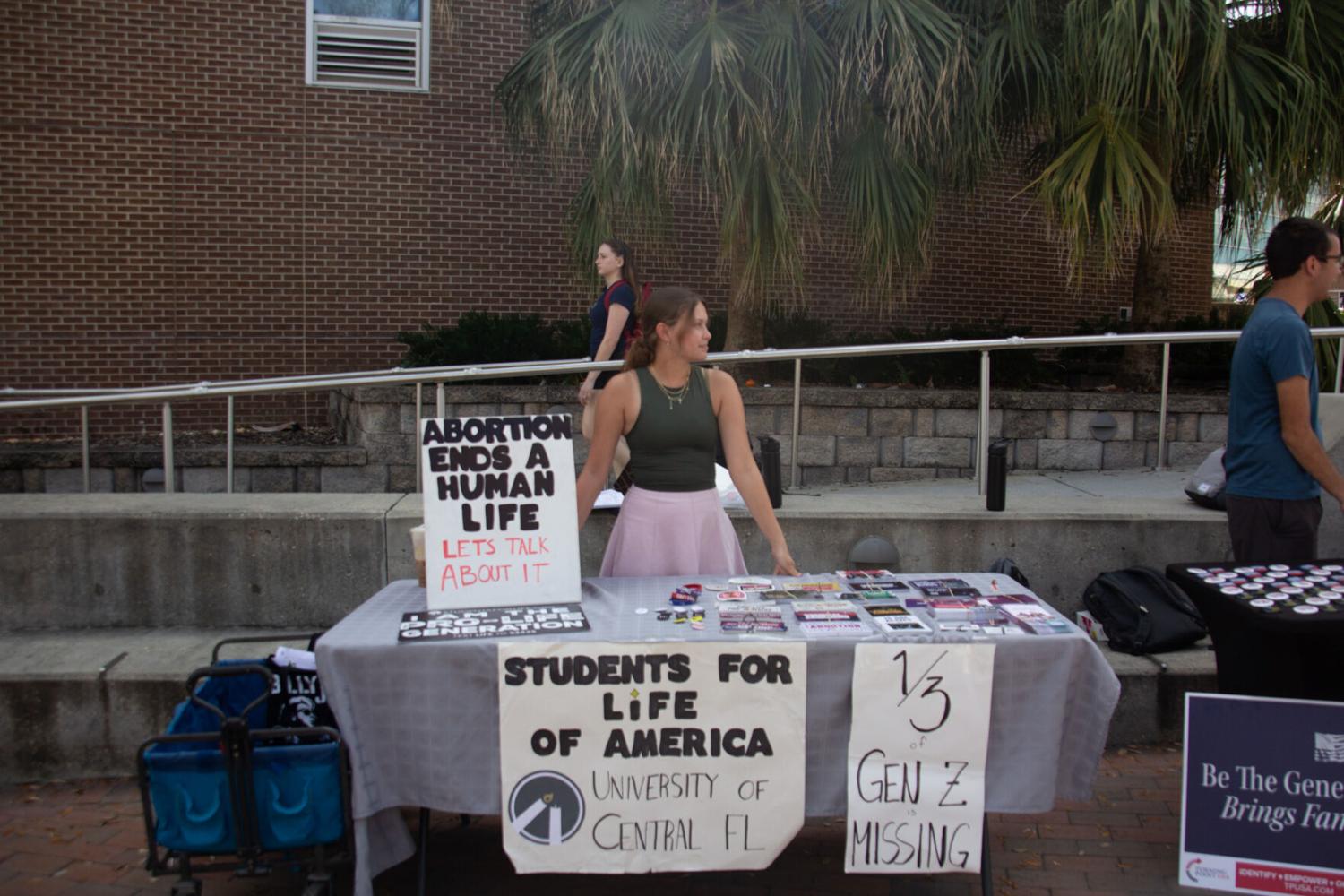

Outside the Student Union, Jasmine Stewart, junior biomedical science student, tables for Students for Life of America, a 501(c)(3) organization. Similar to how organizations cannot promote political campaigns or candidates, HB 725 seeks to do the same for universities, despite many universities already having such policies in place.
Minaal Arain
Students at universities in Florida may find on-campus political activities more limited, as a bill that recently passed the Florida House of Representatives has raised concerns about the effects on student-led organizations.
Florida House Bill 725, which aims to further promote free speech on university campuses and to regulate on-campus political campaign activities for major and minor parties, passed the House on March 4 and is now being considered by the Senate.
Sponsored by Rep. Peggy Gosset-Seidman (R-91), the original bill was much longer and included provisions on student-led political organizations, which are now deleted. The current version of the bill states that universities will be required “to inform students and employees of the Campus Free Expression Act at orientation and on its official website.”
As the election season rolls around, Florida universities may also have to comply with more direct regulations on their participation in political events. The bill also states that the Florida Board of Governors and the State Board of Education, “[describe] the limitations of state universities and Florida College System institutions relating to certain political campaign activities.”
Furthermore, the bill will also push higher education institutions to “publish on their official websites and provide to employees certain information relating to permissible and prohibited political activities, state law, and disciplinary actions.”
The bill comes after Rep. Gosset-Seidman’s previous bill, which would have made political campaigning on campus grounds a misdemeanor, was withdrawn in October 2025. If passed, the bill will take effect on July 1 of this year, but it doesn’t define the consequences universities could face if it is violated.
This provision on university involvement in political campaigns is largely related to tax regulation. The bill states that the Board of Governors and the State Board of Education will restrict tax-exempt state universities and colleges from engaging in political campaigns.
Aubrey Jewett, professor of political science and associate director of the School of Politics, Security and International Affairs at UCF, commented that the bill further solidifies university regulations instead of creating new ones.
“Universities are not supposed to be using any of their resources for political purposes and partisan purposes,” Jewett said. “To my knowledge, they’re not already, but this sort of reinforces it.”
Similarly, the Campus Free Expression Act, which outlines the free speech rights of people on university campuses, was passed and enacted in 2018. UCF’s Office of Student Involvement page has already dedicated a webpage to the act, explaining the act.
Dr. Stephen Masyada, director of the Lou Frey Institute of Politics and Government and its Florida Joint Center for Citizenship, conveyed similar sentiments to Jewett regarding both provisions of the bill.
“A lot of it already is happening. A lot of it is not allowed by ethical constraints to begin with. So in many ways, it’s addressing a problem that does not exist,” Masyada said. “That being said, it never hurts to reinforce state expectations as well.”
Faculty aren’t the only people already seeing the bill’s provisions in place. Brandyn Lovett, a senior advertising and public relations major and member of UCF’s genCLEO chapter, also didn’t see a problem with the text itself and compared the bill to similar regulations for 501(c)(3) organizations.
“They were already attitudes like that, it is just reinforcing [them],” Lovett said.
Gosset-Seidman addressed these points, calling the bill both “sensible and surprising,” according to the Miami Times.
“It’s sensible because it answers so many questions concerning political activities at our institutions of higher learning,” Gosset-Seidman said. “It’s surprising because the answers were right here all along, in each of our university and college’s policy manuals and in our federal codes at the IRS.”
However, Gosset-Seidman is still sponsoring the bill, as she believes making these policies state statute will clarify regulations and further maintain the political neutrality already codified, the Miami Times reported.
Neither Jewett nor Masyada believes the bill would raise any major changes in university policy.
Members of the Young Democratic Socialists of America table outside Parking Garage D, engaging in conversation with students. In a statement to The Charge, Rep. Anna Eskamani (D-42) said that HB 725 could have a chilling effect on student organizations, such as YDSA.
Minaal Arain
“It might be that the university administrations are more explicit about communicating to faculty about what they can and can’t do, and to students what they can and can’t do; it might be that we see a little more information shared with students about the Campus Free Speech Act,” Masyada said. “Other than that, I don’t see any huge policy changes because all the policies that it’s asking for really already exist.”
Lawmakers opposing the bill raised other concerns. Orlando native and UCF alum Rep. Anna Eskamani (D-42) expressed concern about having executive officials define broad state statutes, saying that it might lead to a “chilling” effect on college campuses.
“When the state starts inserting itself into what student organizations can do, who they can associate with, or how political activity is defined, it has a chilling effect on free expression, especially for young people who are just beginning to find their civic voice,” Eskamani said in a statement to The Charge.
Jewett was also concerned about whether that neutrality would be maintained if the bill were passed.
“The president, Congress have been attacking state universities … for being too liberal and for being on the left,” Jewett said. “So if you sort of take all that into perspective, despite sort of some of the neutral language in this and some of the statements of the sponsor, … well, this is part of the crackdown of conservative Republicans in the legislature trying to make universities more conservative.”
That was a concern of Eskamani as well. In a statement to The Charge, Eskamani raised the point that the bill may surpass the legislature’s authority to regulate free speech on college campuses.
“College campuses should be places where students are encouraged to think critically, organize, debate, and engage with the world around them,” Eskamani said in the statement. “This bill fits into a broader pattern of legislative attempts to police speech and civic engagement on campus under the guise of ‘neutrality.’”
Eskamani also noted that the bill may have specific consequences for political or civic clubs on university campuses.
“Student-led groups, especially those focused on advocacy, elections, social justice, or political engagement, could face confusion, increased scrutiny, or fear of punishment for activities that should be protected,” Eskamani said. “That undermines student leadership and discourages participation at a time when we should be strengthening civic engagement, not suppressing it.”
Although no longer included, the provision that would allow students to take the place of a faculty advisor for political clubs on campus was largely supported by both faculty and student organizations. However, some raised concerns about whether students could provide the same expertise as a faculty advisor.
Jewett acknowledged that students can have a hard time finding faculty willing to sponsor their clubs because of their prior obligations.
“Sometimes students do have trouble finding sponsors. I don’t know that it’s often because of ideology, honestly, although sometimes maybe it is,” Jewett said. “I think more often it’s just because faculty are busy.”
Masyada believes the politics might have a little more to do with it, emphasizing that faculty shouldn’t have to sponsor clubs they don’t agree with, making the former provision a good compromise.
“I am a firm believer in the importance of folks being allowed to support what they want to support, as long as we’re in the confines of the law and the community, and if students want to start a club that can’t get any sponsors for, I see no issues with students actually doing that, including with political clubs,” Maysada said.
Florida bill HB 725 passed the Florida House on March 4, aiming to legalize regulations that are already in place at many universities. However, a now-deleted provision of the bill would have allowed students to take the place of faculty advisors for political clubs, something Kyle Troy, junior international relations major and member of Young Americans for Freedom, said he would have supported.
Minaal Arain
Kyle Troy, a junior majoring in international relations and a member of UCF’s Young Americans for Freedom, conveyed a similar sentiment.
“I believe in free speech, and I also believe in personal choice, and I believe that there are factors of members who believe in free speech that might feel like they want to sponsor an organization that they don’t necessarily agree with, simply because they want to support that atmosphere of free speech,” Troy said. “This sort of gets around it. It allows for that free speech to still exist without potentially compromising that faculty members’ beliefs.”
Jewett raised the point that faculty can bring student-led clubs advice they may not otherwise have.
“Sometimes it’s better to have a faculty member who could bring a little bit of experience and age and wisdom to the process, and just knows maybe a little bit more about how the university works,” Jewett said.
This was a point that Rachel Chambless, senior communications major and treasurer of UCF’s League of Women Voters, also conveyed.
“If they’re struggling to find a faculty member who is available to sponsor them then they would no longer have to worry about being shut down,” Chambless said. “On the other hand sponsors help clubs immensely, they are able to help students get in touch with staff members who can help with events and they help students uphold university guidelines.”
Sophomore nursing major and president of UCF’s American Communist Party Nick Daniels (left), said he would have also supported the provision for students to take the place of faculty advisors. Having experienced trouble with getting applications for his club approved, he said that he would back anything to ease that difficulty.
Victoria Garcia-Morales
Nick Daniels, sophomore nursing major and president of UCF’s American Communist Party, also said he would have supported the provision.
“Allowing students to become faculty replacements for faculty advisors for RSOs would make it much easier, much more accessible, for people to start their own clubs,” Daniels said. “As someone who’s been trying to start the RSO, it’s been very difficult because of their bureaucracy, and so anything to lessen that, I support.”