
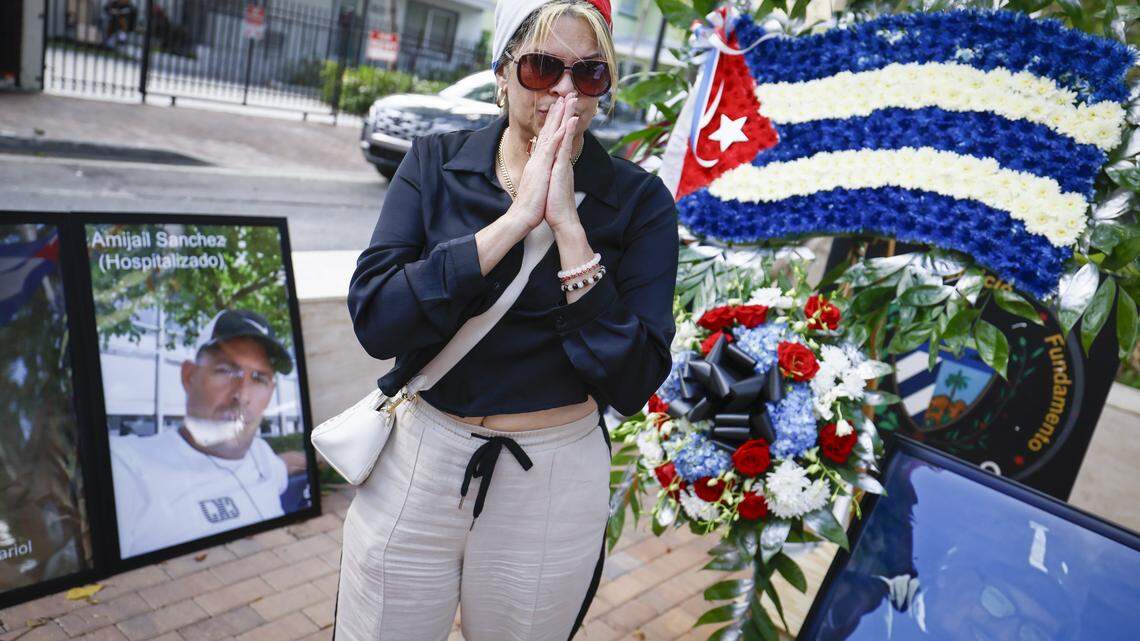
Niurka Prestamo, friend of one of the men detained off the coast of Cuba at the Proof of Life of Our Brothers ceremony at the Bay of Pigs Monument in Little Havana. Cuban dissident groups held a press conference to demand repatriation of the bodies of the men killed in the shootout with the Cuban Coast Guard on Sunday, March 8, 2026. They also demanded that the U.S. citizens involved in the incident be allowed to speak to U.S. diplomatic employees.
PHOTO BY AL DIAZ
adiaz@miamiherald.com
Tallahassee
Amid diplomatic talks between the United States and Cuba, state lawmakers on Friday passed a bill that contains a free trade provision with the island nation should the regime fall.
The amendment had first appeared in February in the Florida House, where Cuban-American House Speaker Daniel Perez, a Miami Republican, oversees the chamber.
“My hope is that the people of Cuba will finally get the freedom they’ve craved for so long and I’m thankful to President [Donald] Trump and Secretary [Marco] Rubio for their bold leadership and commitment to the people of Cuba and the principles of liberty and justice for all,” Perez told the Herald/Times in a statement on Friday.
HB 905 states that the governor of Florida may temporarily “suspend the provisions of any statute or rule restricting interactions with Cuba” should the federal government change “the diplomatic status” of the country. The governor is then directed to make recommendations for policy change relating to Cuba for the Legislature to consider in the following session.
Gov. Ron DeSantis can veto the bill. If he does not, it will become law on July 1.
Cuban-American Republican Rep. Juan Carlos Porras told the Herald/Times he was hopeful.
“I think there’s finally a light at [the end of] the tunnel for generations of Cuban Americans that have fled the island or had family members, like myself, pass as political prisoners in Cuba,” Porras said. “The state of Florida is completely ready for that regime to fall.”
Porras added: “I’d love to see a world where Cuba could be possibly like a U.S. territory, similar to Puerto Rico, and maybe that could open up some opportunities to work with the state as well.”
But some Cuban-American senators seemed a bit more skeptical in their comments on the diplomatic talks between the United States and Cuba.
Sen. Alexis Calatayud said the news of the talks was “nothing new.”
“We knew high-level US-Cuba talks were happening. The Cuban dictatorship kept denying it,” Calatayud, a Miami Republican, told the Herald/Times. “There should be zero trade changes, zero relaxations until there is a change of system, a transition to a new democratically elected government.”
Calatayud added: “The newly signed freedom accords by all the opposition groups showcase that the Cubans inside and Cuban diaspora outside of the island are ready for the change.”
Sen. Ileana Garcia, a Miami Republican, made a similar comment.
“My expectations are seared in current U.S. law which makes clear the U.S. cannot normalize relations with Cuba until all three conditions are met: the liberation of all political prisoners, legalize freedom of expression, including the free press and political parties and schedule multiparty elections with international supervision,” Garcia said.