
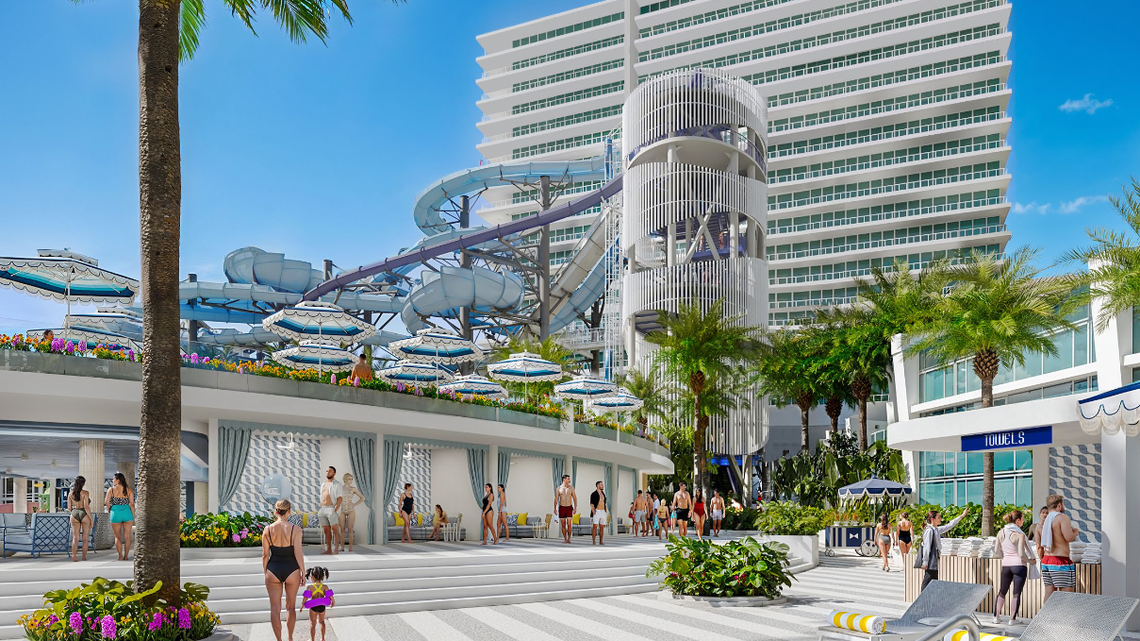
A rendering of the revised proposal by the Fontainebleau Miami Beach hotel to build a water park and renovate the pool area.
City of Miami Beach
Fontainebleau Hotel on Miami Beach will likely get the go ahead to build a controversial water park on its deck under a bill state lawmakers passed on Friday, even though locals and the state representative for the area don’t want it.
Rep. Fabián Basabe told the Herald/Times after the bill passed that he was “very disappointed.”
“Miami Beach has experienced decades of overdevelopment while critical infrastructure has struggled to keep up,” Basabe, a Miami Beach Republican, said. “What our community is asking for is responsible redevelopment that fixes what we already have before placing even more pressure on traffic, water, and stormwater systems.”
Basabe added: “The provision in this legislation effectively addresses a single property in Miami Beach, and decisions like that are typically best handled locally under home rule.”
Doral Rep. David Borrero added the Fontainebleau amendment to HB 399 in February after representatives with the hotel faced opposition from local residents who packed a Miami Beach Historic Preservation Board meeting that month. Borrero told the Herald/Times that he had worked with a lobbyist representing the hotel on the amendment.
Borrero didn’t immediately respond to a request for comment on Friday but told the Herald/Times last month that he didn’t understand why the Historic Preservation Board was “stalling progress.”
Under the bill, the city must “administratively approve” the change request to Fontainebleau’s structure that will allow it to build the water slides on its deck. The provision will sunset after five years — but that is unlikely to affect the changes the Fontainebleau is seeking given it only applies to the application process, not the construction.
“While the sunset provision is in there, that still means that we’re usurping the process, and we are about to do something that the residents of the area do not want,” Sen. Shevrin Jones, a Miami Democrat, said before voting against the bill in the Senate on Friday. Jones narrowly lost his bid, 20-17, to remove the Fontainebleau provision from the bill before his chamber passed it.
Gov. Ron DeSantis can still veto the bill, but that is less likely given that the Senate president said he had input on the final product.
Silencing resident opposition
Alex Fernandez, a Miami Beach commissioner, said the legislation’s passage “allows the Fontainebleau Hotel to silence resident opposition and effectively force a massive water park attraction right next to where people live.”
“The overwhelming amount of residents who passionately opposed this project have been silenced by people in Tallahassee who want to act as the Miami Beach zoning board — dictating irresponsible land-use decisions for a community they neither live in nor understand,” Fernandez said.
Mark Weiss, a Miami Beach resident and attorney who has spearheaded activism against the water slide project, told the Herald/Times that “today is a very sad day for our city and state.
”Our elected representatives don’t control our city, billionaire Jeffrey Soffer does.”
Soffer is the owner of the Fontainebleau. He could not be reached directly for comment.
“Separate from the legislation, Fontainebleau’s Miami Beach proposal involves thoughtful upgrades to existing outdoor amenities, consistent with the City’s current zoning code, permitted uses, and established application process,” Fontainebleau Development said in a statement.
Urban Developement Boundary item removed
After the legislative session wrapped on Friday, Senate President Ben Albritton acknowledged the bill “had its ups and downs all the way through the process.”
“The Florida Senate worked together to figure out how to get a product that this body could be supportive of,” Albritton, a Wauchula Republican, told reporters. “Did the governor have input? Yes. So did the Florida House.”
Another change to the bill driven by the Senate was the removal of a separate controversial provision that would have allowed development in protected areas like the Everglades by allowing the Miami-Dade County Commission to move the Urban Development Boundary line with a simple majority vote. Currently, two-thirds of the 13-member commission board must agree to move the boundary line and greenlight those developments.
Before the vote on that specific change, Sen. Alexis Calatayud, the Miami Republican who sponsored it, asked her colleagues to “support these efforts to maintain the status quo” on moving the boundary line.
“Miami-Dade County’s Urban Development Boundary (UDB) is more than a local planning tool, it is a promise to protect our drinking water, reduce flooding risk, preserve farmland, and safeguard the Everglades that define South Florida,” Calatayud told the Herald/Times in a statement after the bill’s passage with her proposed change.
She added: “I am proud the Florida Senate unanimously voted in opposition to HB 399’s attempt to lower the Miami Dade County Commission’s vote threshold required to push the line outward.”