
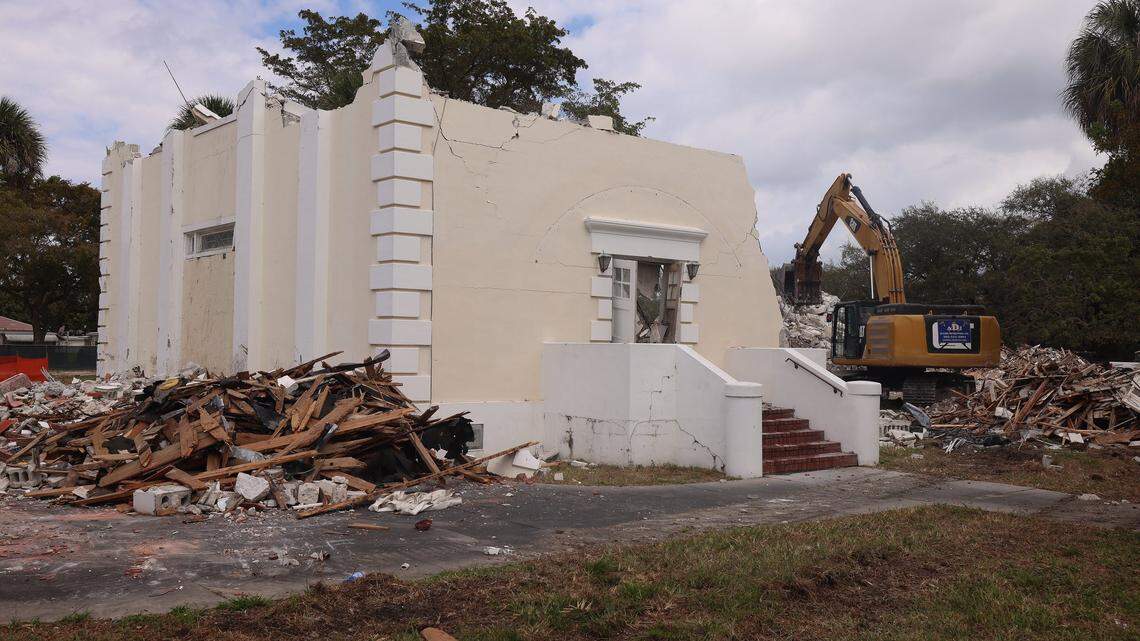
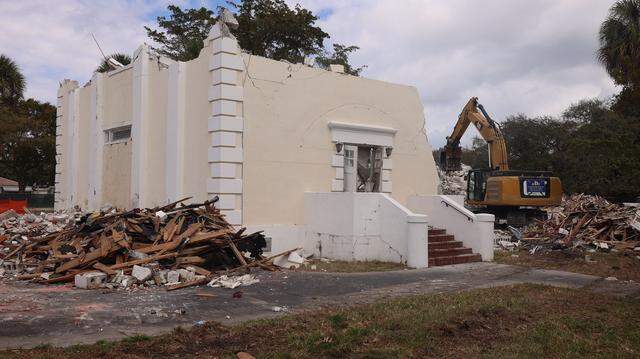
In February, the 70-year-old Rader Memorial United Methodist Church under demolition in El Portal. Developers have plans for the site.
Carl Juste
cjuste@miamiherald.com
The co-founder and former CEO of WeWork and his wife want to build a private school focused on cultivating “spiritual intelligence” in a small Miami-Dade community.
But residents of El Portal, a town of about 2,000 sandwiched between Biscayne Boulevard and I-95, have pushed back, taking issue both with the project and what they see as a lack of transparency from the developer and the town.
In response to the opposition, representatives of the school have offered an alternative that may be even more unpopular to neighbors: an affordable housing development under the Live Local Act.
At a meeting about the project in El Portal last month, Jeffrey Davis, who was representing the school, showed a rendering of a large, boxy building that some residents have taken to calling the “Death Star.”
“I want to be clear,” said Davis at the first of two public meetings he hosted in Feburary. “People ask what the alternative is, right? The alternative is Live Local.”
The Live Local Act, which the state Legislature passed in 2023, allows developers to bypass zoning restrictions if they commit to making 40% of the units in a project affordable for 30 years. The law also means the project could be approved administratively, rather than going before the village council for a vote.
Amanda Hand, a Miami land-use attorney that a group of El Portal residents hired in January, said she’s seen several instances of developers wielding the Live Local law to push a controversial project through.
“It is used as a threat to neighbors and local governments to basically strong-arm approval for something else that might be objectionable,” Hand told the Miami Herald.
In January, El Portal’s planning and zoning committee deferred a vote on the school proposal, asking the developer to first host a series of public meetings with residents. El Portal Councilperson Charles Winters told the Herald this week that the item had not been rescheduled to go before the committee yet.
Church demolition galvanizes residents
The school, called SOLFL, which stands for “student of life, for life” and is pronounced “soulful,” would be built on the site of Rader Memorial United Methodist Church. Last month, demolition began at the 70-year-old church, which was being considered by the county for historic preservation.
The church, which as of late February was little more than a pile of rubble, is on Northeast Second Avenue, El Portal’s main artery.
El Portal is affluent, with a median income just over $100,000. But you won’t see luxury high-rises in the town, which is just south of Miami Shores and just north of the Miami city line. El Portal, which was incorporated in 1937, has retained much of its historic charm. Many of its quiet residential streets are lush with old-growth tropical vegetation, and several houses date back to the early 20th century.
 El Portal resident Ashley Lucio. Carl Juste cjuste@miamiherald.com
The Rader church was built in the 1950s. The building had sat empty for two decades, despite several attempts to revitalize the church over the years. Some residents, like Ashley Lucio, believed the church could have still had a future as a community center.
When she learned the demolition had begun, “I wanted to cry,” she said. “I felt so attached to this building and its potential.”
Lucio has been a vocal skeptic of the proposed school. She has expressed concerns about the zoning variances the project would require and the fact that the nonprofit school wouldn’t contribute tax revenue to the town.
The demolition came without warning, Lucio said. The first meeting about the project was scheduled for Feb. 12, and the demolition began days before, on Feb. 10. The decision to go ahead with the demolition rankled some residents, dozens of whom showed up to the Feb. 12 meeting.
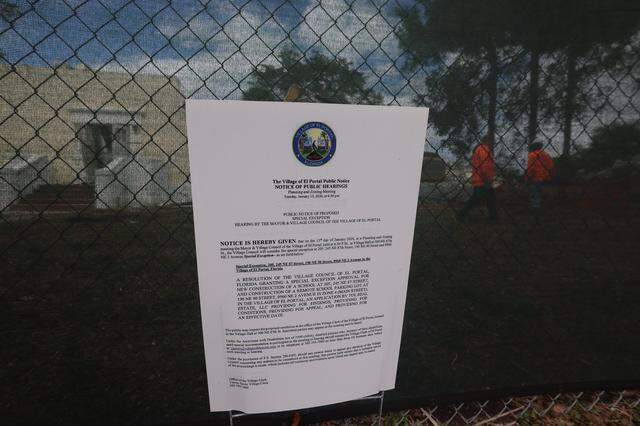 A public notice is displayed at the demolition site of the former Rader Memorial United Methodist Church. Carl Juste cjuste@miamiherald.com
El Portal Mayor Omarr Nickerson released a statement saying he was “angry and sad” about the demolition, which he called a “blind-sided, sneak attack” by the developer. He did not respond to the Herald’s requests for an interview.
The atmosphere in El Portal Village Hall was tense during the 2 1/2-hour meeting that took place days after the demolition. Some in the audience heckled the school representatives as they presented their proposal, and residents queued up to voice their opinions.
“When you knocked the church down,” said Denise White, a longtime El Portal resident who spoke during the meeting, “that was a punch in the face.”
At the meeting, the developer offered up several community benefits, including establishing a small riverfront park and a yearly contribution of $100,000 to the town’s budget. But when residents said those benefits were not enough, Davis brought up the possibility of a Live Local project.
Davis hosted the meeting alongside SOLFL representative Lauren Koplowitz. Both declined to comment after the meeting.
George Alvarez, an El Portal resident who attended both meetings hosted by the school representatives, said the temperature had cooled somewhat at the second meeting. But Alvarez said he’s still worried the developer is not acting in good faith.
‘Conscious learning community’
SOLFL, a private Jewish school with a curriculum focused on Torah study, entrepreneurship, ecology and the arts, is a venture of Adam Neumann and his wife, Rebekah Neumann. Adam Neumann is the co-founder and former CEO of WeWork, and Rebekah Neumann previously served as the company’s chief brand and impact officer.
The El Portal campus, which in renderings on its website looks like a series of tropical bungalows, would teach up to 350 kindergarten through 12th grade students. SOLFL has already begun teaching kids at a temporary campus.
Some residents have taken issue with the eight-foot wall that would be built around the school or the traffic they worry the school would bring. Others say the tuition, which at one point was listed on the school’s website as up to $45,000 per year, makes SOLFL inaccessible for most families in El Portal.
This isn’t the Neumanns’ first foray into education. The school at the center of the controversy in El Portal is a rebranding of WeGrow, a holistic school Rebekah Neumann founded at the height of WeWork’s success. The endeavor was short-lived, and the school closed around two years after it opened.
WeWork, a coworking startup founded in New York, saw a meteoric rise in the late 2010s. The company was said to be worth $47 billion in 2019, but documents filed as WeWork was preparing to go public revealed major financial issues behind the scenes. Adam Neumann was subsequently pushed out of his role as chief executive over concerns about his rampant spending.
Adam Neumann has since invested heavily in South Florida real estate through his development firm Flow. This week, Flow finished construction on Flow House, a 41-story luxury condo tower in downtown Miami.
An entity with ties to the Neumanns has purchased several properties throughout El Portal, including the Rader church. The county granted the developer a demolition permit for the church in November.
What’s next for SOLFL?
Winters, the council member, said he doesn’t know when the issue will be scheduled to go before the planning and zoning committee again. He said the school has been the most controversial development proposal of his tenure.
Since the first meeting, some residents have changed their minds about the project. Some were swayed by the benefits the developer offered, and others have been spooked by the possibility of an affordable housing project in their backyard.
During El Portal’s February council meeting, some residents expressed concern about what the housing development would do to their property values. Others said they wanted more clarity about what the Live Local Act permits developers to do.
Lucio said she’d prefer an affordable housing development to a private school only accessible to wealthy families.
Village Attorney Joe Geller clarified that the Live Local Act doesn’t allow a developer to build whatever it wants, so long as it’s affordable. He said to build a project under Live Local, a developer has to follow a specific set of rules laid out in the statute. Those rules have already been amended by the Legislature several times since 2023.
Geller said the project will need to go before both the planning and zoning committee and the village council in order to go forward. That process will likely take at least a few months.
At the meeting on Feb. 12, Vimari Roman, an El Portal resident and former member of the village council, advised other residents to redirect their anger at the developer toward the village council. She said it’s up to the village’s elected officials to keep residents’ interests in mind: “Where’s the transparency from our council?”

Miami Herald
Catherine Odom covers real estate for the Miami Herald. She previously interned on the Herald’s government team and has worked as a journalist in Germany and Armenia. She is a graduate of Northwestern University.