
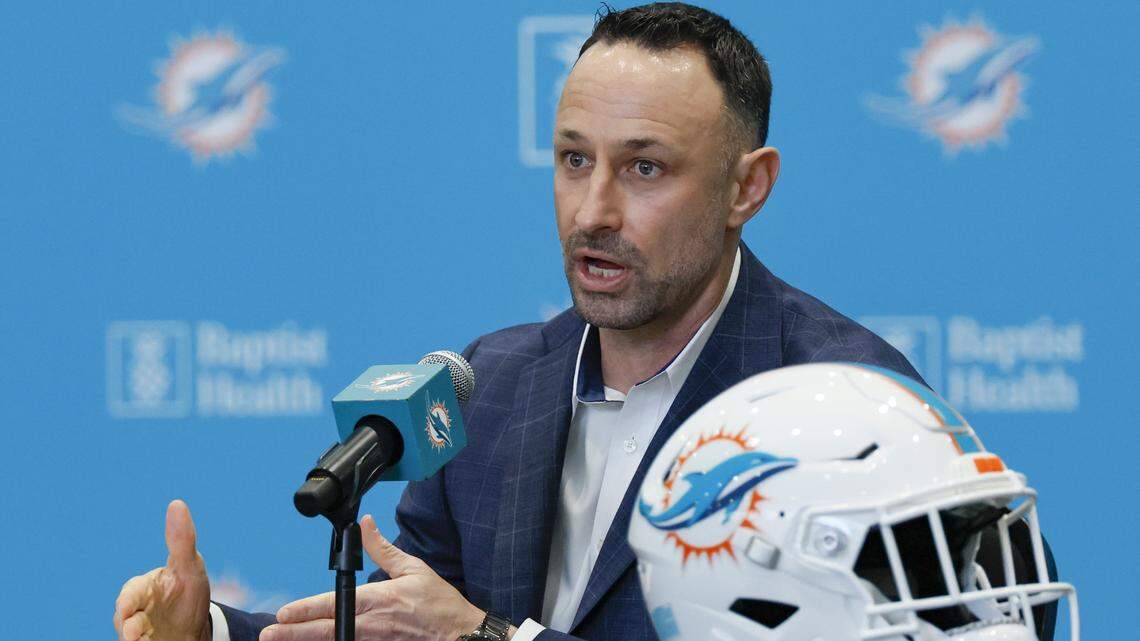
Twelve realities that have become clear a week into Jon-Eric Sullivan’s first foray into free agency as Dolphins general manager:
▪ Sullivan sees value in adding 20-something players who were good starters at one point but haven’t achieved as much since.
That was the case with receiver Tutu Atwell and Jalen Tolbert, who had career years in 2024 but fell off last season partly because of injuries (in Atwell’s case) and fewer snaps (in Tolbert’s case, after the Cowboys acquired George Pickens to pair with CeeDee Lamb).
If the Dolphins get the 2024 versions of Atwell (42 receptions, 562 yards) and Tolbert (49 for 610, seven touchdowns), they will be great value rotation receivers, with Atwell providing an explosive deep threat and Tolbert delivering speed and a red zone target.
The same could be said for former Plantation American Heritage cornerback Marco Wilson, who had three interceptions and an impressive 77.1 passer rating against as an Arizona Cardinals starter in 2022 but has fallen off since.
Keep in mind that Wilson and Tolbert are only 27, Atwell 26.
▪ Sullivan likes taking chances on former second-round draft picks, hoping there is more that can be extracted.
He snagged five of them in his first two months on the job, with edge players Joshua Uche and David Ojabo, receivers Atwell and Terrace Marshall Jr. and safety Lonnie Johnson.
Uche, picked 60th overall by New England in 2020, might still have untapped upside as a pass rusher; last season, he led the NFL in quarterback pressures per pass rush for players with similar snap counts.
Ojabo, chosen 45th by Baltimore in 2022, has been a decent backup for the Ravens the past two seasons after his first two years were largely ruined by a torn Achilles sustained at Michigan’s Pro Day and a torn ACL early in year two.
The speedy Atwell (picked 57th by the Rams in 2021) has a sterling 14.6 average on 105 career catches. For perspective, that 14.6 career average would have ranked 15th among more than 150 NFL receivers last season.
Johnson, selected 54th by Houston in 2019, is a serviceable stopgap at safety, though he’s on his sixth team in five years.
Marshall, the 59th pick in 2021, was a disappointment with Carolina and spent part of last season on the Eagles’ practice squad. But he’s only 25, had 10 receiving TDs from Joe Burrow in seven games in his last year at LSU and is worth a no-risk flyer.
▪ You must be able to play multiple positions on the offensive line if you want to play here.
It’s no coincidence that Sullivan’s first offensive line addition was a player, the Chargers’ Jamaree Salyer, who has extensive experience at both guard and tackle. Unless you’re a star, this regime believes that roster spots, and spots on the game day active list, are too valuable to invest in single-position linemen.
Salyer – who was the Chargers’ second-best pass blocker last season, per PFF – potentially could serve as both a starting guard (if he wins the job) and Miami’s No. 3 tackle. He has been an adequate NFL starter (better than that at times) at left tackle and right guard.
▪ If you’re over 30, you need not apply for a job here. At least not yet.
Under Sullivan, the Dolphins so far have signed (or re-signed) 27 players. Not a single one is older than 30.
Only one (Lonnie Johnson) is 30. Most are in their mid-to-late 20s.
▪ You can pretty much rule out two prominent players for the Dolphins’ pick at 11, but they could figure into the team’s strategy in a significant way nonetheless.
Though Sullivan says he will pick the best available player, two potential top-15 picks wouldn’t make sense because of their position – Notre Dame running back Jeremiyah Love and Alabama quarterback Ty Simpson.
Though Kansas City signing Seattle’s Kenneth Walker Jr. last week greatly lessens the chance of the Chiefs taking Love at No. 9, some draft analysts believe the Commanders will pick him at 7.
But what if he’s somehow on the board at 11 and a team selecting below Miami is enamored by a player that multiple ESPN analysts have compared to Saquon Barkley? Perhaps Miami could seize on that, trade down a bit and pick up another high draft choice.
And what if a team with a pick in the teens or early 20s falls in love with Simpson and wants to grab him at 11? What if the Jets, who pick 16th, become enamored with Simpson and are determined to jump the Rams, who pick 13th and need to start planning for a post Matthew Stafford era?
So Love and Simpson obviously wouldn’t make sense for Miami, but they could be pawns to extract more draft picks.
▪ If you’re a defensive back, you can’t be a smurf in the Sullivan regime.
So far, Sullivan has signed nine defensive backs. Not a single one is shorter than 6 feet. Most are 6-1 or 6-2. The two holdover defensive backs he signed – Ethan Bonner and AJ Green – are 6-1 and 6-2 respectively.
He bypassed re-signing 5-10 Kader Kohou and 5-11 Jack Jones.
▪ Sullivan was serious when he said he wants competition.
Miami has 12 cornerbacks before even going through the draft process.
The Dolphins were the only team to sign two established veteran kickers, even though nobody would have thought twice if they had signed only one among Riley Patterson (27 of 29 on field goals last season) or Zane Gonzalez (19 of 22).
Some Malik Willis critics have cited his signing as contradictory to Sullivan’s remark that he wanted competition at quarterback. But signing someone who’s the obvious heavy, heavy favorite to start wasn’t a reason not to sign the most dynamic, athletically gifted unrestricted free agent quarterback at a salary that places him in the bottom third of NFL starters and at a 2026 cap hit that’s close to the lowest among starters.
▪ The Dolphins need help everywhere, but safety absolutely must be addressed in the first two days of the draft. And cornerback and edge very likely need to be, as well.
With the veterans currently under contract, the only position that the Dolphins could not realistically make it through a season are safety, where only Johnson, special teams ace Zayre Anderson, Dante Trader Jr. and developmental players Omar Brown and Jordan Colbert are under contract.
Though ESPN’s Mel Kiper and Field Yates recently here described a less-than-50 percent pathway where elite Ohio State safety Caleb Downs could fall to 11, the more likely scenario is Miami finding a safety at picks 43, 75, 87, 90 or 111 (or with a second-round or third-round trade down) among the likes of Pittsburgh’s Kyle Louis, TCU’s Bud Clark, USC’s Kamari Ramsey, Penn State’s Zakee Wheatley, South Carolina’s Jalon Kilgore, LSU’s A.J. Hauley, Arizona’s Genesis Smith, Kansas State’s VJ Payne and UM’s Jakobe Thomas.
Toledo’s Emmanuel McNeil-Warren and Oregon’s Dillion Thieneman – considered the draft’s second and third best safeties behind Downs – are projected to come off the board between Miami’s picks at 11 and 43.
▪ The Dolphins are OK with selectively using void years, but with the knowledge that they aren’t going to spend a ton on many players in free agency in the years ahead.
The Dolphins lowered Willis’ cap hit this season from $8.7 million to $5.6 million – and dropped his hit slightly in 2027 and 2028 – by taking on an $8.9 million hit in 2029, when he’s no longer under contract. That was one of the reasons they were able to be so active in free agency.
But the Dolphins, operating under Sullivan’s philosophy, can afford that hit in 2029 because he has said he’s going to splurge in free agency in the future only for highly impactful players, and a limited number of them at that.
Remember:
1). The players that Sullivan drafts will be still under cheap rookie deals in 2029.
2). The Packers, where Sullivan cut his teeth as a front office executive, have signed only 11 free agents to contracts over $2 million annually in the past five years. Only a few of Sullivan’s 27 signings received more than that.
▪ The Dolphins don’t want to leave some positions without veteran bodies for a couple of months, though that option was available.
Sullivan could have left some positions totally devoid of veterans and waited to see what free agents fall through the cracks in June and July free agency. He still has the option of upgrading positions after Miami gains $20 million or so in cap space June 2, thanks to Bradley Chubb’s cap reduction that day.
So it was interesting that he decided to sign veterans (often multiple veterans) on low-money value deals at every position before the draft. Among the players they landed at the minimum: a young starting cornerback (Darrell Baker).
▪ Try to sign some of your own, but draw the line if you believe you can find comparable players for less.
The Dolphins offered pay cuts to multiple players who rejected them, including Jason Sanders and Alec Ingold, and one who opted to stay (Austin Jackson). They offered Julian Hill less than the $3.5 million tender, which displeased him; he said no and signed with New England hours later.
If you want to stay, great. If not, Sullivan will find a comparable player for less money; in Hill’s case, that was former Packers/Vikings tight end Ben Sims, a skilled in-line blocker.
▪ Try to field a representative product while you build a roster.
This was never going to be an intentional tank, though some fans were inexplicably under the impression it would be.
The defense still has so many holes that the Dolphins could end up with a top seven pick if Willis is a disappointment, if the five top-100 picks don’t make an immediate impact and if young players such as Chop Robinson, Kenneth Grant, Jonah Savaiinaea, Jason Marshall Jr. and Trader don’t improve considerably.
But sports is the entertainment industry and the Dolphins were never going to intentionally field a hot garbage product and totally throw away a season hoping to land the No. 1 pick in what would have been a depressing race against sad sack teams (Arizona, the Jets, Cleveland). That’s why they opted to take a $55.4 million cap hit on Tua Tagovailoa in 2026 (and a $43.8 million hit in 2027) instead of the $67 million and $99 million dead money 2026 options that also were available.
That’s why they took on void years with Jackson to facilitate a lower cap hit this season.
Two important things to remember:
1). Void years didn’t get the Dolphins in trouble under Chris Grier. Signing players to regrettable extensions and making bad personnel decisions did. Void years are common.
2). The 2027 draft has a handful of very good quarterback prospects.
So even if Willis and the defense flop this season, Miami still be positioned to land one of those QBs without going into this season trying to lose like, well, the hapless Washington Wizards.
I wrote lengthy live blogs chronicling every day of Dolphins free agency this week as well as an in-depth Willis piece. Please find all of those links here on my Miami Herald home page, in case you’ve spent the week without Internet (or visiting the Arctic Circle) and need to catch up.
This story was originally published March 14, 2026 at 12:37 PM.

Miami Herald
Barry Jackson has written for the Miami Herald since 1986 and has written the Florida Sports Buzz column since 2002.