
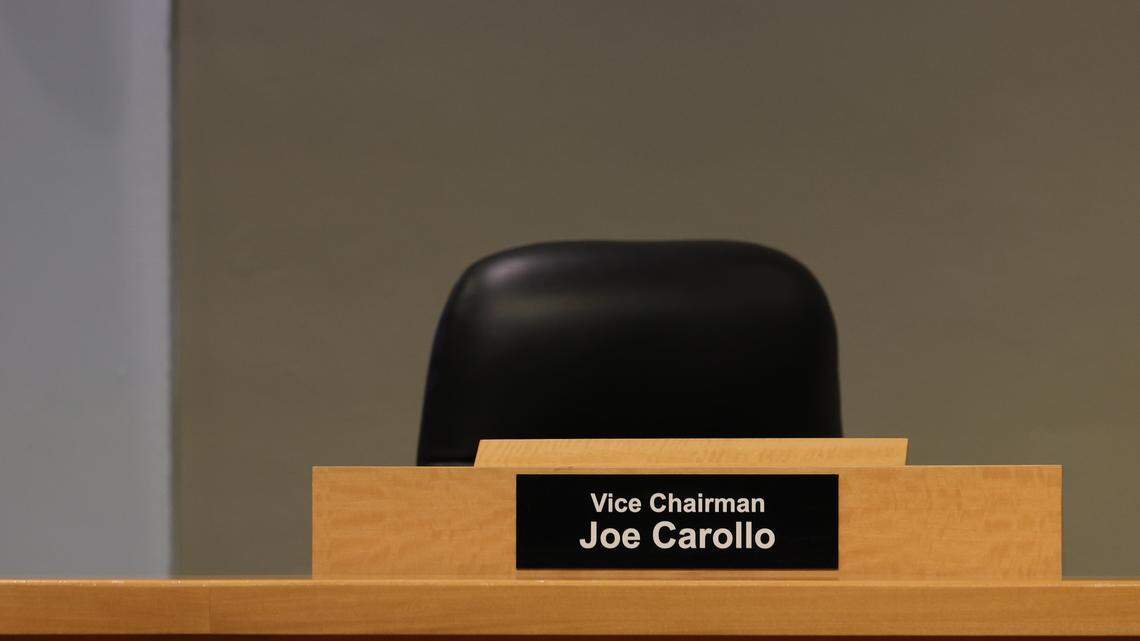
View of Commissioner Joe Carollo’s empty chair, during a commission meeting on Nov. 20, 2025.
Pedro Portal
pportal@miamiherald.com
Former Miami Commissioner Joe Carollo has been out of office since December, but his actions continue to haunt the city — and have cost taxpayers.
Let’s be realistic: Taxpayers will probably never get back the money they forked out to pay for Carollo’s legal fees in a lawsuit he lost in 2023 and that the U.S. Supreme Court last week declined to hear on appeal.
The City Commission on Thursday voted to sue Carollo to recover attorneys’ fees and costs paid from public funds for Carollo’s defense. The commission’s own attorney said the city probably wouldn’t be able to collect that money even if it prevailed in court.
Carollo already faces a $63.5 million federal judgment that would take precedence over anything Carollo may owe taxpayers. To make matters more complicated, the courts have ruled Carollo’s wages and his home in Coconut Grove cannot be seized to satisfy that judgment. And Carollo told the Herald he simply doesn’t have the money to pay Miami back.
But the commission acted on principle, and that matters. And it should be a warning to any elected official who wishes to use their office or city resources for personal vendettas, as Carollo did, according to the allegations in the lawsuit.
While officials and governments get sued all the time, Carollo’s case stands out: A federal jury found he violated the First Amendment rights of two Little Havana businessmen who supported his 2017 opponent. During the weeks long trial in Fort Lauderdale, the plaintiffs described how Carollo weaponized Miami’s code enforcement with repeated inspections and law enforcement visits to William Fuller and Martin Pinilla’s properties — in particular, the historic Ball & Chain nightclub on Calle Ocho — in efforts that seemed intent on forcing them out of business.
The lawsuit depicted a government that works against its people. The fact that taxpayer dollars were spent to defend Carollo — and help him take his case as far as the Supreme Court — adds insult to injury.
How much has Carollo’s legal defense cost the public? There’s no exact figure, but it’s in the millions. The Herald reported on Thursday that City Attorney George Wysong has come up with a rough estimate of $6 million, with insurance covering about $4 million. But when an insurance company sued the city in 2024, it claimed that Carollo’s “legal fees have exceeded $10 million to date,” the Herald reported at the time.
This wasn’t even Miami’s only Carollo-induced legal headache. In 2024, the city agreed to settle another lawsuit that accused the city of harassing Fuller’s businesses by carrying out code enforcement raids and “weaponizing” various departments against him. The city said at the time that it would be responsible for about $8.2 million of the $12.5 million settlement with insurance covering most of the rest.
Another lawsuit related to Carollo against the city is pending in federal court.
Carollo left the District 3 seat last year after reaching his term limit and unsuccessfully running for mayor. Since then, the Miami Commission has taken steps to erase his legacy by undoing some of the projects he championed.
Carollo’s true legacy lives in his actions outlined in legal filings, the $63.5 million judgment he’s facing for weaponizing his position against his enemies and the fiscal burden he’s put on Miami.
After losing his mayoral bid last November, Carollo told the Herald “One thing’s for sure: you can’t blame me for anything anymore.”
If only that were true.
BEHIND THE STORY MORE What’s an editorial?
Editorials are opinion pieces that reflect the views of the Miami Herald Editorial Board, a group of opinion journalists that operates separately from the Miami Herald newsroom. Miami Herald Editorial Board members are: opinion editor Amy Driscoll and editorial writers Isadora Rangel and Mary Anna Mancuso. Read more by clicking the arrow in the upper right.
What’s the difference between an op-ed and a column?
Op-Eds, short for “opposite the editorial page,” are opinion pieces written by contributors who are not affiliated with our Editorial Board.
Columns are recurring opinion pieces that represent the views of staff columnists that regularly appear on the op-ed page.
How does the Miami Herald Editorial Board decide what to write about?
The Editorial Board, made up of experienced opinion journalists, primarily addresses local and state issues that affect South Florida residents. Each board member has an area of focus, such as education, COVID or local government policy. Board members meet daily and bring up an array of topics for discussion. Once a topic is fully discussed, board members will further report the issue, interviewing stakeholders and others involved and affected, so that the board can present the most informed opinion possible. We strive to provide our community with thought leadership that advocates for policies and priorities that strengthen our communities. Our editorials promote social justice, fairness in economic, educational and social opportunities and an end to systemic racism and inequality. The Editorial Board is separate from the reporters and editors of the Miami Herald newsroom.
How can I contribute to the Miami Herald Opinion section?
The Editorial Board accepts op-ed submissions of 650-700 words from community members who want to argue a specific viewpoint or idea that is relevant to our area. You can email an op-ed submission to oped@miamiherald.com. We also accept 150-word letters to the editor from readers who want to offer their points of view on current issues. For more information on how to submit a letter, go here.
This story was originally published March 13, 2026 at 10:02 AM.