
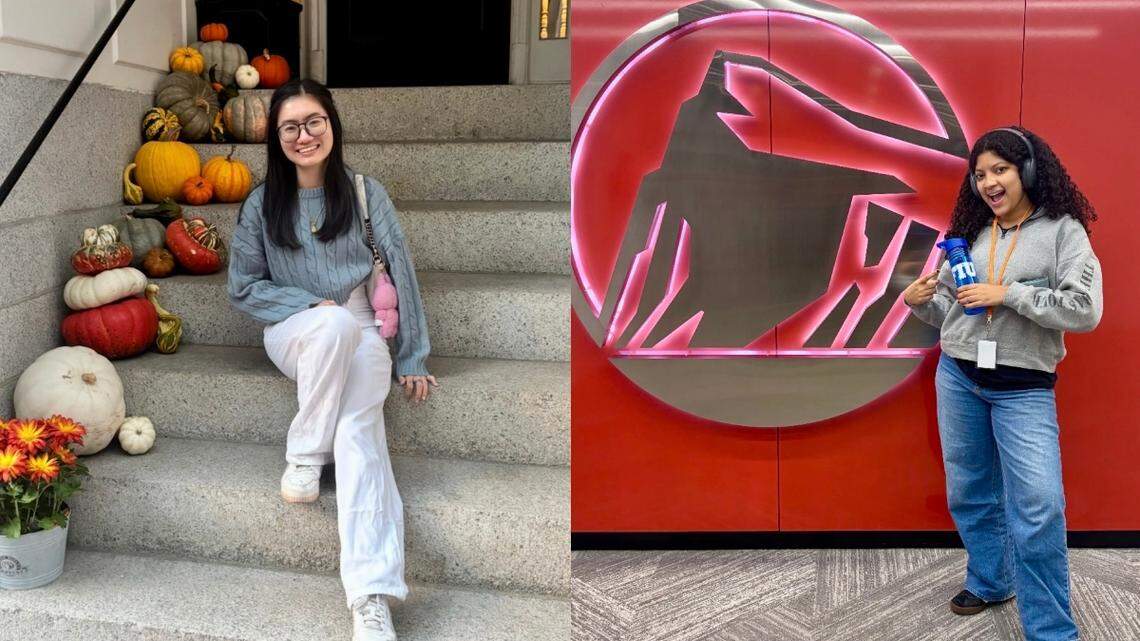
Jenny Li (left) is studying computer science in Boston, and Helen Gomez (right) accepted a cybersecurity position in Washington, D.C. Both are part of a growing number of young professionals building their futures outside South Florida.
Courtesy of Jenny Li and Helen Gomez
As graduation approaches this spring at Florida International University, 21-year-old Helen Gomez is preparing to leave more than just campus life behind. In a few months, she will move from her family’s home in Miami to Washington, D.C., where she has accepted a six-figure cybersecurity position with Capital One.
Nearly 1,500 miles north, 22-year-old Jenny Li has already made a similar transition. After growing up in South Florida, she enrolled at WentWorth Institute of Technology in Boston, where she earned her bachelor’s degree in computer science. She now lives with two roommates while completing her master’s degree in the same field.
South Florida has long marketed itself as a place defined by sunshine, opportunity and cultural vibrancy. But for many young professionals, especially recent graduates, the region is increasingly becoming a place to grow up and then move away from. Rising housing costs, stagnant wages and limited industry depth are pushing the next generation to seek opportunities elsewhere.
Though their paths unfolded at different times, both women arrived at a similar conclusion: Building an independent, financially stable future felt more attainable outside South Florida. Their decisions reflect what local experts describe as a broader demographic shift already reshaping the region’s workforce and economy.
If South Florida continues to lose both educated and semi-skilled young workers, the region may face more than a talent shortage, it may confront a structural shift in who can afford to build a life there.
It will demand policies that better align wages with living costs, expand affordable housing options, and make staying not just emotionally appealing, but financially feasible.
“It is not sustainable for the housing market nor the economy,” said Edward “Ned” Murray, associate director of the Metropolitan Center at Florida International University and a leading expert on economic and housing market issues in South Florida. “Miami’s younger population (ages 20-29) has been decreasing since 2018 when the ‘housing crisis’ first received attention.”
According to Murray, the decline extends beyond college graduates.
“The loss of young workers, both educated and uneducated but semi-skilled, has resulted in a growing labor shortage,” he said. “The impact is already being felt in the labor market, but in the broader community as well, since the younger population will either hold off on having children for cost reasons or move to other locations where the cost of living will allow them to start a family.”
For graduates like Gomez and Li, the decision to leave is deeply personal. For South Florida, experts warn, the implications are increasingly structural.
A plan that changed
When Gomez moved to Miami from New Jersey in 2019, she envisioned building her future in South Florida. Her parents had recently purchased a home, settling into what they hope would be a long-term future in South Florida together as a family. Gomez enrolled at Florida International University, majoring in cybersecurity with a minor in education, and began establishing her academic and social life.
“I kind of had it in my mind that I was just going to live in Miami for the rest of my life,” she said.
That plan shifted during her senior year.
Gomez received an offer to join Capital One’s two-and-a-half-year cybersecurity development rotational program in Washington, D.C.
“We sat down and thought about this decision for a day,” Gomez said of the conversation with her parents. “And then I thought about it over a couple days before I was like, I’m going to accept it. And that I was going to have to move out of Miami.”
She describes the choice less as being forced out and more as being pulled toward professional opportunity.
“I definitely feel like I’m being pulled away just because of how much they are offering me, and it’s geared toward my career path,” Gomez said. “If I didn’t take that opportunity, I’d be really missing out.”
Still, housing costs factored into the equation.
The math behind moving away
Gomez estimates her projected rent in D.C. will be about $2,000 per month. By comparison, she believes comparable apartments in Miami would cost between $2,500 and $3,000.
At first glance, cities like Washington, D.C. and Boston can often appear more expensive than Miami. But for Gomez, the overall cost of living told a different story.
Beyond rent, Miami’s transportation costs would have added significant financial pressure. Daily life in South Florida often requires owning a car, something Gomez expects she may not need in D.C.
“Miami is very drive-based,” Gomez explained. “You have to have a car, and you can’t really rely on public transportation.”
Car payments, insurance, gas and parking can easily add hundreds of dollars to monthly expenses. In Washington, D.C., however, Gomez expects to rely primarily on the city’s metro system and public transportation network, reducing the need for a car and lowering her overall cost of living.
To prepare financially, Gomez has been working two jobs — one as a student assistant on campus and the second a remote internship — while saving scholarship funds. Capital One is providing a $5,000 relocation stipend to cover deposits and initial moving expenses.
“If I stayed in Miami, I feel like the financial strain would be the highest part of what would have eventually pushed me out,” she said.
Gomez searched for cybersecurity roles locally but found limited options.
“The only positions I found in Miami were just IT-related,” Gomez said. “It kind of delimited me.”
In Washington, D.C., entry-level offers were higher.
“In Miami, I feel like they would only offer maybe $90,000,” she said. “D.C. was the highest I could have gotten out of college.”
Looking north before college
For Li, the decision to leave South Florida began earlier.
She moved to Miami from Venezuela at age 11. By high school, she was already thinking about considering attending college out of state.
“Sometime in sophomore year I started thinking, I don’t think I can stay in Miami,” she said.
As she researched universities and compared living expenses, she noticed what she described as a “rent gap” between South Florida and other cities. She ultimately chose Boston.
Now living in the suburb of Brookline with two roommates, Li pays about $1,300 per month for her share of rent in a three-bedroom, two-bathroom apartment, utilities included.
Having roommates played a key role in making Boston financially manageable. By splitting rent with two other people, the cost of living became far more feasible than living alone in Miami, where many young professionals struggle to find affordable housing.
Location also helped reduce her daily expenses. Li’s university campus is about a 10-minute walk from her apartment, eliminating the need for a car or long commute. Grocery stores and restaurants sit across the street from her building, allowing her to run errands on foot.
Boston’s extensive public transportation system also makes it easy to travel across the city without owning a car.
“I can walk almost everywhere I need to go,” Li said.
Had she remained in South Florida and lived independently, Li said she estimates that as much as two-thirds of her annual salary could have gone toward rent. Li said she has a friend in South Florida paying over $2,500 for a smaller apartment in a less central area.
“The expenses were not as high here for me in Boston for rent-wise,” Li said. “Boston’s public transportation system also reduced the need for a car, lowering my overall costs.”
Growth beyond numbers
Affordability was only part of the equation for Li. She also sought independence and professional development. In Boston, she completed two paid co-ops, earning $20 per hour and later $22 per hour, including one at Harvard IT. She described the workplace culture as supportive, even during chaotic technical transitions.
“Moving and relocating to Boston, I got to go to different conventions and meet a lot of different people in the same field,” she said. “It has helped me to think of different ways to resolve problems on my own.”
The Miami Herald is teaming up with FIU Caplin News, along with other local media outlets, to produce a series of stories that put a spotlight on South Florida’s housing crisis.