
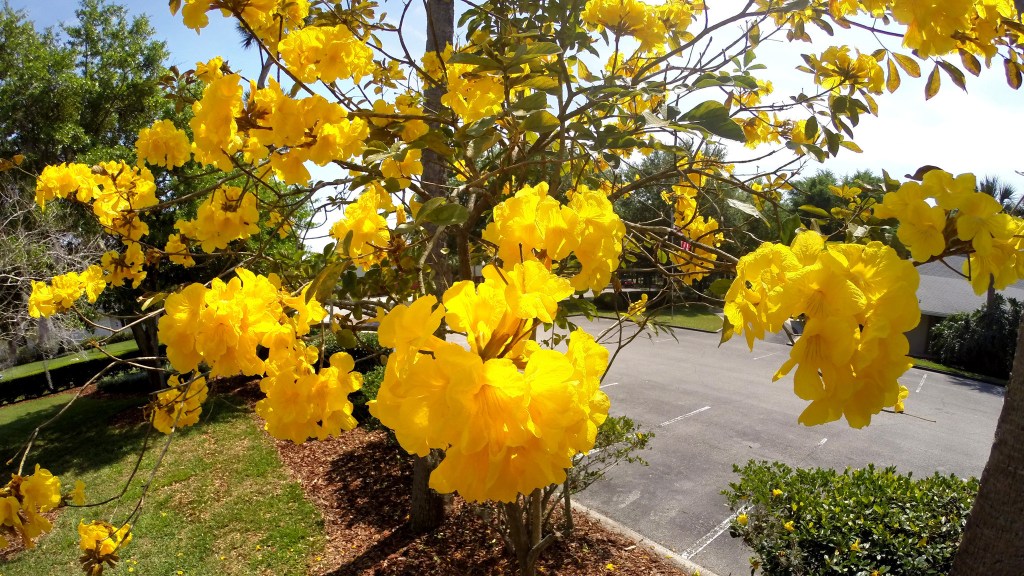
Ever seen those trees across Orlando with the pretty yellow or lavender-pink flowers and wonder where they came from? And why are there so many here?
They’re known as Tabebuias, and an Orlando man named Mulford B. Foster introduced them to Central Florida in the 1940s. They became so popular that when the Orlando Sentinel offered 7,000 for sale as part of a fund-raiser for the Edgewater High band in March 1964, it caused a traffic jam around the newspaper’s downtown building and the supply was sold out in just a few hours.
Here’s an article by Orlando Sentinel reporter Emily Bavar from March 18, 1962, explaining the story behind the pretty flowering trees:
Some people hunt for gold, some for wild animals and some, like Mulford B. Foster, hunt for rare flowers.
Which is how Tabebuia Umbellata, the graceful little tree with the butter-yellow blossoms, came to help glorify springtime in Orlando. Twenty-two years ago the Tabebuia was unknown in Central Florida. But in his Tropical Arts nursery on the brick-paved, tree-shaded street that was Magnolia Ave. in 1940, Foster nursed a twig of a tree he had brought home from Brazil.
The twig was Tabebuia (pronounced taba-B00-ya) and it grew until one fine spring day it burst into a golden bloom that lingered for weeks and caused passersby to pause and stare in wonder and examine the brilliant blossoms that drifted from the treetop.
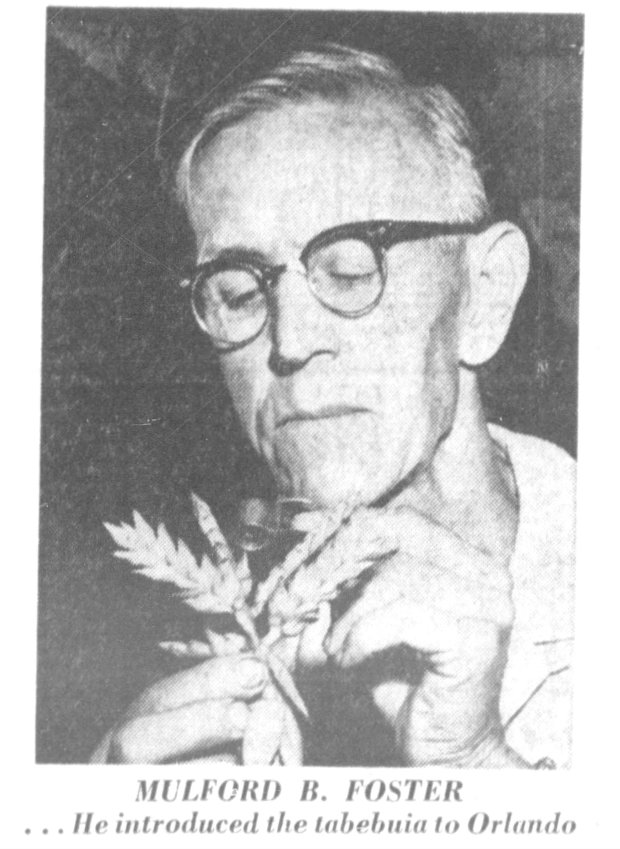 Mulford B Foster brought the first Tabebuia tree from Brazil to Central Florida in the 1940. (Orlando Sentinel file)
Foster had so many inquiries, so many demands for seed he couldn’t supply in 1948 he returned to the coastal plains of Southern Brazil, climbed the Tabebuias that grow wild there and returned with enough seeds to start seedlings of his own.
When the seedlings were large enough to transplant he gave 150 trees to the Orlando Park Department, sold the department another 150 for “a nominal sum” (no one can remember just what) and gave 150 more to the Winter Park Garden Club.
The trees were later set out around the city lakes and in the parks where, now in bloom, they are a delight to Central Floridians to whom they are still a rarity and to visitors unfamiliar with their brilliance.
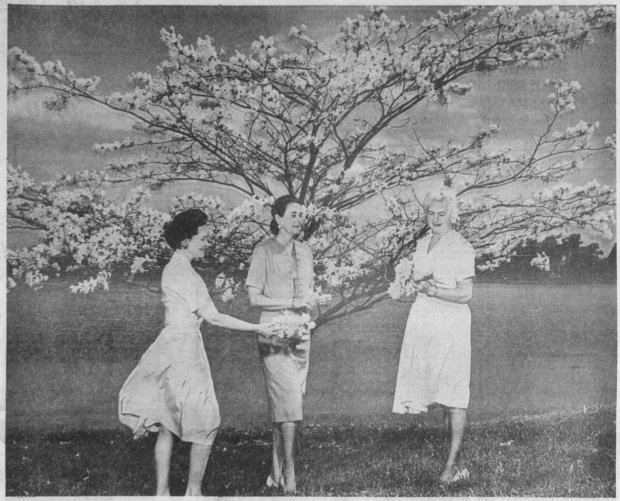 Orlando Garden Club members Mrs. Charles Blackton, Mrs. Dave Starr and Mrs. John D. Grathwol., all of Orlando, with a Tabebuia Umbrellata on the shore of Lake Ivanhoe in March 1962. (Orlando Sentinel file)
The original Tabebuia continued to grow in Foster’s nursery until Magnolia Ave. was marked for commerce. The oaks came down, the broad sidewalks receded, the bricks were replaced by asphalt and Tropical Arts was doomed.
Rather than sacrifice the tree that came to Orlando in 1940, Foster gave it to Harry P. Leu who owned an estate on Lake Rowena and who, he knew, would take care of Central Florida’s first Tabebuia. A derrick moved it to the Leu estate where it thrived. And now the granddaddy tree belongs to the city.
When Leu, early this year, turned all but three acres of his property over to the city for a park the Tabebuia fell under municipal ownership.
Foster’s trees have spread throughout Central Florida. Some have gone to Los Angeles and New Orleans. But they do better, he says, in Florida because of the summertime rainfall.
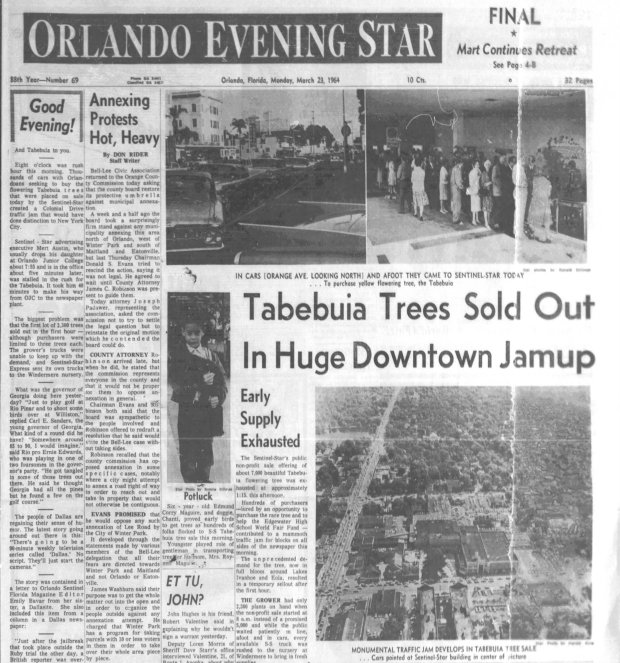 The Orlando Sentinel and Evening Star sold 7,000 Tabebuia trees for $1.50 each on March 23, 1964, to help raise funds for Edgewater High School’s band to attend the world’s fair in New York City. Traffic was jammed along downtown streets as residents flocked to get the trees. (Orlando Sentinel file)
Tabebuia Heptaphylla, a variety that bears lavender blossoms at Christmastime, has more recently been added to the Foster collection. An experiment in cross-pollination has produced a hybrid Foster believes will be superior to either parent.
When Foster brought Tabebuia Umbellata to the U.S. he faced certain rigid restrictions.
Foreign soil is not allowed and all foreign flora must go to quarantine before it receives a certificate of health.
To keep the tree alive it was put aboard ship in its own soil and a reserve supply of sphagnum moss was packed along with it. The night before the ship docked in New York, Foster washed all the soil from the roots and packed them in the moistened moss.
Previous arrangements with quarantine officials speeded the tree through what might have been a lethal delay and it was then put on a train and arrived in Orlando ahead of Foster.
Not all imported plans survive. But Orlandoans who, in years to come, will see and admire the graceful little tree that scatters yellow blooms in the Leu gardens, will know of one that did. And they will rejoice.
For more Orlando Sentinel 150th anniversary stories and photos, go to OrlandoSentnel.com/150