
 While workplace managers can expect a dip in employee productivity during March Madness, Wayne Hochwarter believes there are ways to adjust.
March Madness, one of America’s most popular annual sporting events, returns and brings peak excitement — though it’s also known for reducing worker productivity.
The first round of “The Big Dance” are popular days for employees to take off work. But for those actually working, it’s known as a two-day period that could cost the U.S. economy several billion dollars in lost productivity as workers stay glued to a large afternoon slate of college basketball games.
Florida State University’s Wayne Hochwarter, the Melvin T. Stith Sr. Professor of Business Administration, is an expert in employee motivation, job stress and coping, and influence behavior and proactivity. He has published more than 100 scientific and applied articles covering a wide range of topics, including employee entitlement, worker engagement, job stress, layoffs, workplace politics, abusive work behaviors, personal accountability, optimism and leadership-focused motivation strategies.
While workplace managers can expect a dip in employee productivity, Hochwarter believes there are ways to adjust.
“Managers should recognize that March Madness’ productivity drop is predictable and brief,” Hochwarter said. “Rather than trying to prevent it entirely, managers should adapt. Many workers check scores, stream games or manage brackets during work hours.”
Media interested in exploring the workplace dynamics between managers and employees during March Madness can reach out to Professor Wayne Hochwarter at whochwar@wertheim.fsu.edu.
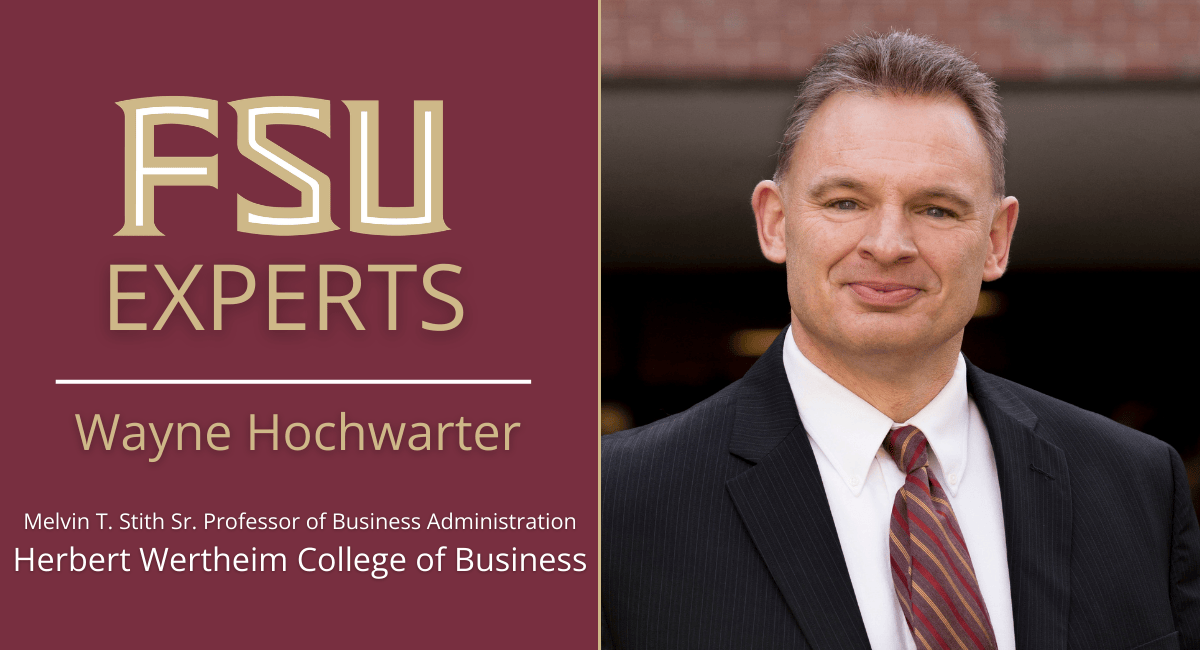
Wayne Hochwarter, Melvin T. Stith Sr. Professor of Business Administration, Herbert Wertheim College of Business
Estimates suggest March Madness could cost the U.S. economy over $13.1 billion in lost worker productivity. How can managers best adapt to this expected drop in productivity?
I question whether that is actually true. People have grown very adept at multitasking at work, and it is common to see employees simultaneously completing work tasks while attending to whatever is on their cell phones. This is particularly true for younger workers who have a long history of navigating most life activities with multiple stimuli vying for their attention at the same time. In my experience, most people do not completely disregard work to keep track of March Madness — it’s just another thing to keep track of while working at their cubicle or in their office.
Many employees are expected to average 2-3 hours per day watching tournament games. Are there any strategies that can be used by workers to ensure necessary work gets finished? How can managers handle this without micromanaging?
Managers should prioritize results over monitoring every action. Today, employees are evaluated based on what they achieve, not how busy they appear. Clear deadlines and deliverables help set expectations while allowing employees to organize their time independently. Some companies even designate common areas or lunch breaks for watching games, so distractions occur at scheduled times rather than throughout the day.
Ultimately, the best approach is a balance rooted in trust: establish clear goals, offer some flexibility and trust employees to manage their responsibilities responsibly. If they cannot do so, I recommend reevaluating the company’s hiring and training programs, since it is obvious they have failed in both areas.
A little micromanaging during March Madness can cause significant harm later on, especially if it’s delivered callously or perceived as punishment-motivated.
For office morale, can it be a healthy work environment if more employers embrace the tournament by doing an office pool and sparing time to watch games together?
First, leaders need to see this as an opportunity to build morale rather than a disruption. This is a good thing for employees to look forward to — it is predictable, you don’t have to be an expert to take part and it can help people distance themselves from increasingly demanding and unpredictable work.
Second, it’s not like there aren’t other distractions at work. Most of them cause more stress or harm to social relations than they bring workers together. For example, politics has become extremely divisive with little room for agreement. When introduced to the work environment, the results are almost always negative — feelings get hurt, people’s motives and morale are attacked and people stop interacting with others.
The most important step is to stop labeling this as a distraction. Instead, see it as an opportunity for growth. I also suggest promoting it in advance to give workers something to look forward to. This can start discussions with colleagues about a topic that isn’t naturally anxiety-provoking. In terms of occupying workers’ cognitive space, replacing “toxic diversions” with ones that encourage positive interactions is an opportunity companies should embrace.