
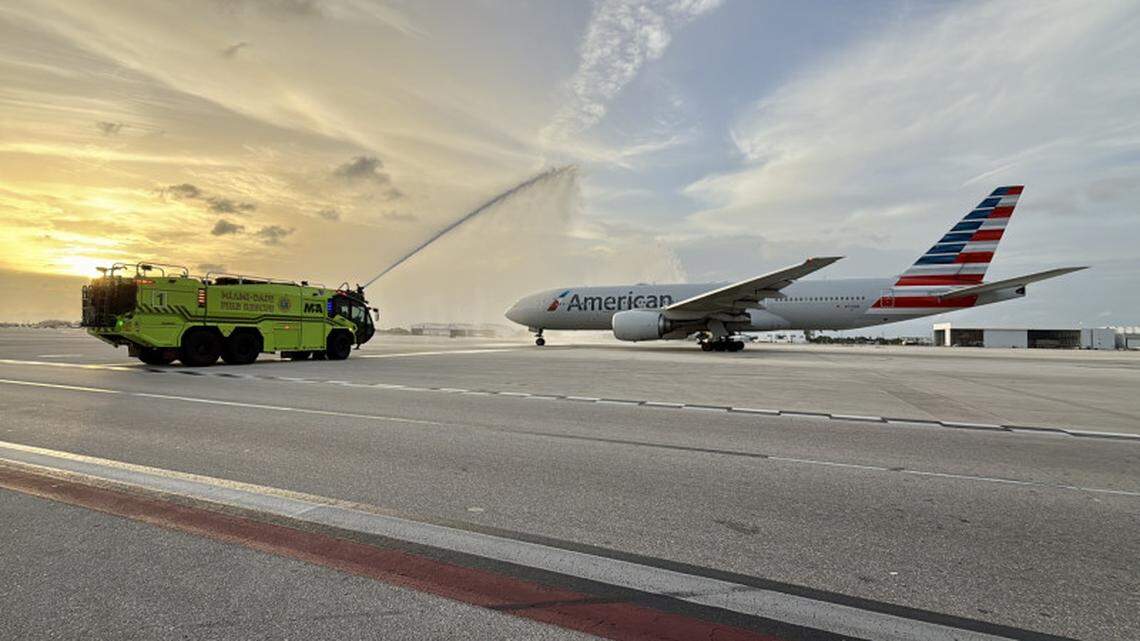
A Miami-Dade Fire Rescue truck gives a traditional water cannon salute to the inaugural Miami-Rome departure of an American Airlines plane.
Miami International Airport
American Airlines, with a major hub at Miami International Airport, is in line to be the first carrier to resume direct flights between the United States and Venezuela.
But no official starting date has been set, and the airline and both governments must complete several more steps before the first planes can take off, according to aviation experts, amid uncertainty and a dynamic political situation.
The first flights between Miami and Caracas and Miami and Maracaibo will likely be operated by Envoy, an American Airlines subsidiary that uses smaller planes and was formerly called American Eagle. When ready, tickets will be available on American’s website and the planes will fly under the American Airlines name.
At American Airlines, one of Miami-Dade County’s largest employers, the hope is that the first flights take off sometime during the first half of 2026, depending on the carrier obtaining all government approvals and positive security assessments, according to an aviation industry expert familiar with the process.
While American obtained approval by the Department of Transportation this month to resume the flights, plenty of other issues could potentially slow the process, according to the aviation expert and a former U.S. government official familiar with Venezuela.
U.S. and Venezuela bureaucracy
Just on the U.S. side of things, several agencies or departments are involved in American Airlines — or any other U.S. carrier — resuming flights. They include the U.S. Department of Transportation, Federal Aviation Administration, Transportation Security Administration, U.S. Department of State, U.S. Department of Treasury and Office of Foreign Assets Control.
On the Venezuelan side, at a minimum the Venezuelan Civil Aviation Authority has to approve the flights. Then the Venezuelan government has to issue visas to Americans who want to board those planes. The Trump administration has to do the same for Venezuelans.
MORE: U.S., Venezuela agree to restore diplomatic ties, 7 years after they were cut off
Trump’s role in the process
Fortunately for the resumption of Miami-Venezuela service, a 1953 treaty between the countries allowing flights was not overturned in the past two decades of conflict, and remains in effect.
In January, the U.S. military under orders from President Donald Trump removed and arrested Venezuelan dictator Nicolás Maduro and his wife, Cilia Flores, in Caracas, and brought them to New York.
The Trump administration left in place Delcy Rodríguez to lead Venezuela. She was previously Maduro’s No. 2 and is implicated in a host of human rights violations and acts of state repression including torture and killings. But the Trump administration has bet on leaving her in place as an effective way to lead to a gradual transition or do its bidding.
While Trump has downplayed the importance of democracy returning to Venezuela, he has pressed forward normalizing some business relations. That includes pushing American oil and mining executives to work there even if it will likely take years before yielding significant results for many companies.
Department of Transportation
On Jan. 29, during a cabinet meeting, President Trump said the U.S. government would allow U.S. airlines into and out of Venezuela. By the end of the day, Transportation Secretary Sean Duffy did.
The Department of Transportation rescinded an order from 2019 that had suspended foreign air transportation between the United States and Venezuela. The same day, American Airlines, which had operated flights until that year, said it “plans to reinstate nonstop service between the United States and Venezuela” and “is ready to commence flights to Venezuela, pending government approval and security.” It quickly filed an application with the DOT.
By the end of Duffy’s news conference, a Federal Aviation Administration’s NOTAM for Maiquetía airport in Caracas was no longer on its website. That’s a restriction that prohibits all carriers from flying into that airspace due to safety concerns.
A statement from the FAA later confirmed that the agency had removed “four NOTAMs in the Caribbean region, including one related to Venezuela, as well as advisories affecting airspace over Curaçao, San Juan (Puerto Rico), and the Piarco Flight Information Regions.”
On March 4, the DOT authorized Envoy Air to do the following for a two-year period: “Scheduled foreign air transportation of persons, property and mail between Miami, Florida and Caracas, Venezuela; and Miami, Florida and Maracaibo, Venezuela.”
The former American Eagle
American Airlines has so far prioritized Envoy because of plane size. The stand-alone carrier uses smaller Embraer-175 planes.
Aviation observers believe American’s advantage in starting off with the Envoy is it allows the company to test the market with a more economically efficient service and allows it to be more nimble. American is expected to eventually use its bigger planes to serve the Miami and Venezuela routes.
American Airlines spokesperson Gianna Urgo declined a Miami Herald request to interview a company executive about the flights to Venezuela.
“We don’t have anything to add at the moment,” she said.
Just after DOT approval, the FAA gave its own. A spokesperson told the Miami Herald: “There is no additional action [required] from the FAA.” At that point, American got everything it needed from the DOT.
Transportation Security Administration
But several more steps remain.
TSA needs to assess the airports in Venezuela through what’s called a Last Point of Departure Audit. TSA approval means that the airports have the security necessary to be a last point of departure to the United States. They evaluate equipment, procedures, the perimeter and perimeter fencing.
TSA officials visited Maiquetía in February, just about two weeks after the Trump administration lifted the ban, considered fast by aviation experts.
The agency now needs to release its audit — and if it includes corrective action, a possibility, the Venezuelans will have to respond.
Travel advisories and visas
The U.S. State Department also plays a role. While the department doesn’t oversee any approvals for airlines, it controls travel advisories, and issues or denies visas.
Venezuela carries a Level 4 Travel Advisory for U.S. citizens, the most perilous. Issued in Dec. 4, it warns: “Do not travel to or remain in Venezuela due to the high risk of wrongful detention, torture in detention, terrorism, kidnapping, arbitrary enforcement of local laws, crime, civil unrest, and poor health infrastructure.” The advisory adds that “the U.S. government cannot provide emergency services to U.S. citizens in Venezuela.”
That’s a big deterrent to traveling, and that level will have to decrease assuming conditions improve to get people on planes, according to aviation experts.
Then, travelers, Venezuelans and Americans, will need visas.
How easy will that be in the U.S. where hostility to immigration is one of Trump’s signature issues? On the other side, Venezuela doesn’t have an easy process for a U.S. citizen to get a visa, according to sources.
The former government official said the only way for U.S. citizens to get visas to enter Venezuela for now is to go to Aruba, Curaçao, Panama City or Bogotá. And even before the first flights, the American Airlines’ corporate security team will need to visit Maiquetía and do various checks. Many of them will need visas.
The U.S. Department of Treasury has a role, too.
The Office of Foreign Assets Control, known as OFAC, is charged with sanctions. And many have been issued against Venezuelans involved with the Maduro regime. So, it’s necessary for American and other U.S. airlines that follow to monitor carefully who their passengers are, to make sure no one still faces sanctions.
For the carriers, the Treasury department already updated general licenses to allow airlines to purchase aviation fuel in Venezuela or pay the airport for other services. And OFAC seems willing to allow exemptions.
Still, other tasks remain.
Caracas local office
American Airlines will have to register a local office and open a bank account and establish a legal entity. The company also has to find vendors and rebuild IT infrastructure.
Then there’s the money it lost from previous operations in part due to using Venezuelan currency. As one example, the Wall Street Journal reported in 2016 that the carrier wrote off at least $592 million then. And American and other U.S. carriers left more money stuck there.
American and other carriers are aware of those losses, but for now the primary goal is to restart operations. And the Trump Administration has indicated it could help companies recover lost assets, giving them hope.
There are other challenges.
The Trump Administration seems to be using sanctions to exact leverage with the former members of the Maduro regime. That makes for a dynamic process in determining who’s on a sanctions list.
Then there’s Maiquetía carrying a Category 2 in air safety standards, a result of the FAA downgrading it in 2019. At that time, the FAA said Maiquetía didn’t comply with International Civil Aviation Organization safety standards. It noted that a Category 2 “means the country either lacks laws or regulations necessary to oversee air carriers in accordance with minimum international standards, or its civil aviation authority … is deficient.”
This won’t keep American Airlines from resuming direct flights between the U.S. and Venezuela in the short term. But it does prevent Venezuelan air carriers from launching new service to the U.S. And at some point, Venezuelan officials may decide they’d like some kind of reciprocity.
Miami Herald
Vinod Sreeharsha covers tourism trends in South Florida for the Miami Herald.