
Moneywise and Yahoo Finance LLC may earn commission or revenue through links in the content below.
Florida’s housing market boomed during the pandemic, as Americans flocked to the Sunshine State in search of warmer weather, lower taxes and more space. But that surge has now pushed one of its biggest cities into dangerous territory: Miami has just been ranked the world’s most at-risk housing market.
According to the Global Real Estate Bubble Index 2025 released by UBS, Miami was at the top of its list, having a bubble risk score of 1.73 — well above the threshold of 1.5 that signals “high” risk (1).
That score puts the city ahead of famously overheated markets like Los Angeles, Toronto, San Francisco and New York.
The index tracks metrics such as price-to-income and price-to-rent ratios, construction activity and mortgage rates. In Miami, affordability for buyers has fallen to near record lows, yet home prices continue to diverge sharply from rents.
“Over the past 15 years, Miami has posted the strongest inflation-adjusted housing appreciation among all cities in the study,” UBS wrote in its report. “The current price-to-rent ratio has surpassed even the extremes of the 2006 property bubble, signaling a high bubble risk.”
What followed that mid-2000s bubble was a collapse that wiped out trillions in household wealth, triggered a wave of foreclosures and set off the worst financial crisis since the Great Depression.
The study also noted that Miami’s housing inventory has climbed back to near pre-pandemic levels, while regulatory changes are forcing many condo associations to finally tackle decades of deferred maintenance, saddling owners with hefty repair bills.
On top of that, insurance premiums are surging, driven by mounting environmental risks such as flooding and hurricanes. These combined costs are prompting more owners to sell, adding to the pressure on the market.
But one corner of Miami’s housing market is still booming: billionaire real estate.
So, what’s bringing in the billionaires?
Miami’s coastal appeal must have something to do with it. Beyond that, its favorable tax environment is also still drawing high-net-worth newcomers from across the U.S. — particularly since Florida does not impose a state income tax.
That influx has helped fuel eye-popping deals in some of the region’s most exclusive neighborhoods.
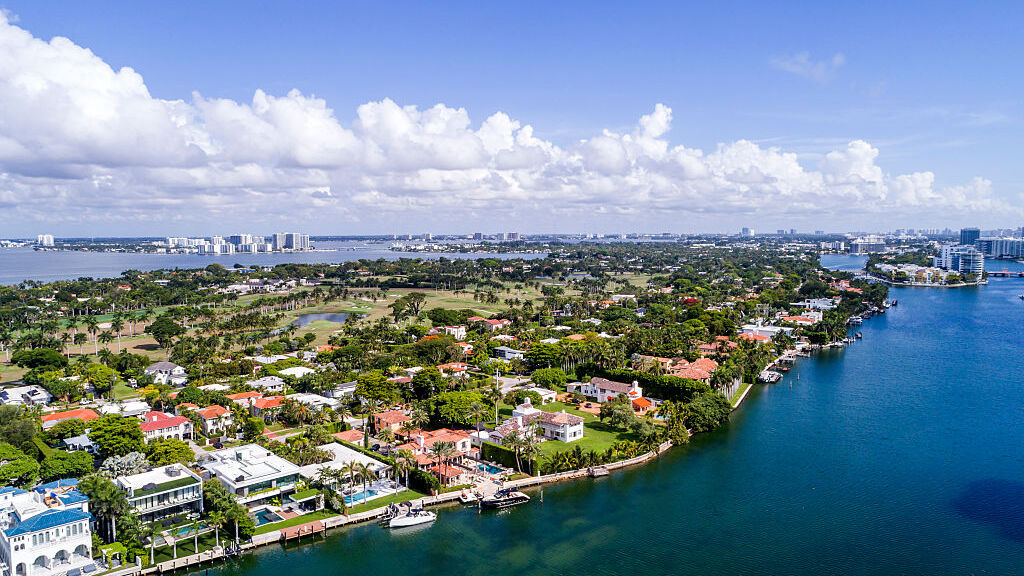
For example, billionaires have been snapping up homes on Indian Creek Island — the ultra-exclusive Miami enclave known as the “Billionaire Bunker.” The tiny island has only 41 waterfront homes and a population of about 84 people (as of 2020), but it has quietly become a magnet for some of the world’s richest residents (2).
Currently, two of the five richest people in the world own property there: Jezz Bezos and Mark Zuckerberg.
Amazon founder Jeff Bezos moved there in 2023 — shortly after Washington state, where he previously resided, imposed a 7% tax on long-term capital gains exceeding $250,000 (3).
Meanwhile, Mark Zuckerberg, the billionaire cofounder of Meta Platforms, is the latest high-profile arrival. He recently bought a roughly $170 million mansion on a private island, setting a record for the most expensive residential sale in Miami-Dade County (4).
Unsurprisingly, Zuckerberg’s move to Miami came as Californian lawmakers proposed a 5% “wealth tax” on global fortunes, spread over five years.
Apart from Bezos, his new neighbors include former NFL quarterback Tom Brady and billionaire investor Carl Icahn.
That is resplendent company, indeed.
Read More: I’m almost 50 years old and don’t have retirement savings. Is it too late to catch up?
Read More: Non-millionaires can now invest in this $1B private real estate fund starting at just $10
But not everybody can resettle as easily as billionaires.
While they are busy snapping up multimillion-dollar homes on private islands, most people aren’t in a position to write seven-figure checks — or carry seven-figure mortgages.
But there are ways to play the same game. Real estate crowdfunding platforms let you own a portion of commercial or residential properties and share in the profits alongside other investors — without the headaches of being a landlord.
That way, you won’t have to juggle multiple mortgage payments, chase down tenants, handle insurance or even worry about whether a storm is headed your way.
To get started, you can tap into this market by investing in shares of vacation homes or rental properties through Arrived.
Backed by world-class investors, including Jeff Bezos, Arrived allows you to invest in shares of vacation and rental properties, earning a passive income stream without the extra work that comes with being a landlord of your own rental property.
To get started, simply browse through their selection of vetted properties, each picked for their potential appreciation and income generation. Once you choose a property, you can start investing with as little as $100, potentially earning quarterly dividends.
Once you’re an investor with Arrived, you’ll also gain access to their newly launched quarterly secondary market, where investors can buy and sell shares of individual rental and vacation rental properties directly on the platform.
This allows you to buy into properties you may have missed at the initial offering or sell shares before a property reaches the end of its hold period.
With access to more than 400 properties in 60 cities, this new way to trade real estate opens up flexibility and opportunities to gain access to more properties every quarter.
Single-family rentals and vacation properties are a great start, but there’s a whole other level of real estate that tends to attract long-term, seasoned investors. Commercial and industrial properties are where professional investors often focus, thanks to their steady income generating potential and long-term appreciation.
If diversifying into industrial rentals appeals to you, you could consider investing with Lightstone DIRECT, a new investing platform from the Lightstone Group, one of the largest private real estate companies in the country.
Since they eliminate intermediaries — brokers and crowdfunding middlemen — accredited investors with a minimum investment of $100,000 can gain direct access to industrial real estate opportunities. This streamlined model can help reduce fees while enhancing transparency and control.
And with Lightstone DIRECT, you invest in deals alongside Lightstone — a true partner — as Lightstone puts at least 20% of its own capital into every offering. All of Lightstone’s investment opportunities undergo a rigorous, multi-stage review before being approved by Lightstone’s Principals, including Founder David Lichtenstein.
How it works is simple: Just sign up with your email, and you can schedule a call with a capital formation expert to assess your investment opportunities. From here, all you have to do is verify your details to begin investing.
Founded in 1986, Lightstone has a proven track record of delivering strong risk-adjusted returns across market cycles, with a 27.6% historical net IRR and 2.54x historical net equity multiple on realized investments since 2004. All told, Lightstone has $12 billion in assets under management — including commercial and industrial real estate.
As such, even if commercial and industrial rentals don’t appeal to you, Lightstone could still serve you well as an investment vehicle for other real estate verticals.
Get started today with Lightstone DIRECT and invest alongside experienced professionals with skin in the game.
One reason people gravitate toward real estate is its reputation as a hedge against inflation. When the cost of living rises, so do the prices of materials, labor and land — and that often pushes home values higher as well.
But it’s worth remembering that real estate isn’t the only shield against inflation. For generations, investors have also turned to gold as a time-tested store of value.
Gold’s appeal is straightforward: Unlike paper money, the precious metal can’t be created at will by central banks. It’s also considered the ultimate safe haven — untethered to any single country, currency or economy. In periods of market stress or geopolitical turmoil, demand for gold tends to surge, often driving prices higher.
And over the past 12 months, gold prices have climbed more than 76% (5).
In fact, experts like Ray Dalio, founder of the world’s largest hedge fund, Bridgewater Associates, have long been highlighting gold’s importance to maintaining a resilient investment portfolio.
“People don’t have, typically, an adequate amount of gold in their portfolio,” Dalio told CNBC in late 2024 (6). “When bad times come, gold is a very effective diversifier.”
Just as it is a great diversifier of your portfolio, there are also diverse ways of investing in the yellow metal.
One way of investing in gold that also provides significant tax advantages is to open a gold IRA with the help of Priority Gold.
Gold IRAs allow investors to hold physical gold or gold-related assets within a retirement account, thereby combining the tax advantages of an IRA with the protective benefits of investing in gold, making it an option for those looking to help shield their retirement funds against economic uncertainties.
To learn more, you can get a free information guide that includes details on how to get up to $10,000 in free silver on qualifying purchases.
At the end of the day, everyone’s financial situation is different — from income levels and investment goals to debt obligations and risk tolerance. If you’re unsure which type of investment is right for you, consulting an expert might offer some insights.
With Advisor.com, you can find the best advisor for your needs — both in terms of what they can offer your finances and what they’ll charge to work for you.
Just enter a few details about your finances and goals, and Advisor.com’s AI-powered matching tool will connect you with a qualified expert best suited for your needs based on your unique financial goals and preferences.
Finding the right advisor isn’t always easy — there’s no one-size-fits-all solution. That’s why Advisor.com lets you set up a free initial consultation with no obligation to hire to see if they’re the right fit for you.
Join 250,000+ readers and get Moneywise’s best stories and exclusive interviews first — clear insights curated and delivered weekly. Subscribe now.
We rely only on vetted sources and credible third-party reporting. For details, see our editorial ethics and guidelines.
UBS (1); Fortune (2); Morningstar (3); The New York Times (4); APMEX (5); @CNBCInternationalLive (6)
This article provides information only and should not be construed as advice. It is provided without warranty of any kind.