
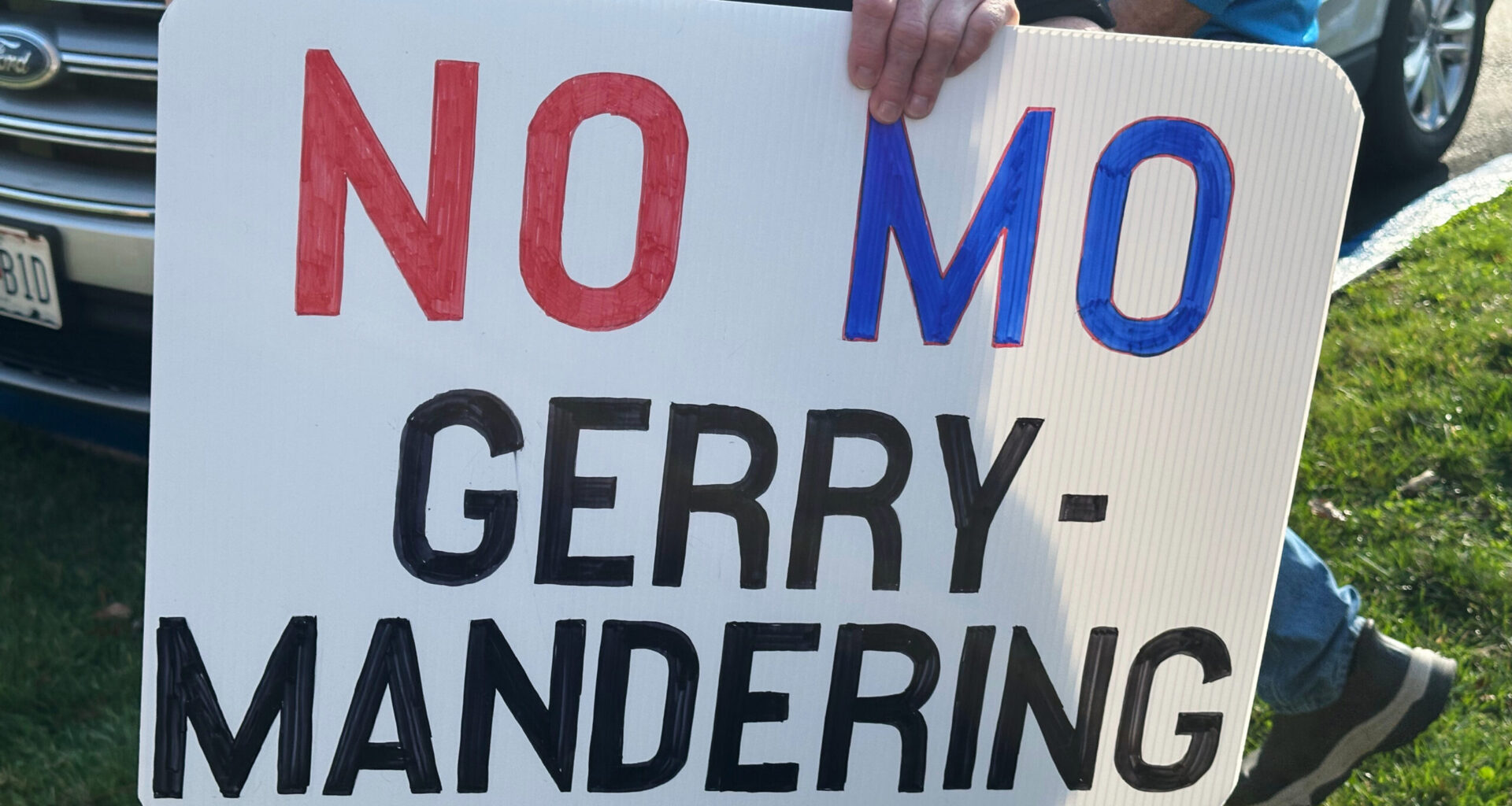
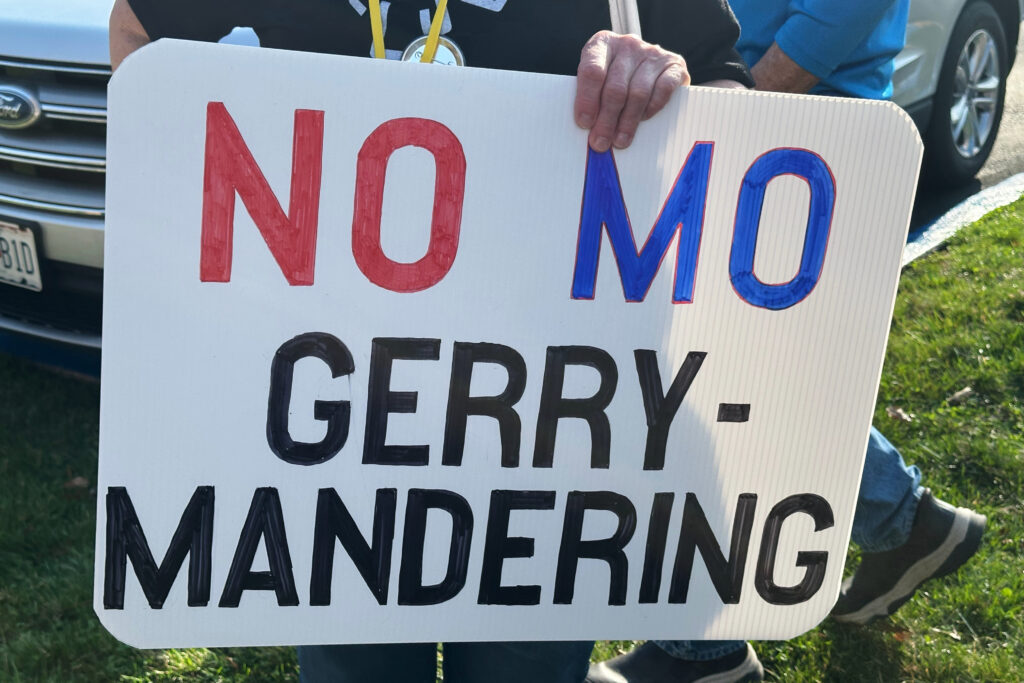
 A person holds a sign opposing the new U.S. House districts passed by the Missouri General Assembly during a protest outside the state Capitol, in Jefferson City, Mo., Tuesday, March 10, 2026. (AP Photo/David A. Lieb)
President Donald Trump’s plan to rig the 2026 midterm elections by pushing GOP-controlled states to redraw their congressional maps isn’t over yet.
Last year, California voters fought back against Trump, approving their own new map intended to erase Republicans’ gains in Texas. But now, Virginia and Florida are locked in a similar battle of political wills, with Virginians currently voting on Democrats’ redistricting plan and Republicans set to redraw Florida’s congressional map in their favor next month.
Typically, states only redraw congressional maps once per decade, when new census data is released. But thanks to Trump’s push for unprecedented mid-decade redistricting to benefit the GOP, states across the country have entered the fray and raced to pass new gerrymanders in time for the 2026 midterm elections.
Republicans have potentially already gained a total of seven more seats in Congress — five in Texas, one in Missouri, one in North Carolina. And they could gain three to five more seats when Florida holds its redistricting special session next month.
Democrats, meanwhile, have potentially gained a total of six seats — five in California and one in Utah. They could gain four more in Virginia if voters approve a redistricting ballot measure — and if the plan holds up in court.
Ultimately, redistricting is just one of the strategies in Trump’s sprawling war to engineer a GOP win in 2026 midterms, despite sinking polling numbers. He’s also demanding Congress pass the most restrictive voting bill in history, threatening to “take over” elections, trying to force states to hand over their unredacted voter rolls and weaponizing federal agencies to launch election investigations based on conspiracy theories.
Here’s where the redistricting fight currently stands in each state.
Virginia
Much like California voters last fall, Virginians are now casting their ballots on a redistricting plan after Democrats raced against the clock to pull together a special election in response to Trump’s gerrymanders in other states. Currently, Virginia’s congressional delegation consists of six Democrats and five Republicans. If voters approve the redistricting measure — and if it survives legal challenges — the state will enact a “10-1” map for the 2026 elections that could net Democrats four more seats in Congress.
The Virginia Supreme Court is allowing the election to move forward before it rules* on the plan.
Democrats are counting on former President Barack Obama’s endorsement to help persuade voters to vote “yes” on redistricting. Republicans are also launching a full-court press against the measure, including by sending out deceptive racist mailers.
Early voting runs until April 18. Election day is April 21.
Florida
Florida Gov. Ron DeSantis (R) has called a redistricting special session starting April 20. With Virginia holding its referendum vote the following day, the two states appear to be on a map-drawing collision course.
National Republicans’ leading mapmaker, Adam Kincaid, recently told podcast host, former Trump press secretary and former Dancing With The Stars contestant Sean Spicer what he’s expecting to see unfold in the Sunshine State.
Kincaid said he’s not directly involved with the state’s redistricting effort, but he predicted Florida Republicans would redraw the congressional map next month, and the plan could net Republicans three to five more seats in the House.
Rep. Kat Cammack (R-Fla.) told the Washington Post that Republicans are more likely to pick up two to three seats.
Notably, Florida voters passed a ban on partisan and racial gerrymandering in 2010, which seemingly should be a major hurdle for Republicans. But Florida Supreme Court justices — most of whom were appointed by DeSantis — have signaled that they don’t actually consider the voter-approved ban to be a barrier to gerrymandering.
Florida Republicans aren’t relying on redistricting alone to give themselves an advantage in the midterms. Last week, the state legislature passed a state version of the national SAVE America Act, a Trump-backed bill that faces an uphill battle in Congress. In an enormous change to Florida’s voting systems, voters will be required to prove their citizenship status once the legislation goes into effect in 2027.
Missouri
Six months after Missouri Republicans passed their gerrymander — splitting up Black communities in Kansas City’s 5th District and moving them into far-flung Republican-leaning districts — we still don’t know whether the new map will be used in this year’s midterm elections.
Missourians turned in more than 300,000 signatures to hold a citizen’s “veto referendum” election on the GOP-controlled legislature’s gerrymander. And referendum organizers say they’ve cleared the signature verification process. But Republicans aren’t done waging a bare-knuckle brawl to stop voters from holding the election.
Missouri courts are taking their time. There are still two pending legal cases* on the map itself and three pending decisions related to GOP efforts to block the referendum.
But the Missouri redistricting saga could come down to one case: a lawsuit challenging Missouri Republicans’ claim that the new gerrymander is already in effect, even though the referendum hasn’t been held yet.
Precedent dictates that the map should not go into effect until after Missourians have a chance to weigh in. But the Republicans are entirely ready to break with precedent if it gives Trump a win.
Utah
Utah’s congressional map for 2026 is locked in: The state will be using a court-ordered map that could result in one more Democratic seat in Congress.
A state court struck down a GOP gerrymander last year, ruling that it violated Utah’s voter-approved gerrymandering restrictions by splitting up Salt Lake City — the state’s liberal power base — across all four of its congressional districts.
Republicans are mad as hell about the decision, but they’ve exhausted their legal resources to stop the court-ordered map — at least for the midterms.
Now they’re focused on rewriting the rules for the future, so it will be harder to challenge their next gerrymander. Most notably, they’ve gathered enough signatures to put a measure on the November ballot to repeal the state ban on partisan gerrymanders.
Maryland
Maryland Democrats pushed their redistricting plan through the House, but it appears to be completely dead in the Senate, after state Senate President Bill Ferguson (D) repeatedly refused to hold a vote on the measure.
Ferguson insisted the plan could ultimately yield a loss for Democrats, because a legal challenge might result in a court-ordered redraw with potentially fewer Democratic seats. While Ferguson himself has been quiet on the rationale for why he believes this, Kincaid felt confident that the Democrat-led General Assembly had already stretched their luck with the current 7-1 congressional map in favor of Democrats. The state’s fairly conservative Supreme Court, Kincaid argued, may be less inclined to uphold the current map if it were ever challenged, let alone if the General Assembly passed an 8-0 map.
Texas
In Texas, where Trump began his redistricting war, the GOP gerrymander is in effect for 2026 — although early estimates that it could net Republicans five more seats in Congress seem to have been revised downward.
In his recent interview, Kincaid — who drew the Texas map — said it’s likely to result in three to five GOP pickups.
Last year, a federal three-judge panel found that the Texas map was likely an illegal racial gerrymander. But the U.S. Supreme Court majority disagreed, arguing that it was also too close to the election for federal courts to intervene.
While the map will be used in 2026, the lawsuit* challenging the gerrymander is still active and likely won’t be resolved until next year.
Chris Gober, who was reportedly on retainer with the Republican National Committee (RNC) and appears to have helped direct the mapdrawing effort, won the Republican primary this month to fill one of the congressional districts he helped redraw.
California
California voters approved the redistricting plan in November, clearing the way for Democrats to potentially pick up five more seats in Congress.
Republicans filed numerous legal challenges, but a federal three-judge panel and the U.S. Supreme Court allowed* the new California map to be used in 2026.
Two GOP lawsuits are still pending.
North Carolina
North Carolina’s congressional map is also locked in for 2026, after federal judges allowed* the state’s Trump-backed gerrymander to go into effect. The new map brazenly dismantles a district with a historical record of Black representation.
After the ruling, the plaintiffs dismissed their remaining claims.
New York
New York voters filed a lawsuit* in state court challenging New York’s 2024 congressional map, arguing that it violated the New York Voting Rights Act by diluting the voting power of Black and Latino residents of Staten Island in Congressional District 11. A New York court agreed with them and ordered a new map to be drawn. The state court of appeals ordered the redraw to move forward while the appeals process continued. However, the U.S. Supreme Court quickly paused the lower court’s order and blocked the new map.
The existing 2024 map will be in effect for 2026.
*The Elias Law Group (ELG) is representing a party in this case. ELG Firm Chair Marc Elias is the founder of Democracy Docket.