
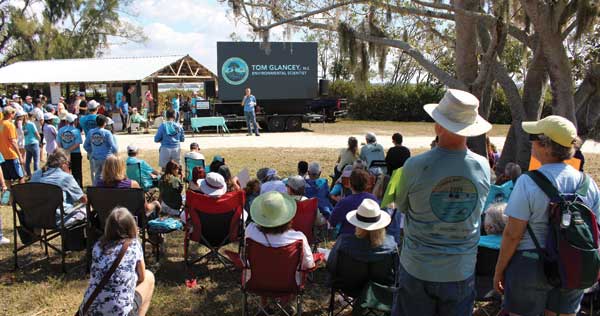
Terra Ceia resident and environmental scientist Tom Glancy speaks to a crowd Feb. 14 during a rally opposing a proposed cruise port near the mouth of Tampa Bay. Islander Photo: Robert Anderson
Florida lawmakers have approved a coastal protection measure that supporters say could block a proposed cruise port near Terra Ceia, though at least one expert warns the legislation may still allow other large-scale development next to the aquatic preserve.
The Terra Ceia debate centers on the 328-acre Knott-Cowen tract near the mouth of Tampa Bay, where developers SSA Marine and Slip Knott LLC have proposed a terminal for cruise ships too tall to pass beneath the Sunshine Skyway Bridge’s 180-foot vertical clearance.
The Knott-Cowen tract is adjacent to the protected Terra Ceia Aquatic Preserve, which covers about 21,736 acres in northwest Manatee County, stretching from near Little Redfish Creek at Port Manatee to Emerson Point on Snead Island, where its seagrass flats and tidal creeks serve as key nursery habitat for marine life in lower Tampa Bay.
Public opposition has grown quickly, prompting the formation of People Protecting Terra Ceia Aquatic Preserve, a grassroots coalition of residents, fishermen and environmental advocates, as well as rallies, social media campaigns and legislative action during the 2026 session.
Senate Bill 302, a coastal resiliency measure sponsored by state Sen. Ileana Garcia, R-Miami, passed the Senate with an amendment by state Sen. Jim Boyd, R-Bradenton, addressing the aquatic preserve.
The Florida House unanimously passed the measure March 10, sending the bill to Gov. Ron DeSantis. If enacted, the measure would take effect July 1.
SB 302 would expand nature-based coastal protection strategies statewide and direct the Florida Department of Environmental Protection to develop shoreline resilience guidelines. The amendment, specific to the Terra Ceia Aquatic Preserve, would restrict dredging and filling while allowing projects such as marinas, boat ramps, piers, docks and related navigation channels and access roads if officials determine the projects would not harm water quality or the preserve’s ecological value.
Boyd has said his goal with the amendment would be to protect the area surrounding Terra Ceia. In a Feb. 3 opinion column in the Tampa Bay Times, he wrote, “Preserving Rattlesnake Key, Knott-Cowen and the surrounding properties is a critical mission. And I’m going to do everything I can to protect it.”
State Rep. Will Robinson Jr., R-Bradenton, in a floor speech advocating for the protection measure, said, “This is one of the most pristine areas in our state, and we don’t need mega cruise ships in this area.”
While many port opponents have viewed the amendment as a win, Tom Glancy said he sees it as a “Trojan horse.”
Glancy, a marine permitting specialist from Terra Ceia who has emerged as a leading voice among residents tracking the issue, holds a master’s degree in marine biology from the University of Florida. He worked for the Florida Department of Environmental Protection 2002-12 in state lands and environmental resource permitting, then spent more than a decade in marine construction permitting before launching an environmental consulting firm.
“I’ve been reading these rules and been reviewing this stuff from both sides of the table for the last 25 years,” Glancy said March 12.
“It looks on the surface as if this was done to protect the aquatic preserve from this big, supposed boogeyman of the cruise port, but we don’t know for sure that they were ever really planning on doing that,” he said.
The cruise port concept surfaced publicly in January through conceptual materials tied to pre-application discussions with Manatee County involving the Knott-Cowen tract. which is zoned for general agriculture and residential single-family.
About Boyd’s amendment, Glancy said, “That language is intentional to open the door to commercial development.”
“If that monster really existed, that monster has probably been severely wounded,” he said of a port proposal and Boyd’s amendment. “But it created some very large open doors for development.”
The shallow seagrass flats and nursery habitat in the area make it vulnerable to dredging, boat traffic, turbidity, fuel pollution and long-term ecological damage.
“This is one of the very last places like this around, and it’s an extremely important estuary nursery,” Glancy said. “I think we’re just waiting to see what the next monster is that comes over the horizon and then prepare for battle.”
More from The Islander: