
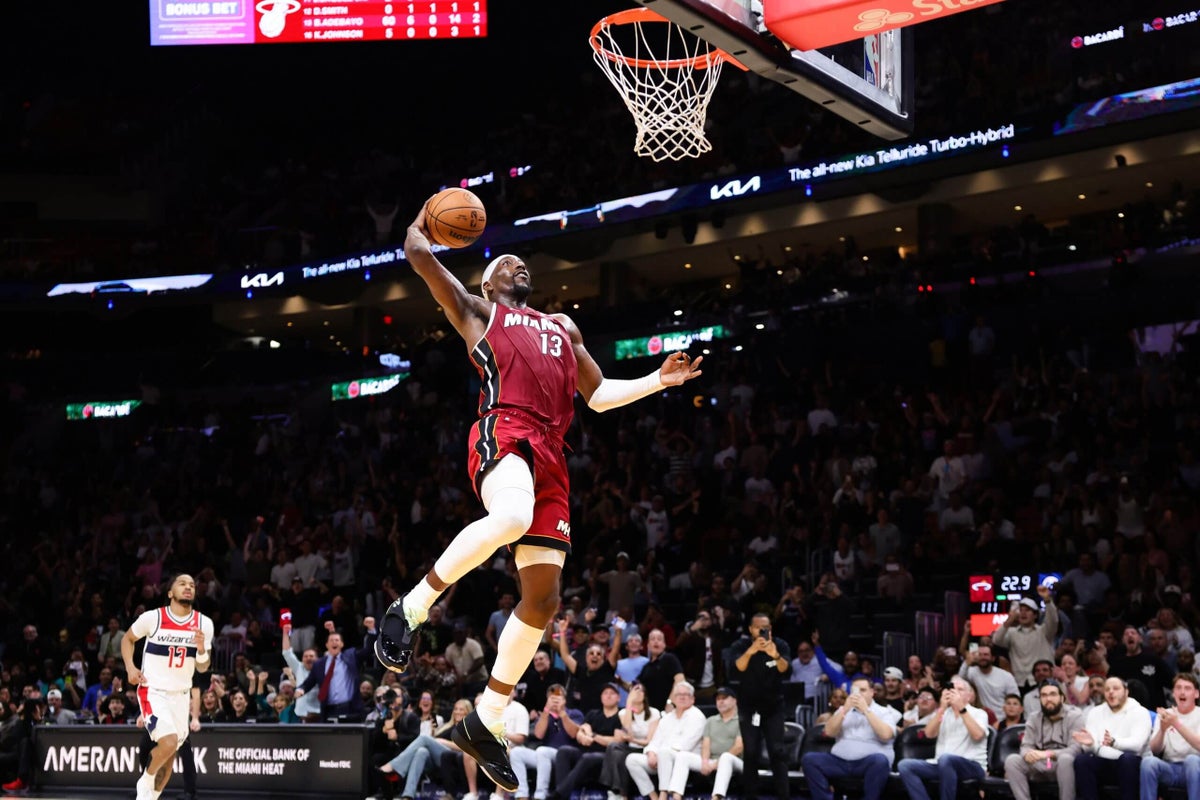
MIAMI — The faux pain began midway into the third quarter.
After yet another free throw from Bam Adebayo, Jamie Carrig turned to the fellow Miami Heat staffer seated next to him.
Carrig’s hand was cramping. Or so he claimed.
“I need a reliever,” he joked to Heat media relations veteran Rob Wilson.
Carrig has been Miami’s official scorer for the past four seasons and has worked on the team’s stats crew since the organization’s inception in 1988. But in 38 years, he had never seen what was before him a week ago. Save for the lucky few present for Wilt Chamberlain’s trek to triple digits, no one had.
When Adebayo dropped a historic 83 points on March 10, it was Carrig’s job to log each one in his scorebook.
BEAT OUR EXPERTS
Predict how you think the tournament will
play out. Can you beat one of our experts?
All the 2-pointers. All the long balls. And, most strenuous, all of Adebayo’s record-setting 43 free-throw attempts.
“I had to make sure to hydrate,” Carrig joked while recalling the experience to The Athletic.
Even during the digital age, an old-school tradition remains at each NBA game. An official scorer locks in at a sideline table to track each basket and each foul by hand. Carrig most often is that man for the Heat, taking over first-string duties after Miami’s longtime official scorer, Peter Abraham, retired in 2022.
Every once in a while, Carrig will shift to another job at the scorer’s table. The Heat will shuffle their stats crew around, sometimes out of mere superstition. Carrig could move to another statistical assignment for one evening. On other nights, he might operate the clock.
Wilson, his seat neighbor, will occasionally threaten to bench Carrig if the Heat have a bad night. Clearly, the official scorer bears the most blame for any loss. But Carrig, as he was for Adebayo’s breakout night, the second-highest-scoring performance in NBA history, most often takes the book.
The job entails two requirements: attention to detail and tiny handwriting. Carrig’s scorecard is lined with green boxes that divide the first, second, third and fourth quarters. Along with fouls, he must track every made shot per player per quarter.
If someone sinks a field goal, he delineates the difference with a little No. 2 or No. 3. Free-throw attempts are circles; makes get a tiny “X” scribed in the middle of them.
Last Tuesday, Carrig doodled 43 of those circles for Adebayo. If carpal tunnel ever develops, he might have a case in court against the center who set the record for single-game free-throw attempts.
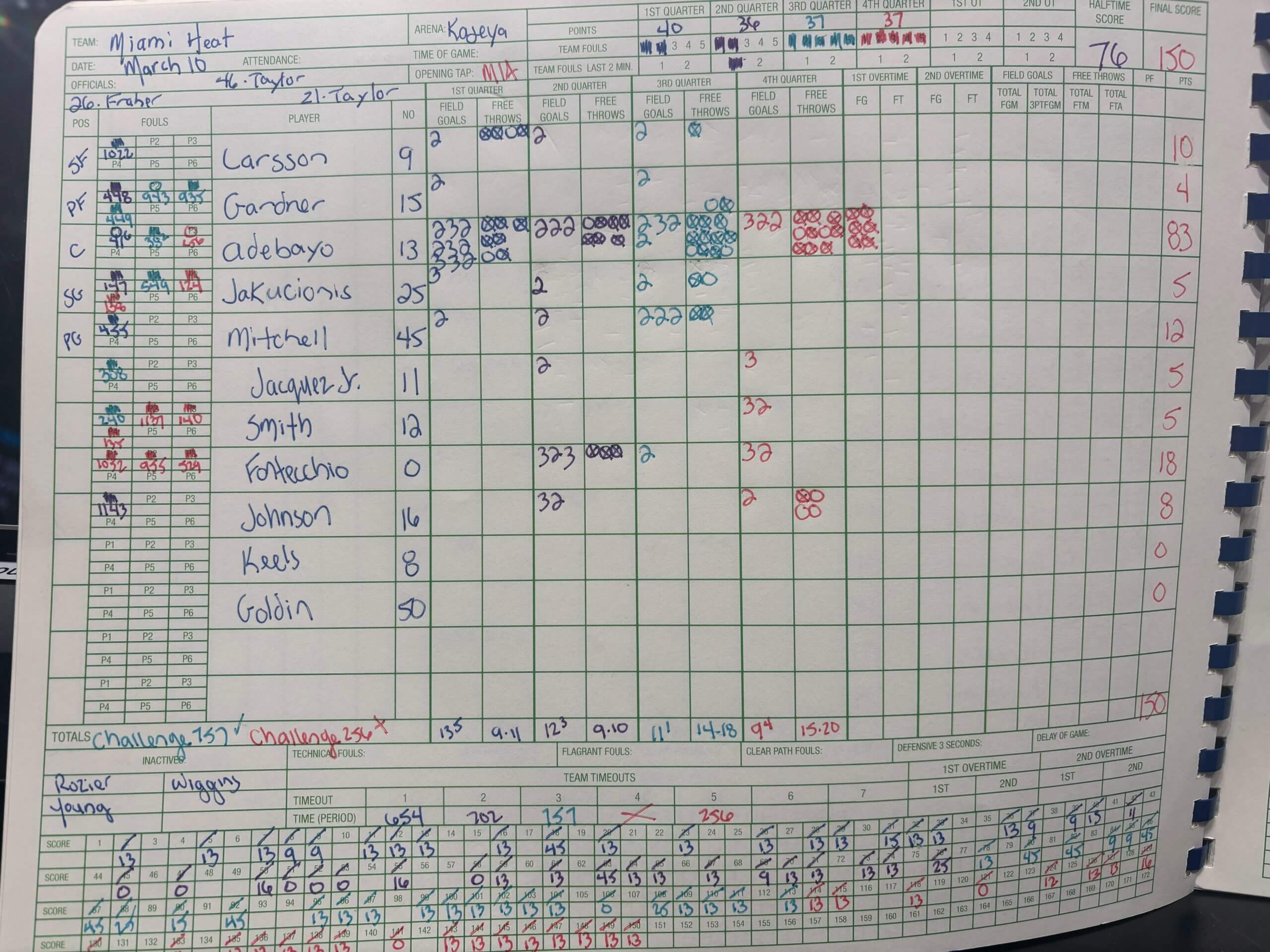
Jamie Carrig’s official scoring of Bam Adebayo’s 83-point night for the Miami Heat. (Fred Katz / The Athletic)
“(I got) no ice bath afterwards,” Carrig said. “But I thought about putting (my hand) in the ice cream cooler in the back where we have our dining.”
Baseball might inspire the most romanticized handwritten scorekeeping of any sport, but in basketball, the tradition is just as vital. Every NBA team has its own version of Carrig, some who have been in the role for years. Abraham scored Heat games for more than three decades.
Each person with the gig has his or her own quirks. Carrig will color-code his quarters, using a different pen to mark each one. For now, the first quarter is blue; the second is purple. The third is a lighter blue, and the fourth is red. If the Heat go on a losing streak, he’ll switch up the order. Sometimes, when he’s feeling particularly risqué, he’ll add a new color to the mix.
The handwritten book isn’t some relic, either. In 2026, every statistic, especially points and fouls, is readily available on the internet within seconds of occurring.
And yet, Carrig’s role still has utility. Carrig’s right hand is a real-time backup.
For example, in 2018, a power outage knocked out the clocks and stat monitors in a game between the Oklahoma City Thunder and Sacramento Kings. The Golden 1 Center had air conditioning and light. The electric doors worked. But resources resembled those of a high school game.
Whatever online box score fans wanted to use showed dashes across it. Arena workers had to set up temporary clocks on either baseline, so players could see how much time remained in any possession. The only way for players, coaches or referees to know how many fouls someone had committed or if a team had entered the bonus was to check with the official scorer.
“To document everything, to do it by hand, it’s still important to do,” Carrig said.
He’s needed on normal nights, too. When the Heat’s public address voice, Michael Baiamonte, needs to announce foul totals, he’ll check with Carrig, not with the computer. Of course, that means Carrig’s notes must be legible, which Adebayo put to the test last week.
It wasn’t even the free throws that took up the most space. The Heat’s captain sank 10 field goals during a 31-point first quarter. That’s when Carrig knew he was witnessing greatness, not just because of the basketball in front of him but also because of that teensy box stuffed with enough digits to form a phone number.
For the first time he could remember, Carrig scored a quarter where his handwriting, specifically the markings for Adebayo’s first-quarter baskets, spilled into another column. That’s when he knew Adebayo’s performance, and this otherwise simple sheet of paper, which Carig will have to submit to the NBA when the league recoups all 30 scorebooks at the end of the season, would be, as he put it, “really, really special.”
“I was there writing stuff in the book and thinking, ‘This is history that’s happening,” Carrig said. “It’s surreal.”