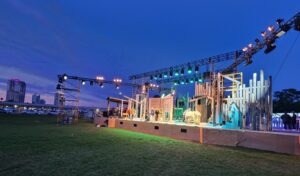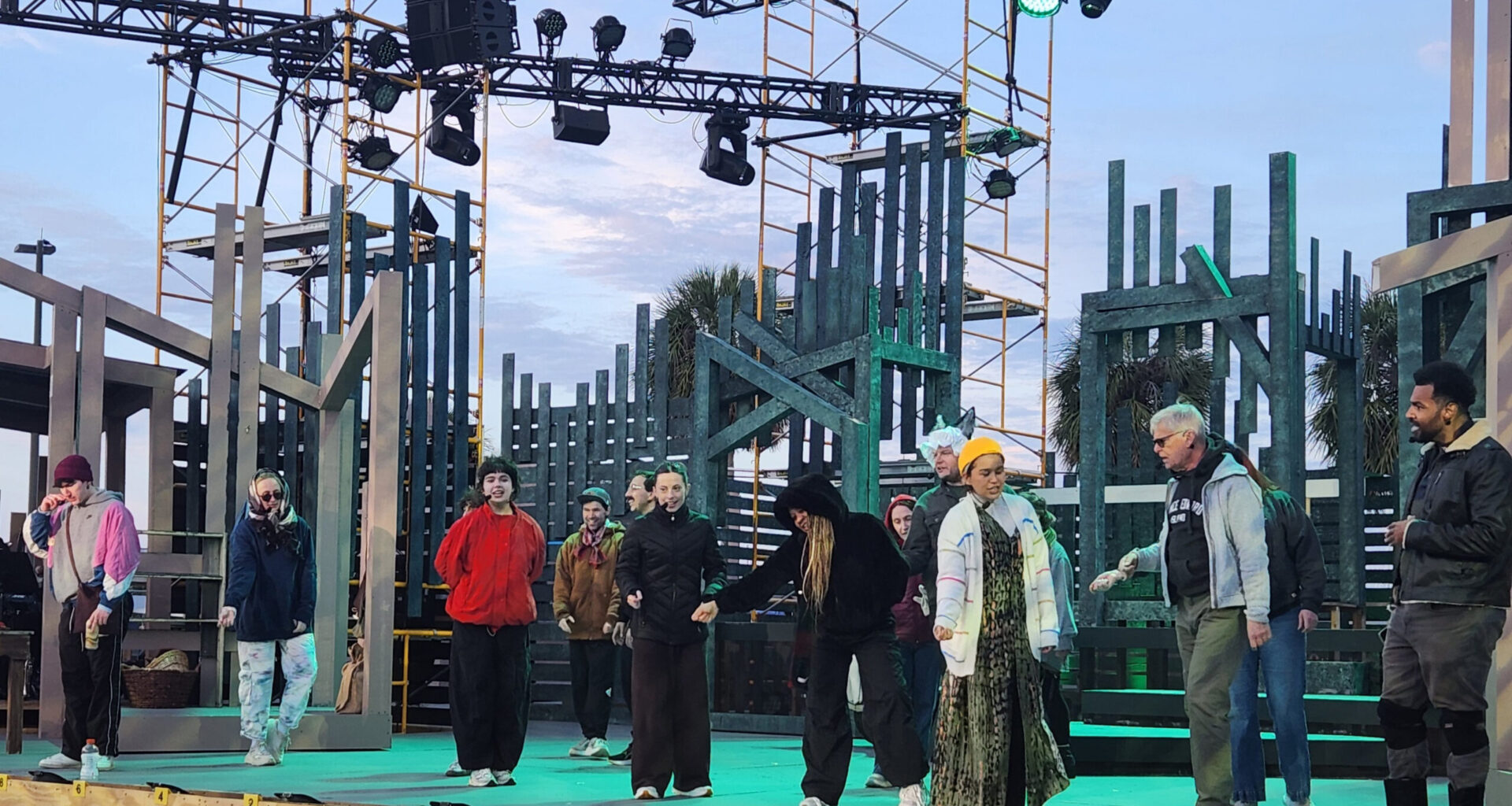
The temperature dipped into the low 50s as the company of American Stage’s Into the Woods gathered Tuesday afternoon at Demens Landing Park. It was the first day for the cast, and the band, at the outdoor site on the St. Petersburg bayfront.
Dressed for maximum warmth, the actors spent just under nine hours on the enormous not-yet-dressed wooden stage, as sound, lights and spatial relationships were adjusted. Day One always begins with a “getting to know the stage” exercise.
They had already worked on the classic Stephen Sondheim/James Lapine musical, for weeks, in American Stage’s spacious (and warm) rehearsal room.
The move to the park is a “massive” shift, said director Helen R. Murray. She had the cast “walk the set” on first arrival. In the rehearsal room, they’d hit their marks via duct tape on the floor.
“As we’re putting the show together,” she explained, “we’re saying ‘This cross is going to take a few moments longer, so please anticipate it,’ and ‘This is going to be a change in level, so you have to be ready for the fact that you’re walking up four steps here.’ There’s a lot of that.”
They’re tasked with learning exactly where the edge of the stage is, and spots where there might be possible costume snags on the moving set pieces (costumes, however, won’t be in play until the end of the week). “It’s very important for them to walk the entire set in full broad daylight,” Murray said.
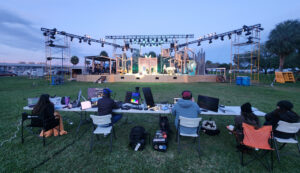
Into the Woods is the fifth spring-tradition “Park” show supervised by Murray since she was named Producing Artistic Director in 2022, although it’s the first time the veteran theater-maker has directed at Demens Landing herself.
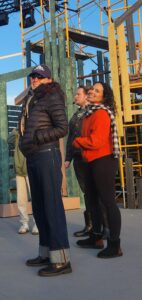
Director Helen R. Murray, left, and choreographer Jennifer Kerner Scruggs.
“Because logistically it’s such a massive piece of theater, it’s been much easier for me to just produce when we’re doing it,” she said. “Because my workload is already really, really heavy as the producer. I’m already out there a ton of the time, solving problems and taking care of things.”
Late in the afternoon, the actors were fitted with head microphones, and harmonized on several of Sondheim’s show tunes with the musicians as sound levels were tested and adjusted.
After a dinner break, the company re-assembled for scene tweaks, and a full run-through of the show. The lighting designer and operators arrived just before the sun went down, and worked on the stop-and-start lighting maneuver theater people know as cue-to-cue.
The intricate lighting rig is all that’s between the actors and the Florida sky. Because there’s no proscenium arch overhead, there’s no rigging or fly system to drop in backgrounds or set pieces. There’s also no wing space to hide set changes, so everything in the fairy-tale world of Into the Woods (Little Red Riding Hood, Cinderella, Jack & the Beanstalk et al) has to fit snugly out of sight until it can be rolled on when needed.
Murray and her team move with military precision. “The backstage,” she said, “is as much of a dance as the front, as what’s onstage. There’s a constant movement backstage to make sure everything is rolling on at the right time, things are where they need to be so that when the actor walks on it’s put in their hand, all that kind of stuff is happening.”
Into the Woods will open March 27 (with previews on the 25th and 26th) and run through April 26.
Until then, the company will be working at the park nearly every day. “Into the Woods, for as much as it’s got in it, is not the hardest thing we’ve done,” Murray explained. “And it’s Sondheim – there’s more movement than there is heavy dance work.
“Even so, it’s a show where everybody’s wearing kneepads under their costumes. And everybody’s shoe tread is doubled because they need traction.”
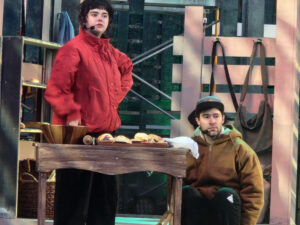
The Baker’s Wife (Morgan Tapp, left) and The Baker (Edward L. Simon).
“Park” was in danger of getting cut as American Stage began to feel the post-Covid financial pinch, followed by the twin head-butt of the 2024 hurricanes. The annual spring show’s high overhead was eating into the organization’s already dwindling reserves.
On her arrival, Murray remembers, she wondered aloud why Park was allowed to continue. What was the big deal?
She looked at the bottom line: Park was steadily losing money. But, she recalled, everybody wanted to keep it, so Park became a big factor in budget balancing. “And I adjusted the ticket prices, which hadn’t been done in over 15 years. That closed the gap a lot.”
The first Park show Murray herself programmed was Beauty and the Beast in 2024 (she inherited its predecessors, Ragtime and Footloose, because they’d already been scheduled).
“I did Beauty and the Beast, and it showed how successful Park could be. We closed the gap so much. People were so excited about it.
“Then I did the most requested musical we’ve had in years, Hair. And it showed a massive drop-off in attendance. And I said ‘I think that Park is a family-friendly event.’”
She hadn’t originally factored in Park’s importance to the community. Launched in 2023, the “Save Park” campaign raised over $400,000 in its first weeks. “And it wasn’t all huge givers,” Murray said. A lot of smaller donations were received from members of the community.
“The other thing about park is that it’s an event. It’s not just a piece of theater. It is the entry point for our community, in to the theater. And we need to lean into that heavily.’”
She’s doing that by working corporate nights, community nights, special events and other group-specific programming into the show’s monthlong run.
Each Park show costs approximately $600,000 to produce.
Money, or the lack of it, is always a major concern for nonprofits like American Stage. Today, Murray reported, “We’re stable, but we’re not back to our pre-Covid numbers in either attendance or income. And quite frankly, and not to be dark about it, we’ve lost people. People have passed on, and some of our larger donors moved away after the hurricanes.
“But we are seeing an uptick. While we’re seeing growth, it’s not at the speed we would like it to be. So we have to be very careful and mindful.”
There have also been personnel changes at American Stage. “When I came in, the cash burn at American Stage was higher than their annual income was. And what was creating a false sense of security was, we had some really large one-off gifts. And we had all the Covid funding as well.
“But those were one-offs. I realized that’s not repeatable every year. So I cut the budget, a lot, once I got here. And it’s because our operational costs should not be where they were having that kind of cash burn. They’d been extremely fortunate in those one-off gifts.
“It’s not that we’re financially in a horrific place, it’s that if we don’t do these really smart, looking at the budget, and reducing to the point where our expenses and our income are balanced, then we will be in that place.
“The board and I all look at it and go ‘We’re not going to be able to sustain if we keep this up. So let’s be smart.’”
Showtimes and tickets for Into the Woods are available at this link.