
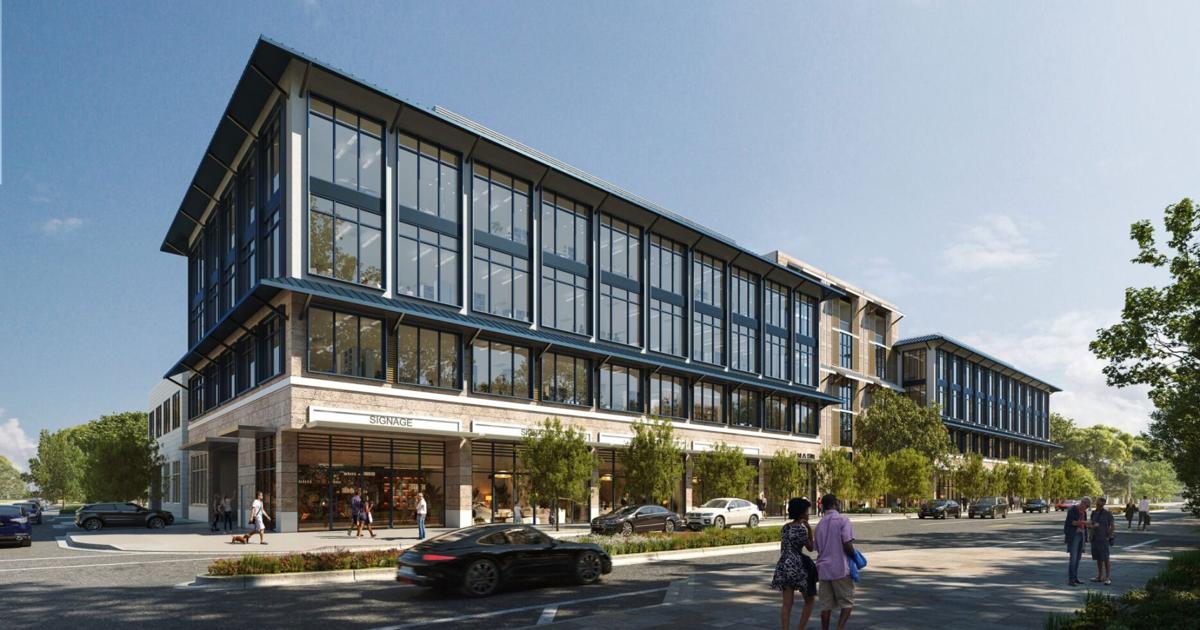
Construction noise rang out this month along both sides of Grand Avenue in the West Grove as a new five-story apartment building climbed higher in the sky while a smaller, dilapidated building across the street with 14 post-war apartments came tumbling down.
After years of desolation, there’s a surge of development activity along a three-block stretch of Grand Avenue at the center of a neighborhood battle over affordable housing and the displacement of Black families in the West Grove.
Three community organizations are fighting to preserve a neighborhood that many long-term residents can no longer afford. As part of that effort, the organizations filed a Fair Housing Act complaint against the City of Miami in 2023.


A shuttered apartment building at 3395 Grand Ave. was torn down this month, refreshing concerns about gentrification in the West Grove.
(Don Finefrock for the Spotlight)
The complaint contends that hundreds of Black residents living on or near Grand Avenue were pushed out of the neighborhood because of unfair and discriminatory land-use and zoning policies put in place by the city.
Those policies incentivized developers to acquire, then demolish or shutter 18 multi-family residential buildings, displacing at least 162 people and hollowing out the neighborhood, in violation of the Fair Housing Act of 1968, the complaint contends.
Earlier this month, a demolition crew tore down a two-story apartment building at 3395 Grand Ave. – one of 18 residential properties that formed the basis of the complaint.
The 18 properties are scattered over the six blocks that front on Grand Avenue between Plaza and Margaret streets.
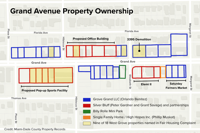
Two major property owners control the majority of land along a three-block stretch of Grand Avenue in the West Grove.
(Jenny Jacoby for the Spotlight)
The City of Miami approved a Major Use Special Permit (MUSP) in 2011 for a mixed-use project spanning those six blocks on Grand Avenue.
That project, known as Grove Village, was never built, but the legacy of that zoning action continues to shape the neighborhood today.
Community leaders and long-time residents in the West Grove say the demolition of the shuttered apartment building at 3395 Grand Ave. is emblematic of the development pressures that are changing the face of the historically Black neighborhood.
“It kind of makes you shed a tear. Those things represent lives,” said Reynold Martin, chairman of GRACE (Grove Rights and Community Equity), one of the organizations that brought the Fair Housing complaint.
“The neighborhood I grew up in is slowly disappearing,” added Kimberly Davis, the president of the Coconut Grove Optimists Club and a leader of youth sports in the neighborhood. “My children will never know the Grove I grew up in.”
Davis lived with her family on the block behind the 1954 apartment building that was torn down.
The property is owned today by Grove Grand LLC, one of the neighborhood’s largest property owners. Plans for the property are unknown. Orlando Benitez, a company director, declined to speak with a Spotlight reporter last week when reached by phone.
Grove Grand owns 23 properties that face Grand Avenue between Plaza and Margaret Streets, including the entire block between Hibiscus and Elizabeth Streets except for Billy Rolle Mini Park, which is owned by the City of Miami.
Grove Grand also owns four vacant properties where the farmer’s market is held on Saturdays. Across the street, where a demolition crew was at work this month, the company owns three other post-war apartment buildings.
At Grand Avenue and Elizabeth Street, Silver Bluff developers Grant Savage and Peter Gardner are building Elemi Phase 2, a five-story apartment building with 27 units on property that includes the former site of the Bain Range Funeral Home. The Black funeral home was demolished in 2024.
Silver Bluff and its partners are the other major property owner on Grand Avenue.
Together, they control 15 individual properties, including the entire block between Plaza and Hibiscus, where they plan to build a pop-up sports facility with pickleball and padel courts as a placeholder for a future five-story apartment building with 175 living units.
None of the apartment projects planned or under construction by Silver Bluff include affordable housing. All of the units will be rented at market rates, Savage has said.
Silver Bluff is also planning to build a commercial building with 80,000 square feet of Class A office space and ground-floor retail on six Grand Avenue properties between Hibiscus and Elizabeth. Construction crews recently cleared those lots in preparation for construction, which could begin later this year.
As development activity increases along Grand Avenue, West Grove community leaders and their allies say they will continue to press the grievances outlined in the Fair Housing Act complaint. That complaint was rejected last year by the U.S. Department of Housing and Urban Development (HUD), but the battle may not be over.
One of those community allies – Anthony Alfieri, the director of the University of Miami School of Law’s Center for Ethics and Public Service – told residents this month that HUD’s rejection of the West Grove complaint fits a national pattern of decisions made in Washington under the Trump Administration.
In rejecting the complaint, HUD officials said the community groups that brought the action – including the Coconut Grove Ministerial Alliance, which represents neighborhood churches – did not have “standing.”
“This is an issue across the country” Alfieri said. “Many churches and nonprofits and low-income alliances have filed these civil rights complaints and they have been rejected across the country on the grounds of standing.”
That is tantamount to saying the neighborhood suffered no injury because of the city’s zoning decisions, Alfieri said. That’s not the case, he added.
“There are many churches that are gone, so that feels like an injury to us. There are many churches that suffered massive declines in their congregations. That feels like an injury,” Alfieri said.
In addition to HUD’s decision, Alfieri also questioned the development decisions made closer to home that are reshaping Grand Avenue, saying those decisions are out of line with the city’s decision to approve the Major Use Special Permit (MUSP) on Grand Avenue.
“If we take the MUSP on its terms, and the representations that were made, and the commitments that were made by the developers and the city in 2011, how does that square with what is going on and what is not going on?” Alfieri asked.
“How is it that we are getting pickleball courts and paddle courts in our community when there is so much need for low-income and affordable housing?” he added.
Alfieri also questioned what he described as “land-banking” along Grand Avenue, where developers buy and hold property without delivering needed housing.
“Land-banking, without any commitment to low-income and affordable housing given the magnitude of the housing crisis in Miami-Dade County and South Florida, is unacceptable,” Alfieri said.
This story was produced by the Coconut Grove Spotlight, a nonprofit newsroom covering Coconut Grove and Miami City Hall, as part of a content sharing partnership with The Miami Times. Read more at coconutgrovespotlight.com.