
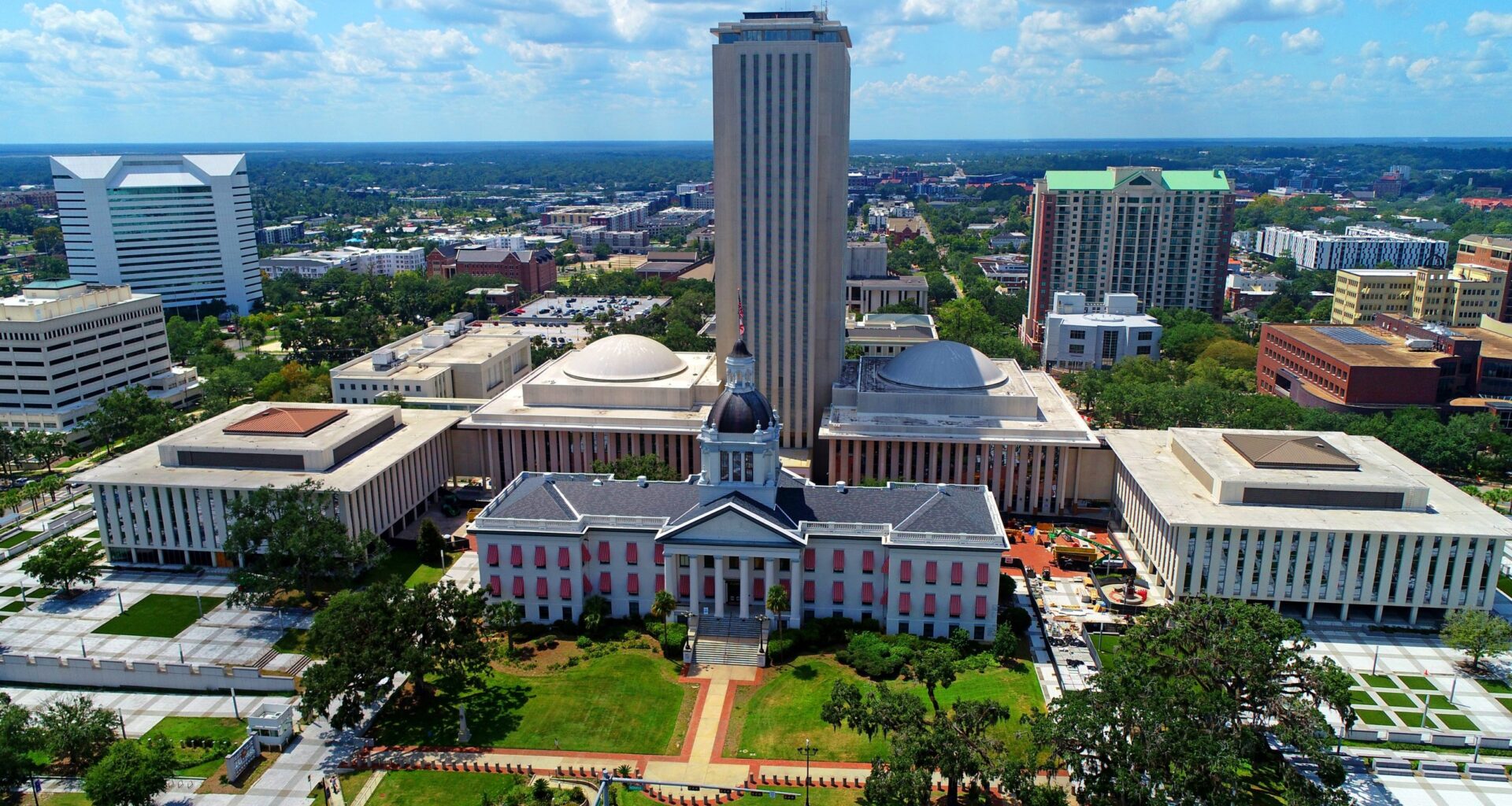
 The Florida State Capitol in Tallahassee, Florida on Sept. 15, 2025. Credit: Dennis MacDonald / Shutterstock
Herbert Block, The Washington Post’s legendary political cartoonist, advocated tirelessly for government in the sunshine. The first page of his 1957 anthology, HERBLOCK’s Special for Today, depicted two bureaucrats discussing a stack of documents in a government office. One is reaching for a set of rubber stamps on his desk.
“Well,” he says to the other, “We certainly botched this job. What’ll we stamp it – ‘Secret’ or ‘Top Secret?’”
Florida has – or used to have – the nation’s strongest government-in-the-sunshine laws. The Legislature has riddled them with more than a thousand exemptions. And now, officials don’t even need that form of rubber stamp to conceal whatever they choose to keep secret.
More and more, they’re simply ignoring the law. Requests for public documents can go unanswered for weeks, months, even years. When they do bother to reply, they may pose prohibitive charges for copying the material.
An ABC News inquiry into the Florida prison system is still waiting three years later for the desk calendar of the secretary of corrections.
The Lee County Port Authority told a private citizen there would be a $391,000 charge for a set of documents.
“The default position is now ignore, delay, deny,” says Bobby Block, director of the Florida First Amendment Foundation.
Block says secretive officials are exploiting the weakened finances of the news media, their advertising revenues having been hollowed out by the internet. It can be costly to sue for public records so litigation is less likely. Reimbursement isn’t guaranteed.
Darkness is descending in other states also, Block said, and it’s spreading in the federal government where delay has become a default too.
The Federal Freedom of Information Act was modelled on Florida’s, but FOIA requests to U.S. agencies are going unmet due to President Trump’s vast layoffs and firings. A Washington Post op-ed Saturday took note of 26 lawsuits, involving 13 agencies, in which government attorneys have replied that there were too few remaining FOI officers to provide timely disclosure.
Florida’s regular legislative session concluded last week without enacting a potent public records reform bill (CS/HB 437) that the House had approved 111-0. It contained enforceable deadlines, limits on costs and meaningful financial penalties for scofflaws. It died on adjournment in the Senate, where the leadership had put it in three committees that were not meant to take it up.
It’s not clear whether that owed more to the mutual dislike between the two chambers, to the institutional opposition of the Florida Sheriffs Association and other public officials, or to the influence of Gov. Ron DeSantis, the most secretive chief executive in Florida’s modern history.
The bill’s sponsor, Rep. Alex Andrade, R-Pensacola, had exposed how DeSantis’ chief of staff – who’s now Florida’s attorney general – laundered $10 million in Medicaid money into DeSantis’ political advertising campaign against a 2024 recreational marijuana initiative. There appears to be a grand jury report on that which has yet to be released. One of Florida’s “shade” laws allows someone who’s not indicted to contest a grand jury’s criticism.
The importance of public records to public integrity underlay a key element of Gov. Reubin Askew’s 1976 “Sunshine Amendment” initiative, an ethics code that among other things requires public officials to disclose their personal finances. He saw that reporting as preventing misdeeds more than exposing them.
Government in the Sunshine isn’t just for the media. It’s for everyone. Citizens need it to keep their local governments honest. But they’re even more likely than the media to be met with resistance to public record requests and even less able to afford the fees.
Not many years after that Herblock cartoon, President Lyndon Johnson’s administration had stamped “Top Secret” on what came to be known as the Pentagon Papers, a 7,000-page Defense Department history of one of the all-time botched jobs, the U.S. involvement in Vietnam.
It told, among other things, how Johnson and other officials had persistently misled the nation deeper into an unwinnable war that cost 58,281 American lives.
Daniel Ellsberg, one of the authors, disclosed much of it to the media in 1971 but it took 40 more years for the documents to be completely declassified for the public.
That was one of the great examples, among countless others, why sunshine is indispensable. In 2010, Lucy Morgan of the St. Petersburg Times uncovered gross irregularities in the construction of a $48 million, lavishly furnished new courthouse for the First District Court of Appeal in Tallahassee, on a suburban site conveniently near the home of its chief judge, Paul Hawkes.
“How did it get funded?” Morgan wrote. “Like many things that gain life in Tallahassee, the courthouse grew out of a last-minute amendment on the last day of a legislative session. The funding for the courthouse was buried in the middle of a 142-page transportation bill, approved the last day of the 2007 session.”
Her exposé led to a Judicial Qualifications Commission investigation of Hawkes and to his resignation from the bench. Ironically, he had been the good-guy plaintiff in a landmark lawsuit that led to a 1992 constitutional amendment guaranteeing access to government records and meetings.
The South Florida Sun Sentinel won a Pulitzer Prize for its 2012 investigation of habitual high speeding by some 800 scofflaw police officers, most of whom were off duty. Reporter Sally Kestin and Database Editor John Maines used 1.1 million toll records from Florida’s SunPass system to compute the travel times of 3,900 police transponders.
They revealed not only a small army of lawbreaking cops but also 320 crashes that had killed or maimed at least 21 people. Only one officer had been jailed. Cops routinely “badged their way” out of tickets.
But today, reporters curious about where a city’s cops live would be stymied by a law that conceals anything that might tell where they or their families reside. The law has been expanded to exempt home addresses of thousands of public officials and employees, many of whom have no plausible need for such security.
In 2025, legislative investigators found the $10 million that had been diverted from a Medicaid overbilling settlement into DeSantis’ campaign against the recreational marijuana initiative. Digging deeper, the Tampa Bay Times plumbed the state’s accounting system and found that a total of $36.2 million in public funds had been laundered into those ads. Nearly half of the spending had not been posted, as required, to the state’s contracting data base.
Reporters tracked the money “by tracing 29-digit account codes and 6-digit object codes across three state databases,” the newspaper said reported. The precise amounts were unavailable because the administration has not turned over such documents as invoices and work products.
Documents have also gone missing from the database pertaining to the $608 million DeSantis spent just to open Alligator Alcatraz, his immigrant prison in the Everglades, that is costing $1.2 million a day just to run.
A lawsuit filed by Friends of the Everglades disgorged the state’s request for a $1.49 billion grant from the federal government, which may or may not be forthcoming. The First Amendment Foundation was told the Department of Emergency Management was allowing contractors – most of them were chosen without bidding competition – to redact their documents to protect “propriety information.”
In 2023, while he was seeking the Republican presidential nomination, DeSantis had the Legislature make his travel records secret, purportedly for security.
It left Florida in the dark about how public funds might be subsidizing his political ambitions. The governor’s visitor log, a public record for decades, has vanished as well, the better to conceal who’s lobbying him.
Florida law and the Constitution provide for virtually all records and meetings to be public but allow for exemptions enacted by a specific law limited to one subject and passed by a two-thirds majority in each house. Such laws must “sunset” after five years, meaning they must be renewed or allowed to die. The Constitution also requires the Legislature to state a “sufficiently compelling” reason to override the public’s right of access.
Trouble is, the Legislature has had no trouble finding excuses to enact and renew an ever-lengthening list of exemptions. There are now more than a thousand major ones. This year’s session carved out two new enormous exemptions.
One seals records identifying crime victims. There is an implied exemption for court records, given that the U.S. Constitution guarantees the right of defendants to confront their accusers. The other loophole provides up to 63 days of darkness for the identities of police officers who claim to be crime victims themselves. That’s what police customarily allege after they have killed or beaten someone.
That bill, CS/HB 1113, overturned a state Supreme Court opinion that had sensibly interpreted the 2018 victims’ rights constitutional amendment known as “Marsy’s Law.” Despite the severe damage to the public records law, there were no votes against the bill in the House and only three in the Senate. DeSantis is not likely to veto it.
The session’s data center bill also granted shade to applicants, allowing them to request up to a year’s confidentiality – time enough to steal a march on citizens’ objections. The Senate wanted prompt disclosure but the House got its way by waiting until the next-to-last day to send the bill back with a harmful amendment.
A Legislature that believed as much in open government as Florida lawmakers once did would have done none of that. And it would have enacted Andrade’s bill.
There has never been a statewide audit of public records compliance. A responsible legislature should want that too.
Disclosure: The author of this article is a current member of the Sun Sentinel’s editorial board and a retired editorial writer for the Tampa Bay (formerly St. Petersburg) Times.
This article first appeared on Florida Trident and is republished here under a Creative Commons Attribution-NoDerivatives 4.0 International License.
Pitch in to help make the Tampa Bay Journalism Project a success.
Subscribe to Creative Loafing newsletters.
Follow us: Google News | NewsBreak | Reddit | Instagram | Facebook | BlueSky
This article appears in Mar. 12 – 18, 2026.
Related