
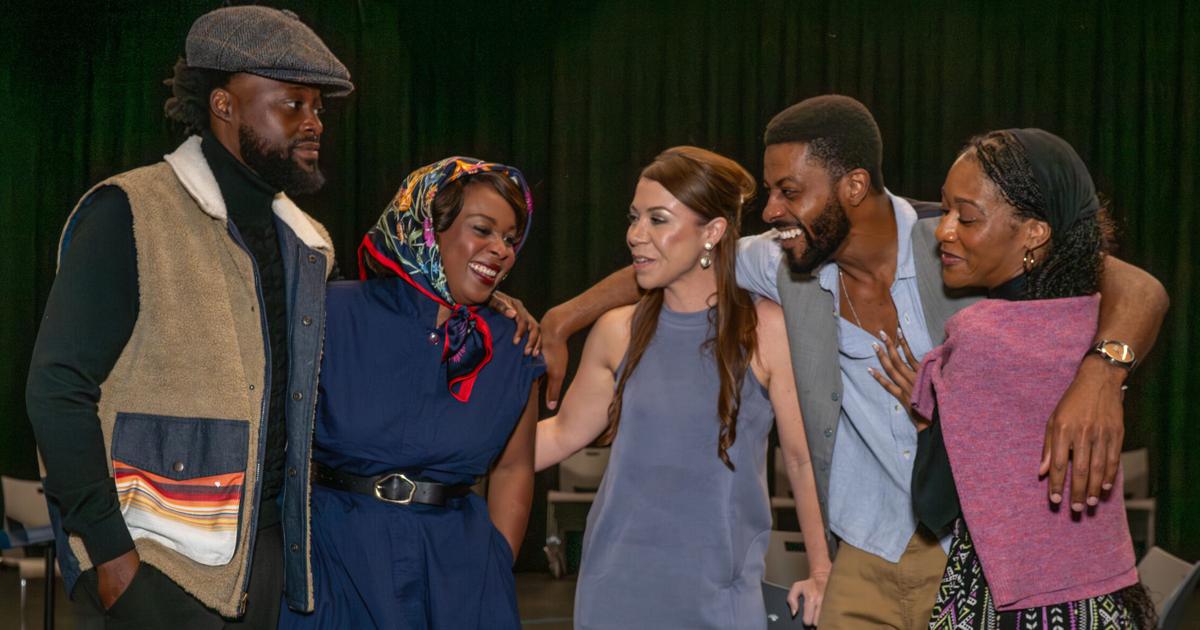
“Detroit ’67” at the Marshall L. Davis Sr. African Heritage Cultural Arts Center is bold, ambitious, and epic — American storytelling at its best. This simmering production delivers depth, honesty and nostalgia, exploring themes as relevant today as they were 50 years ago.
Set in Detroit in 1967, the play unfolds just before riots that shook the city and the nation. Motown music fills the air as the story introduces siblings Chelle (Sheena O. Murray) and Lank (Milton E. Lyles II) who run an unlicensed underground after-hours joint in their basement that they inherited from their father. Chelle’s friend Bunny (Tyquisha A. Braynen) and Lank’s partner Sly (Jean Hyppolite) round out the party. It’s a vibe: music, dancing, drinks, escapism mixed with dreams of what America could be, social mobility, stability and respectability.
Trouble arrives in the second scene when Lank and Sly carry a beaten and battered white woman Caroline (Melissa A. Hubicsak) off of the streets and into their basement. They reluctantly agree to tend to her, to let her stay and help around the house and business.
The play is a slow burn. It runs two-and-a-half-hours, but it cooks as the dialogue is fast, juicy and authentic. The basement setting becomes immersive, in the streets above there is racial tension brewing and in the basement below the temperature is also on the rise.
Written by Dominique Morisseau, “Detroit ’67” first premiered at The Public Theater in New York in 2014. It is part of a three-play cycle known as “The Detroit Projects” inspired by August Wilson’s “The Pittsburgh Cycle” both capturing the black experience in the respective cities.
In this Miami production, the ensemble has remarkable chemistry, creating a family that feels authentic. Standout performances include Braynen, who plays Bunny with a dynamic range that goes from sexy to sullen and Lyles as Lank who successfully triangulates his relationships with the other four. Hyppolite played Sly, or Sylvester as Chelle called him, with a warm charm, and Murray’s portrayal of Chelle as the emotional and moral anchor is endearing.
At the end of Act One the play takes off when rioting breaks out in the streets above the basement and it is revealed that Lank took the family’s savings and bought a bar with Sly.
Here is where the themes of the play collide. Chelle wants to buy a house with that money. She desires stability and accumulating generational wealth slowly. Lank is a dreamer who wants fast money and bigger hustles. The dichotomy is a very relevant look at pursuing the American dream. Add in racial tension, police brutality and income inequality, particularly for the Black community, it’s hard to hold onto a dream when reality looks more like a nightmare.
Andre L. Gainey’s direction is confident and focused, guiding the story with clarity and purpose. The scenes transition well, led by stage manager Carey B. Hart. The set design by Michael Miles is intimate, detailed, and first class, from the ’60s era couches, tables, eight-track player, the bar and pantry. The walls are covered in pictures of Black icons from the era and artwork by the siblings.
Every element of the production works together to create a vivid sense of time and place.
The result is a powerful theatrical experience that feels personal and historical, genuine and rooted in the community. “Detroit ’67” is a reminder that the pursuit of stability, opportunity and dignity has never been simple, and not just in Detroit, but anywhere in America.
IF YOU GO
WHAT: “Detroit ’67” by Dominique Morisseau
WHERE: Marshall L. Davis Sr. African Heritage Cultural Arts Center, 6161 NW 22nd Ave., Miami.
WHEN: March 20-22. 7:30 p.m. Friday and Saturday; 3:30 p.m. Sunday.
COST: $29, general admission
INFO: (305) 638-6771 or ahcacmiami.org
ArtburstMiami.com is a nonprofit media source for the arts featuring fresh and original stories by writers dedicated to theater, dance, visual arts, film, music and more. Don’t miss a story at www.artburstmiami.com.