
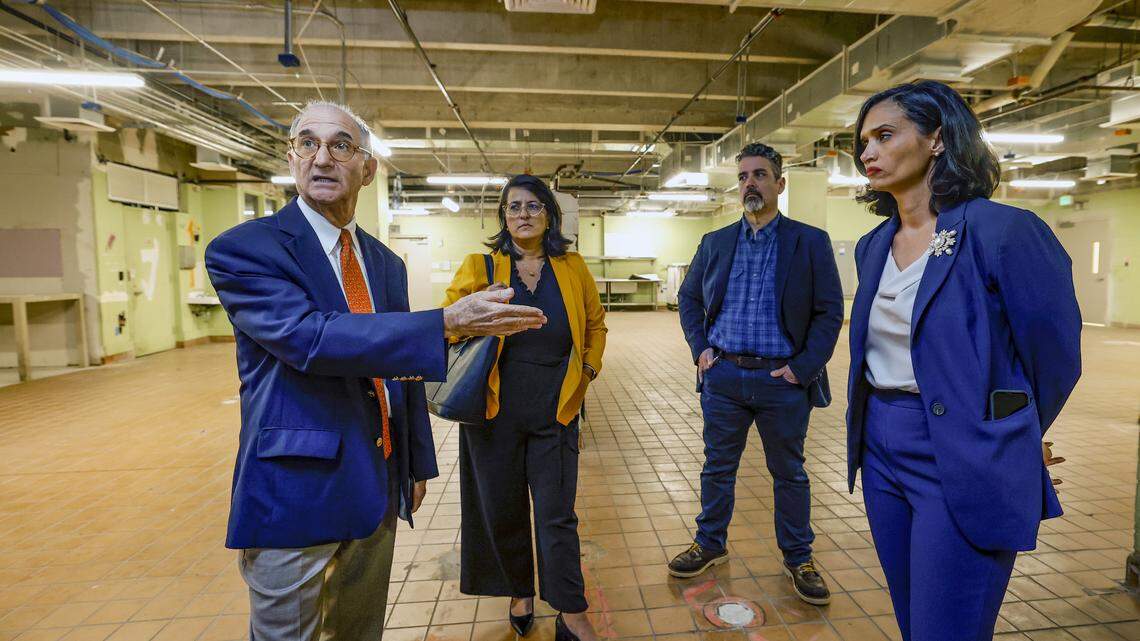

Retired Miami-Dade Judge Steve Leifman, left, gives a tour in January 2025 of a mid-rise building that has been renovated in order to serve people with mental illness at Miami Center for Mental Health and Recovery. To his left are: Natalia Jaramillo, then communications director for Mayor Daniella Levine Cava; Anthony Escarra, chief of staff for Miami-Dade County Commissioner Raquel Regalado; and Cathy Burgos, the county’s Community Services director.
AL DIAZ
adiaz@miamiherald.com
As a retired judge struggles to win final county support for a nonprofit psychiatric center that’s been over two decades in the making, a national treatment provider hopes to step in and open the facility itself.
Retired Judge Steven Leifman has failed twice in winning the votes needed from Miami-Dade County commissioners to advance a funding and management plan for the seven-story facility designed to shrink Miami-Dade’s jail population. The property at 2200 NW Seventh Ave., between Wynwood and Allapattah, has already gone through a $51 million county-funded renovation but remains empty.
Commissioners have balked at giving final approval for the two nonprofits Leifman wants to open and run the Miami Center for Mental Health and Recovery, citing budget strains for Miami-Dade once short-term funding is exhausted in three years.
“We’re at the one-inch yardline,” said Leifman, who helped secure the renovation dollars for the facility in a countywide bond referendum 22 years ago. “All we need is their approval.”
In 2024, commissioners instructed Mayor Daniella Levine Cava to negotiate operating agreements with the nonprofit Advocate Program and WestCare Foundation. Leifman wants commissioners to approve those contracts and let the facility open. But months ago, the administration received a competing proposal from Recovery Solutions, a Tennessee-based for-profit psychiatric treatment provider with facilities in South Florida.
While Recovery Solutions hasn’t gone public with its interest in running the treatment center for Miami-Dade, it has hired one of County Hall’s top lobbyists, former state Sen. Oscar Braynon.
Braynon, who works for the Southern Group, signed on with a Recovery Solutions subsidiary in late September, according to a publicly available database that lists Braynon as lobbying on behalf of the company for the mental-health center issue.
Recovery Solutions issued a statement this week saying it decided to submit the proposal after following the commission’s deliberations on what to do about the county’s planned treatment center.
“Throughout our history, we have worked with public partners to develop novel solutions to address gaps in treatment for those facing mental illness,” read the statement. “We look forward to an opportunity to discuss our capabilities with Miami-Dade County.”
A challenge to Miami-Dade’s longstanding plan for a mental-health center
Last week, the Miami Herald obtained the proposal through a records request to the Levine Cava administration, which said it received the document late last year but had not shared it publicly. Leifman said it had not been shared with him, either.
“The first I heard about it was this morning,” the retired judge said Tuesday, a few hours after the Herald sent him a copy of the 43-page document.
 By DOUGLAS HANKS
The proposal offers Miami-Dade an alternative to Leifman’s plan, though it’s not clear how the offering would fix commissioners’ stated cost concerns.
Recovery Solutions said it can provide a 58-bed facility that would cost the county about $14 million in its first year, with Miami-Dade covering the additional $7 million the Levine Cava administration says it would cost to operate the county building.
That’s roughly the same service cost as what the Advocate and WestCare team is pitching, but those nonprofits would operate 75 beds, according to an administration forecast released earlier this month. Leifman also said the Recovery Solutions proposal lacks some of the short-term treatment beds that cost more but are part of the Advocate and WestCare plan. “They are trying to match the existing proposal, and they can’t,” he said of Recovery Solutions.
Cathy Burgos, the county’s Community Services director under Levine Cava, released a statement Wednesday saying that Recovery Solutions had submitted the proposal late last year.
The statement does not say what the administration thinks of the proposal but notes the commission’s prior direction to negotiate deals with the nonprofits backed by Leifman.
“We remain ready to respond to the will of the Board as it deliberates on how to best provide these critical services to our most vulnerable residents,” Burgos said.
Based in Nashville, Recovery Solutions runs mental-health facilities in South Florida, including those that treat people who are facing criminal charges but deemed mentally unfit for trial. Its website says the company operates across 11 states.
WestCare, meanwhile, is a nonprofit network of mental-health facilities and providers across the country, including the Village South family centers across South Florida. The Advocate Program is a Miami-based charity that works with people facing criminal charges while dealing with mental-health issues.
Competition from Recovery Solutions is the latest hurdle for Leifman, who retired from the county bench in 2024 and has been pushing to open the Miami treatment center under four Miami-Dade mayors. Voters in 2004 authorized Miami-Dade commissioners to borrow $22 million for renovation costs as part of a $2.9 billion bond program passed in the final days of then-Mayor Alex Penelas’ administration.
The Leifman plan: treat mentally ill offenders instead of jailing them
The idea behind the plan is to provide a residential treatment center and other services for people with mental illnesses who frequently land in jail for brief periods of time only to be released back onto the streets. They haven’t committed crimes serious enough to get them lengthy prison sentences, aren’t competent enough to stick with medication and counseling offered by a patchwork of existing local and state treatment options across Miami, and frequently are living on the streets and addicted to drugs.
“There are some people that are just too sick. They need a more structured environment,” Leifman said. “That’s what the building would provide, with all of the services available right there.”
But can Miami-Dade afford it? The recent forecast from Levine Cava’s staff predicted the center would cost about $24 million a year to run and that a mix of local, state and federal treatment dollars would cover roughly half of that. Miami-Dade would then need to cover the shortfall of roughly $12 million a year.
With $10 million a year already earmarked for the center, the forecast lists a shortfall of about $2.5 million annually once the county exhausts the basket of one-time funding sources secured by Leifman to get the facility running for its first three years.
Leifman insists Miami-Dade will see jail bookings drop enough from the new treatment option to allow the county to cut the Corrections Department’s current $561 million budget and redirect those funds to the center.
So far, that argument hasn’t been enough to advance the legislation needed to open the facility.
“Judge, I do understand where your heart is,” Commissioner Roberto Gonzalez said at a March 11 meeting of the board’s Intergovernmental and Economic Impact Committee, where the funding request legislation stalled on a deferral vote. “What we’re trying to figure out is: Is there a proper revenue stream that does not stop … so that this project can continue on for years?”
That was the second time Leifman appeared before a commission committee only to see members defer making a decision on the funding and operating-agreements legislation. A different commission committee opted not to vote on the proposal in February, too. A small number of county commissioners sits on each committee, and legislation typically needs to progress through one of those committees before it can be voted on by the full 13-member County Commission and then implemented.
Leifman and his allies say they have enough votes on the full County Commission to pass the legislation if they can get the greenlight from a committee and then be placed on the board’s agenda by Commission Chair Anthony Rodriguez.
With the county already backing his nonprofit plan for the facility through various votes in prior years, Leifman said it makes no sense for Miami-Dade to start fresh by considering a new proposal.
“Other providers want to come in and make money off of this project — there is a lot of money at stake,” he said. “Nobody realized that until we were getting ready to open.”
This story was originally published March 18, 2026 at 4:43 PM.