
Charlotte County officials are warning of significant budget shortfalls if proposed state legislation aimed at reducing property taxes becomes law.
During a March 17 budget workshop, Commission Chair Joe Tiseo said the potential impact of House Bill 203 could be severe. “We’re basically insolvent at that point,” Tiseo said.
Assistant Budget Director Francine Lisby presented data showing how several proposed property tax relief measures could affect county finances. Of eight bills introduced in the Florida House, three advanced through committee, with HB 203 passing a full House vote.
If enacted, HB 203 would reduce Charlotte County’s ad valorem tax revenue by an estimated $160 million, according to county staff.
Under the bill, property taxes would continue to fund public schools, law enforcement, firefighters and other first responders. However, counties would lose a substantial portion of revenue used to support general government operations, including services, employee salaries and infrastructure.
Homesteaded property owners would still receive tax bills, but those payments would be limited to funding core public safety and education services.

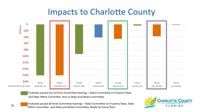
A county presentation chart outlines the potential financial impacts of several proposed Florida property tax reform bills on Charlotte County’s budget.
Charlotte County government
Commissioners expressed concern about how the county would maintain operations with significantly reduced revenue.
“Talk about taking meat off the bone, there’s no bone left,” Tiseo said, calling the projected impact astonishing.
Commissioner Ken Doherty criticized the proposals, describing them as a “complete disconnect from fiscal reality.”
Two other bills, HB 209 and HB 213, would have less severe but still notable impacts, reducing county revenue by about $45 million and $37 million, respectively. Tiseo said those proposals are more manageable but would still require adjustments to services.
Assistant County Administrator Emily Lewis said the Legislature has not finalized a plan, and Gov. Ron DeSantis could call a special session after the House and Senate failed to reach agreement. She said the governor could select one of the existing proposals or introduce a new plan.
State leaders have framed property tax reductions to address affordability challenges, as rising costs for housing, insurance, utilities and other essentials continue to strain homeowners.
County staff have already analyzed the potential impacts of the legislation and are preparing to educate residents about what officials described as expectation gaps between tax relief and service levels.
Commissioners said that outreach should emphasize the potential effects of HB 203, given its projected impact on the county’s budget.
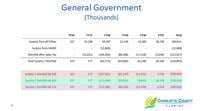
A Charlotte County presentation shows projected budget surpluses and shortfalls under several proposed property tax bills, including HB 203, which officials say could significantly reduce county revenue.
Charlotte County government
Regardless of which proposal ultimately appears on the Nov. 3 ballot, Lisby said any approved tax cuts would affect the level of services the county can provide.
Departments supported by the General Fund — including community development, community services, economic development, emergency management, facilities and public works — could face reductions. Officials said cuts would be targeted rather than applied uniformly across all departments.
To prepare, the county is evaluating options, such as using reserves, prior surpluses and other financial strategies, to offset potential revenue losses.
Lisby noted that any changes would not take effect until the fiscal year 2028 budget cycle, giving the county time to plan.
However, she warned that failing to prepare for a measure like HB 203 could lead to financial instability as early as 2029.
County leaders have already begun outreach efforts. Lewis and County Administrator Hector Flores recently met with the Realtors of Punta Gorda-Port Charlotte-North Port-DeSoto Inc. to discuss how potential tax changes could affect the local economy.