
Welcome to the Catalyst’s Community Voices platform. We’ve curated community leaders and thinkers from all parts of our great city to speak on issues that affect us all. Visit our Community Voices page for more details.
Babe Ruth is rightly credited with putting St. Pete on the national map, beginning with the New York Yankees’ arrival here for spring training in 1925. As early St. Pete Mayor and baseball booster Al Lang reflected, “The Yankees with Babe Ruth and their stars meant millions to this town.” While St. Petersburg is greatly indebted to Babe Ruth for floods of tourists, there was another tourist promoter diligently working to do the same. His name was John Lodwick.
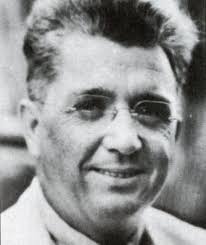
John Lodwick
“Lodwick,” wrote Ray Arsenault in St. Petersburg and the Florida Dream, “emerged as the master of masters when it came to public relations. In an age addicted to ballyhoo and buffoonery, the press welcomed these stunts and begged for more.”
Lodwick was born in Ohio in 1890. He began his career as a messenger boy at age 13 for the Associated Press in Cleveland. Later he became a member of the Cleveland Press and then went on to become sports director for the City of Cleveland, after which he relocated to Akron where he became sports editor for the Akron Press.
In December, 1918, Lodwick relocated to St. Petersburg, like so many of our early city leaders for reasons of health. He began by volunteering his time to the St. Petersburg Times writing local stories for which he was unpaid. It was through Walter Fuller, a staff writer for the newspaper at the time, that Lodwick connected with L.A. Whitney, secretary of the Chamber of Commerce.
The three had lunch together at which time Lodwick proposed that a good way to market St. Pete to tourists was to turn St. Pete into a “sporting capital,” hosting a multitude of “world championships” throughout the year. The publicity, he insisted, would reach national audiences free of charge to the city. He proposed to create headlines and datelines displaying St. Petersburg, Florida in publications across the nation, featuring Tampa Bay’s natural beauty and ideal climate as a backdrop.
As Fuller later recalled, Whitney was intrigued with Lodwick’s ideas and asked him what pay he required to direct such a project. Lodwick then astounded Whitney by offering to work for the Chamber without pay, leaving it up to Whitney to pay him what Whitney thought his services were worth at the end of the tourist season (ultimately Lodwick was paid $500, about $10,000 calculated for inflation). Thus, Lodwick became the first city publicity director, not only in St. Pete, but in Florida.
And so, all sorts of “World Championship” events (“World Champion Horseshoe Contest,” “World Champion Shuffleboard Contest,” “World Champion Geriatric Boxing Match” and many more) were born. So well-known was Lodwick’s influence as “the man who organized National Horseshoe Championships,” that his rules and regulations of the “game every boy in America can get into” appeared in publications nationally. In 1923 Lodwick reported that he was in correspondence with over 300 newspapers during the horseshoe tournament. These world champion events provided alternatives for tourists to spending the day at the beach, fishing and golfing, but more importantly captured the imagination of the nation’s press and received invaluable media coverage.
Lodwick had a real flare for public relations stunts designed to bring the national limelight to St. Pete at very little cost. Another of his earliest ideas was the simple but brilliant one of just taking photos of tourists, often with a mock catch of large fish, and sending the photos and a brief article to the tourists’ hometown newspapers for publication. The idea was another huge success, giving the city lots of free publicity and significantly increasing the stream of tourists coming to St. Pete.
Lodwick subscribed to a newspaper clipping service so that he could measure the impact of his work. Based on the clippings received he calculated that during the 1924 winter season St. Pete received $241,784.10 in free advertising. He further noted that typically the clippings accounted for only about 12% of the total publicity received. The clippings came from every state in the nation. On one occasion St. Petersburg Mayor Pulver tongue-in- cheek charged Lodwick with grand larceny, for stealing newspaper space.
Mayor Frank Fortune Pulver was Lodwick’s kindred spirit, promoted by Lodwick as “The Millionaire Bachelor Mayor.” Pulver was elected mayor in 1921. The two worked together hand in glove to promote St. Petersburg as a major tourist destination.
Pulver moved to St. Pete in 1917, the year before Lodwick, and soon became a successful businessman. He bought and operated the Detroit Hotel, at the time the city’s foremost. Pulver favored white suits and straw hats and together with Lodwick created “White Suit Day,” to celebrate the arrival of spring. White suits were symbolic of St. Pete’s sun-drenched climate. One of their stunts was for Mayor Pulver to go to New York City and march down Broadway with a group of Florida bathing beauties, creating a major traffic jam.
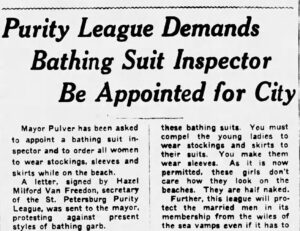
St. Petersburg Times, 1922
Another was the creation of the mythical “Purity League.” With the support of the Purity League and a supposed city ordinance prohibiting women’s bathing suits from covering less than half their bodies, he went about town with a tape measure and photographer measuring revealing swimsuits. Police escorted the guilty “Sea Vamps” away.
All of this was photographed and sent off to the nation’s press. Pulver himself paid for full-page ads in northern papers to advertise St. Pete and its many attractions.
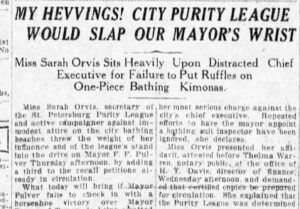
St. Petersburg Times, 1923
The bedrock of marketing in that era was print media. While Lodwick cleverly obtained hundreds of thousands in advertising free through his tourist photo program, he also redirected the popular practice of sending penny postcards. In 1924 he noted that the penny postcard in many ways “thoroughly outweighs any other variety of publicity” in attracting tourists. Lodwick kept a collection of scenic city photos, and sent the best ones to postcard publishers. In one case a publisher printed 300,0o0 color copies of the cityscape taken from the bay featuring the Soreno Hotel (now the site of the Florencia Condominiums).
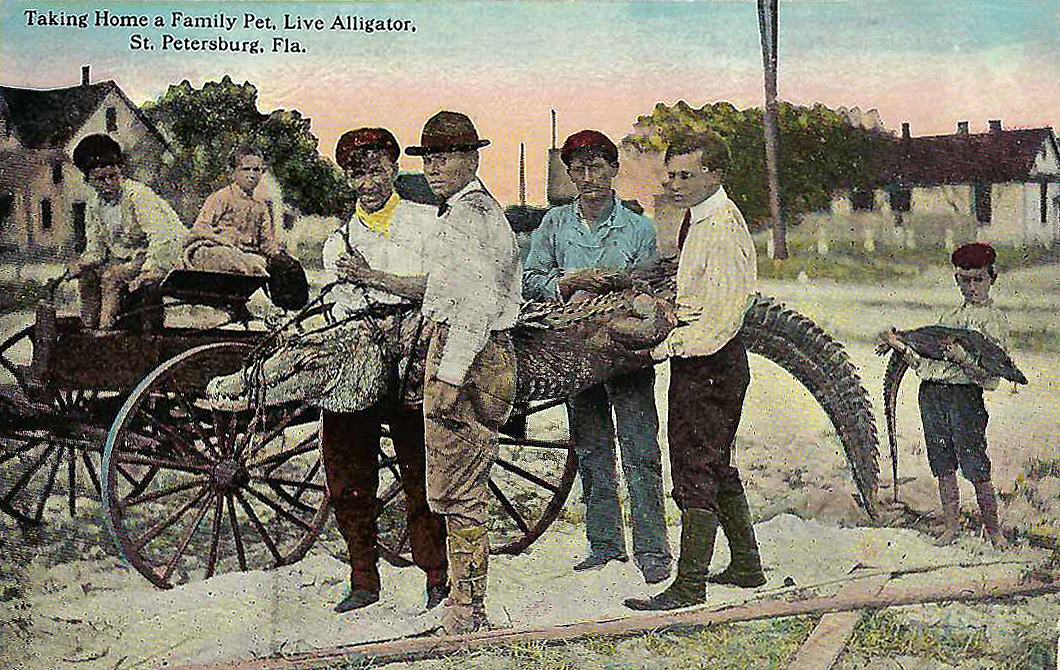
This was soon followed by another half million cards, and then another three publishers each produced an additional half million. Lodwick opined, “the day of one-color pictures as well as the old type bathing beauty, alligator, and comic pictures of Florida are a thing of the past … the alligator postcard has done much to prejudice the minds of tourists against this state … these have been instrumental in broadcasting the idea that Florida is the habitat of the world’s fiercest alligators and snakes. They should be absolutely banished from every postcard stand in the state.” The Chamber provided tourists postcards with scenic city views for free, to send to the folks back home.
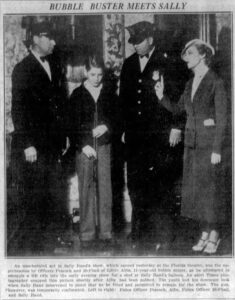
On another occasion Lodwick arranged for erotic fan dancer Sally Rand to pose half nude on Spa Beach near the Downtown Pier. In league with Nicholas Dennis, owner of the Dennis Hotel on Williams Park (now the Williams Park Hotel), he created “Room 310.” The room was filled with all kinds of gimmicks from whoopee cushions and electric shock devices to a skeleton in the bathtub. Babe Ruth was one of the many tourists visiting the attraction.
Later, in the 1930s, Lodwick came up with the idea of the “Sunshine Babies” to celebrate 18 months of continuous days of sunshine in St. Pete. Photos of the babies, all born within the eighteen-month period, boasted they “never have known a cloudy day.” “All Sunshine, No Clouds in their Young Lives,” reported national newspapers.
Cooing and smiling, one set of twin girls and six other tots’ photos radiated above captions claiming, “Happy and Healthy, These Babies Haven’t Seen a Sunless Day,” and “All eight of them have been taught to walk and talk without a sunless day.” For months, publications reprinted the articles gaining the Sunshine City, as St. Petersburg was called, endless free publicity.
One of Lodwick’s less successful projects was bringing the Goodyear Blimp to St. Petersburg in 1929 as yet another attraction. The Goodyear Tire and Rubber Company was located in Akron, known as the “Rubber City,” where Lodwick previously worked. Likely using his Akron connections, Lodwick arranged for the company to locate a blimp at the new Albert Whitted Airport and got the city to pay for construction of a necessarily large hangar. On December 11, 1929, the blimp Vigilant of St. Petersburg was christened and gave rides to VIPs over the city.
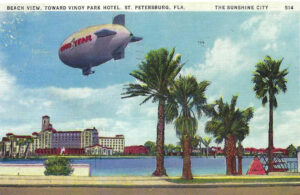
Unfortunately, his timing for this was off as the nation soon plunged into the Great Depression, and tourism sharply declined. But the blimps remained a part of the downtown cityscape for 10 years. They provided tourists with magnificent aerial views of St. Petersburg and Tampa Bay. The blimp Reliance paid a visit in 1932, and in 1933 the dirigible Akron paid a visit. There was also a fourth blimp, the Mayflower, which made a brief appearance in 1935. However, after receiving rife shots while in the vicinity of Plant City, the deflated blimp was shipped back to Akron by rail.
Mayor Al Lang brought Major League spring training to our city beginning with the then-St. Louis Browns in 1914, later followed by other teams including the New York Yankees and Babe Ruth in 1925. Particularly the Yankees and Ruth had a huge impact on attracting tourists and the economic benefit they brought to the city. Lang was mayor at the time Lodwick arrived in the city. Likely in addition to his many zany marketing ideas, another reason for Lodwick’s hiring was his background as a sports journalist in Ohio. While the particulars of Lang’s association with Ruth are unknown, no doubt they were well acquainted with one another, and Lang was well acquainted with Lodwick by 1925.
It was through Lang that John Lodwick befriended Babe Ruth. St. Petersburg loved the “Sultan of Swat.” Stories abound of the Babe’s kindness towards children, and his love for all things excessive. Boosters like Lang and Lodwick even encouraged owners and players to sign Major League contracts during spring training, making St. Petersburg the dateline for countless sports pages. Lodwick also staged a surprise birthday bash for Ruth on at least one occasion.
Lodwick’s untimely death was reported by the Times on October 17, 1942. “Slumping over in the seat of a Central Avenue street car which was carrying him from his home at … Jungle avenue north to his office at the chamber of commerce, John Harris Lodwick, 52 – director of St. Petersburg’s city publicity since December, 1918 – died suddenly from a heart attack …”
His death at 52 as a shock. By one o’clock that afternoon, mourning the loss of “the pioneer booster,” the Chamber of Commerce closed its doors for the day. Tributes were paid by many.
Immediately following his death, Nelson Poynter, president and editor of the Times, praised Lodwick noting he “contributed greatly to St. Petersburg’s fame as a winter resort, and his vision and creative genius helped to make this the great winter capital of Florida’s west coast.”
He then went on to observe “Henceforth, Florida communities which expect to continue to grow and prosper, hardly will be able — as St. Petersburg has been in the past — to put all their eggs in one basket, in this case, the tourist trade.” Poynter was writing at the beginning of World War II, when the bottom fell out of the city tourist trade.
While St. Petersburg has rightly diversified its economy since the Lodwick era, tourism continues to be significant. Visit St. Pete Clearwater reports that despite two back-to-back hurricanes in 2024, tourism brought an $11.2 billion economic boost to Pinellas County, breaking a new record.
(The writer is especially indebted to Nevin Sitler, Curator and Historian, St. Petersburg Museum of History, and author of Selling St. Petersburg: John Lodwick and the Promotion of a Florida Paradise and Warm Wishes From Florida for contributions to this article.)
Will Michaels is former director and trustee of the St. Petersburg Museum of History, and the author of The Making of St. Petersburg and The Hidden History of St. Petersburg. This article was previously published in the Northeast Journal.