
We are living through a historic technological inflection point. Technology has already transformed how people interact with services, and expectations continue to rise. We now expect every industry to deliver the same convenience we get from Amazon, UberEats or ChatGPT. Artificial intelligence will inevitably reshape local government, likely faster than most cities are prepared for. Right now, cities risk making long-term infrastructure decisions based on outdated assumptions.
Fast forward 10 years and imagine what city government could look like.
 Alison Fournier is vice mayor of Pompano Beach. (courtesy, Alison Fournier)
We will bring services to residents instead of expecting residents to come to us. Rather than concentrating services in one central building, cities will adopt distributed access, reducing in-person visits.
Imagine neighborhood service kiosks handling most city transactions. Need a new garbage can, want to report a pothole, or need to apply for a permit? Requests could be handled instantly through simple digital interfaces.
Government operations will change just as dramatically. At a recent business forum, Amazon founder Jeff Bezos told former Miami Mayor Francis Suarez that a decision on a building application should take 10 seconds. The reaction was shock followed by quiet recognition that AI could make that possible.
For years, many of us have advocated for searchable transcripts of our public meetings. That investment never happened, but today, I can generate them instantly myself. AI is leapfrogging entire generations of government technology.
Procurement is another area ready for transformation. AI can open bids, verify compliance and apply evaluation criteria consistently. Experts will still provide technical judgment, but AI can reduce bias and improve transparency.
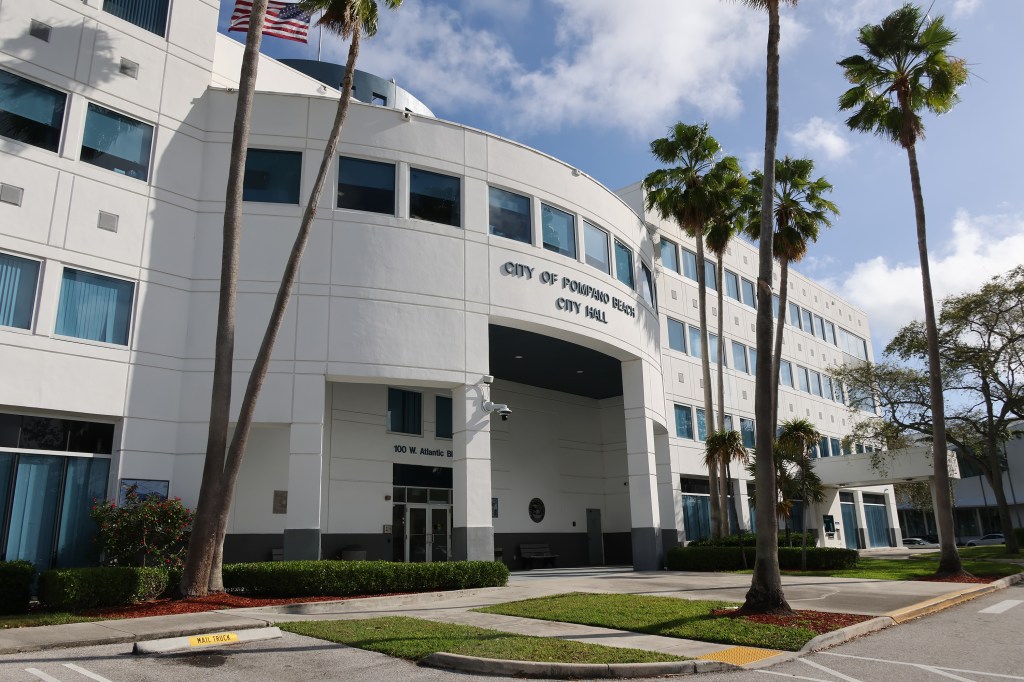
All of this raises an important question for Pompano Beach: What should a modern City Hall actually look like? Are we about to invest $100 million based on assumptions from a past that’s already disappearing?
Instead of rows of offices designed for paper-based processes, a modern civic building might resemble a trading floor, an active operations hub focused on customer service and efficiency. It should include an operations nerve center that monitors city processes, routes service requests, communicates with residents, and provides real-time awareness across departments.
Eventually, departmental boundaries will blur and siloed operations will fade. Many tasks that once required hours of staff time will take seconds, freeing employees to focus on more complex, higher-value work. Implementation will involve costs and cyber risks, so change won’t happen overnight. Cities must balance technological progress with equitable access and public trust. Skills will evolve, and job descriptions will change, but people will remain essential to government.
Technology, AI and the constant threat of reduced municipal funding from Tallahassee make change inevitable. Cities could face major financial pressure if property tax reform passes.
Some believe growth alone can solve these challenges. I do not. History shows that despite steady growth in our tax base, tax bills still rise each year. We cannot simply grow our way out of financial strain; we must rethink how city government operates.
The same mindset that produced planning missteps in Pompano Beach, like the Atlantic/Dixie lane reduction project, belongs in the archives. It’s time to move beyond traditional management and consultant playbooks written for another era. Continuing down the current path risks burdening residents with debt while leaving us behind the curve — a costly combination.
Pompano Beach should proactively launch a Pompano 2036 Plan to examine how each department might evolve over the next decade. Our annual budgeting process should include five- and 10-year projections for a modernized government. This plan would chart a vision for an integrated, technology-enabled, lean government that is more responsive to an uncertain future.
The strategy we choose today will shape the years ahead. Now is the time to get it right.
Alison Fournier is vice mayor of Pompano Beach.