
Generations of Floridians have chosen to live, work and vacation on Longboat Key. With its white sand, gentle Gulf waters and quiet neighborhoods sandwiched between the ocean and Sarasota Bay, the area resembles a perfect postcard. But despite the normalcy of it all, things are changing in the area.
Twice a month, high tides flood the streets, and stormwater cannot drain as it once did due to heavy rains. Hurricanes, even those far offshore, still punish the land with damaging storm surge. For the people who call Longboat Key home, these issues are not vague projects but daily realities.
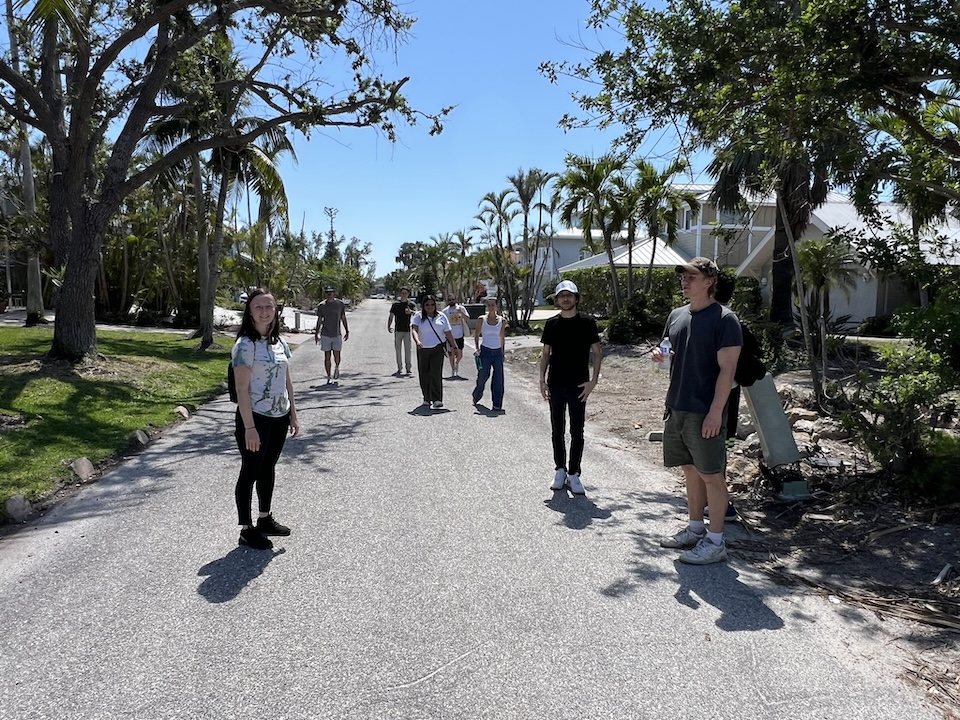
That is why graduate students from the University of Florida’s College of Design, Construction and Planning — in the Architecture, Energy and Ecology class led by School of Architecture professor Martin Gold — stepped directly into that reality to make a change.
The students traveled to Longboat Key to study how design can help safeguard one of Florida’s most vulnerable and valuable landscapes. Supported by the National Academies’ Gulf Research Program and UF’s Florida Institute for Built Environment Resilience, their work is more than an academic pilgrimage. It is a blueprint for how UF is helping Florida responsibly and proactively adapt to environmental challenges.
“Longboat Key is one of many Florida barrier island typologies and offers an opportunity for students to understand the importance of these islands in terms of the natural ecology, built environment, tourism and investment value,” Gold said. “These real-world challenges offer students an opportunity to study potential responses that might lead to innovation in urban organization and architecture.”
For residents of the Sarasota-Manatee area, Longboat Key represents the first line of defense from storm surge and wave energy. Bay water in the region has risen by 6 inches over the past 20 years — a rate three times faster than in previous decades prior to 2000, Gold said. If the islands erode or fail, the consequences could ripple far beyond their shorelines.
“My favorite part of working on Longboat Key was that it was a real place with real environmental challenges,” UF graduate student Zahra Zare said. “Learning about the island’s history, its barrier island ecology and how development has shaped it over time made the design process much more meaningful. It was also inspiring to see how each student interpreted the same context differently and proposed unique ideas for resilient coastal living.”
The ecology of Sarasota Bay and the estuary system as a natural habitat is rich in diversity. Should Longboat Key erode, it would expose the mainland to another level of storm intensity without the island buffers. But Longboat Key is already acting, with the town planning to elevate streets in phases over the next 10 to 20 years.
All new residential construction is now required to be built at least 11 feet above mean sea level. Seawalls have been allowed to increase in height. Stormwater systems are being redesigned so that water is directed to bays and estuaries without flooding neighboring properties. For residents and business owners on Longboat Key, policies like these shape daily life; they also reshape what architecture must become.
Gold challenged his students to see architecture not as a fixed object, but as part of a living system that connects to rising waters, shifts ground elevations and forces the evolution of municipal infrastructure. Each student selected a real site on the island and developed a three-bedroom housing prototype that would respond to actual climate data, prevailing winds, solar patterns and stormwater conditions.
“One of the biggest takeaways for me was realizing how deeply architecture is tied to environmental systems,” Zare said. “Studying Longboat Key made the challenges of climate change and sea level rise feel very real. As we analyzed the island’s hydrology, infrastructure and development patterns, I began to see architecture less as isolated buildings and more as part of a larger ecological system.”
Gold’s crew explored ground planes that rise with future street levels. They designed homes that captured breezes through careful section planning and shading strategies, reducing reliance on mechanical cooling in Florida’s humid climate. Cisterns and stormwater gardens were integrated to slow runoff during intense rain events. For the neighborhoods, proposals included district cooling systems that used bay water as a thermal sink, shared green infrastructure and compacted development patterns that allowed more diverse housing options.
“The students took the work very seriously and, as a group, tested different scenarios based on their perspective on which issues were of highest priority,” Gold said. “It was rewarding to see the students commit themselves to understanding and responding to these issues.”
The connection between research and reality is where UF’s impact becomes most tangible. This group of students will carry this knowledge with them as they enter practice across Florida. They will understand that raising a house is not just a code requirement but a safety measure. They will remember that shade can reduce temperatures by 10 to 20 degrees and lower energy demand.
“Professor Gold challenged us to think critically about both the environmental and historical context of the site,” Zare said. “He encouraged us to understand how the island has changed over time before proposing new designs. His approach pushed us to connect architecture with climate, water systems and long-term coastal resilience, which made the design process much deeper and more thoughtful.”
Longboat Key may be about 10 miles long and 1 mile wide at its widest point, but the lessons unfolding there are much bigger. Florida’s future will be shaped by water, heat and growth. The question is whether it will also be shaped by foresight. At the University of Florida, the answer is yes.