
We are officially more than 10% (11.8%, to be precise) through the 2026 season, which both sounds like a lot and also like not that much. With only one win and three losses, Orlando City surely feels more so on the “not that much” side, and would point to the fact that on points alone the Lions are in a five-way tie for ninth place in the Eastern Conference standings and only one point out of a tie for seventh.
In reality though, the Lions are in 13th place, because when multiple teams have earned the same number of points, they are separated by goal difference. At -7, Orlando City has the worst differential in Major League Soccer. There are still 30 games left in the season though, which is plenty of time for the team to get hot and turn that goal differential around.
The way to improve a goal differential is to score goals while also preventing the opponents from doing so, and while Orlando City is doing neither very well at the moment, the club is struggling considerably more to prevent goals than to score them. And when I say struggling, I mean struggling. Take a look at the table below, using the Opta tracking data that is still available on fbref.com and fotmob.com, and remember that there are only 30 teams in MLS.
Metric2026 PerformanceMLS Rank (of 30)Goals Allowed per Game3.030Shots Allowed per Game17.029Shots on Target Allowed per Game7.830Goal Conversion Allowed16%23Expected Goals Allowed per Game (xGA)2.6030Expected Goals Allowed per Shot15%27xGA per Game – Actual Goals Allowed per Game-0.422
These are terrible stats, and we will look at just how terrible shortly, but we have to note that four games is a small sample size. We also have to note that in one of those four games the team played down a man for 72 minutes, which means that the Lions have played down a man for 20% of their season. Small sample sizes can provide noisy data, but in this case we are looking at the whole league on either a per-game basis or a conversion-percentage basis, and since 28 of the 30 teams have also played the same number of games, nearly every team is being evaluated on the same four-game sample.
The Lions’ defense is comfortably near the bottom of the league in every significant metric around team defense and ranks dead last in shots on target allowed, expected goals allowed, and the one that matters most — goals allowed.
It has not really mattered who was playing on the back line. Every combination that has played double-digit minutes together has been…shall we say, less than stingy.
Back LineMins. PlayedGoals AllowedGoals Allowed per 90Marín – Iago – Brekalo – Dorsey12932.1TRB* – Miller – Brekalo – Dorsey10454.3Marín – Miller – Brekalo – Dorsey8622.1TRB – Iago – Brekalo – Dorsey3125.8TRB – Marín – Iago – Brekalo – Taifi600.0Marín – Miller – Brekalo – Taifi400.0
*TRB = Tahir Reir-Brown
If you listen to The Mane Land PawedCast (and if you are not, then you should be), our hosts Michael Citro and Dave Rohe have extensively covered some of the reasons for why the defense has yet to gel. Injuries, late arrivals for new acquisitions, a goalkeeper who broke his commitment to sign with the club, and a coaching change all have made the circumstances difficult for the back line. Other teams have had issues as well, yet it is Orlando City that sports what is statistically the worst defense in the league through four games.
I will reiterate that there is plenty of season left, and these numbers will surely regress some towards the mean, but we are where we are after four games, and Orlando City’s defense is not just the worst in the league in 2026, but it is at the bottom when we look at every defense since the club joined the league in 2015. Including 2026, there have been 308 team defenses since that 2015 season, and in the four metrics that have consistent tracking back to 2015…well, you can see below. Bad.
Metric2026 PerformanceMLS Rank (since 2015)Goals Allowed per Game3.0308Shots Allowed per Game17.0306Shots on Target Allowed per Game7.8308Goal Conversion Allowed16%299
Now, the giant caveat is that aside from the other 29 teams in 2026, all of the other 278 defensive seasons are full length seasons, and over a full season, most teams tend to end up right around the same averages: allowing approximately 1.4 goals and 12.7 shots per 90 minutes. The chart below is every defense since 2018, due to Microsoft Excel’s limitation on the number of items that can be shown in one scatterplot. The defenses from 2017, 2016, and 2015 averaged allowing, wait for it…1.4 goals and 12.7 shots per 90 minutes…so you can safely assume that the chart would not change dramatically if they were included.
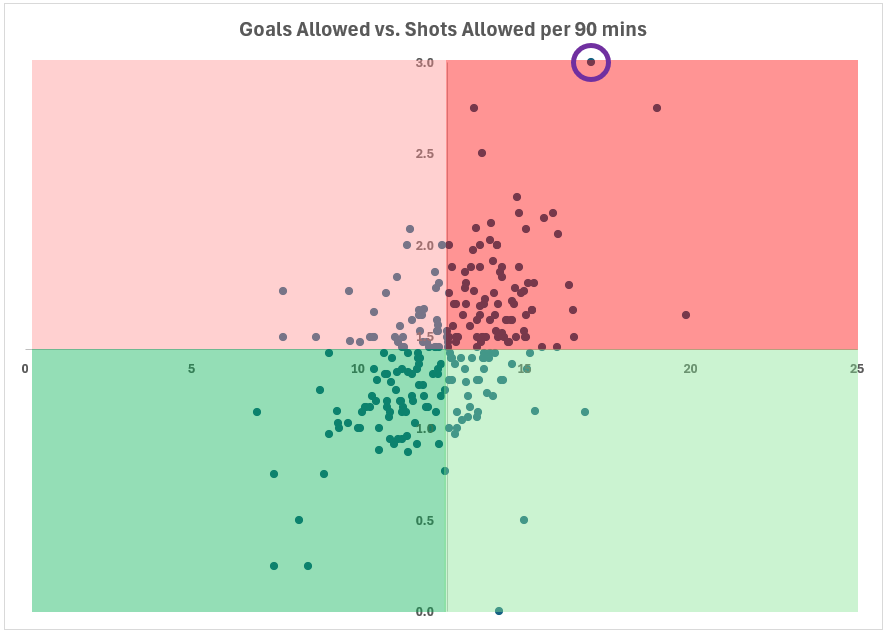
Goals allowed is on the y-axis (vertical) and shots allowed is on the x-axis (horizontal), so teams in the upper right, like Orlando City’s 2026 defense (circled in purple) are allowing an above average number of goals and shots each game. It should be noted that most of the extreme outliers for goals allowed on this chart are from 2026, which is not surprising because it is still so early in the season. LAFC, for example, is the first team in league history to open a season with four consecutive shutouts, but nobody expects the team to go the whole season without giving up a goal, just like nobody expects Orlando City to ship three goals per game for the rest of the season either.
The upshot of all of this is that while it is true that the Orlando City defense has been on the struggle bus through four games, we will need a lot more data before we start to really worry about this defense being the worst since 2015. This is where the Lions are, though. They also opened the season by playing three of those four games against the teams that are currently ranked first, third, and fourth in the Eastern Conference, which means that according to playoffstatus.com, the Lions have played the toughest schedule in the conference thus far.
You’ll notice that Orlando City has not played against the team ranked second in the conference, but do not fret because the Lions will go ahead and check that box Saturday night when they play at Nashville. We will see if Martín Perelman can lead the team to a second straight result, and while he is a coach who is more known for his offensive style of play, the fence, sorry, fense that needs the most mending in training this week is the one that starts with a ‘d.’
Vamos Orlando!